
Introduction
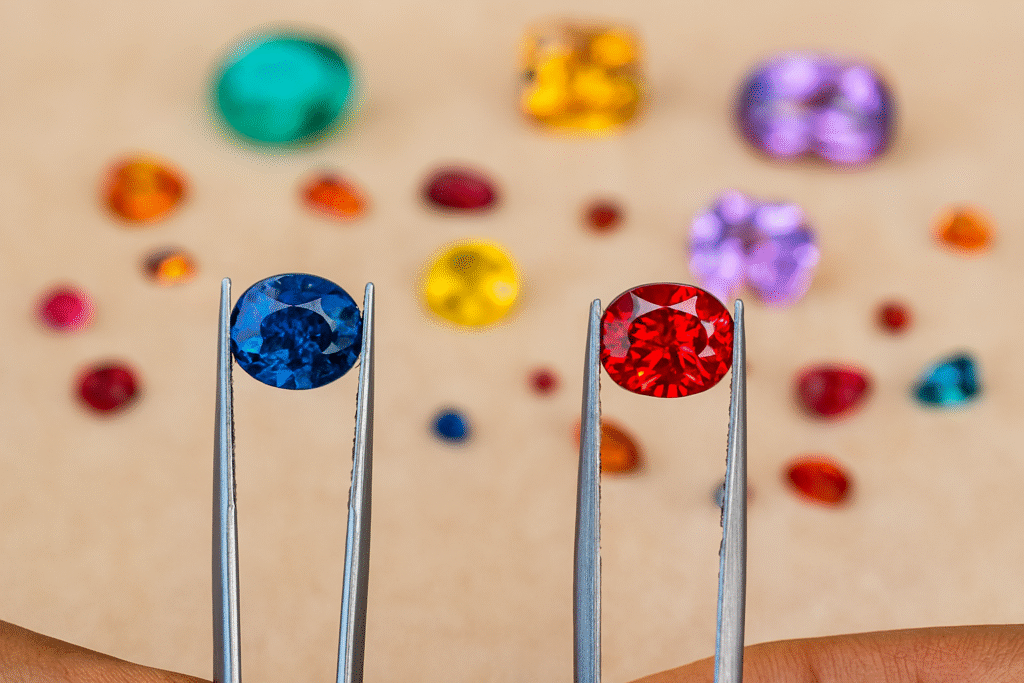
Imagine a spice rack bursting with the warm glow of a Kerala kitchen—vibrant chili reds, earthy turmeric yellows, deep cumin browns, and fresh green cardamom. Now, picture these hues captured in shimmering crystals. The Tourmaline Color Palette, known in gemology as the ‘stone of many colors,’ mirrors this masala magic perfectly.
To begin with, this gemstone is chemically complex. It is often called a “garbage can mineral” by geologists because it accepts so many different elements (Iron, Manganese, Copper) into its structure. As a result, the range of Tourmaline Colors is infinite. In this article, we will explore how these hues evoke the spices of South India, making it a gem for collectors and food lovers alike.
Red and Pink Tourmaline Color Palette: The Chili Heat
First, let us look at the red and pink varieties, technically known as Rubellite. These ignite the eye like Kashmiri chili powder scattered across a sizzling curry.
According to the GIA, these stones flaunt intense, translucent crimson hues that deepen with manganese content.
For instance, a faceted Rubellite might pulse with paprika-like warmth under candlelight. Additionally, a phenomenon called Pleochroism enhances this effect. If you tilt the gem, it shifts from ruby red to subtle pink, much like the layered heat of a chili. Therefore, Rubellite suits bold jewelry. It evokes the same passion as the Kempu Ruby used in temple jewelry, but with a more modern, pinkish flare.
Green Tourmaline Color Palette: Cardamom and Curry Leaves
Shifting to the greens, we find Chrome Tourmaline and Verdelite. These capture the minty freshness of Green Cardamom pods or the vibrancy of fresh curry leaves.
- Chrome Tourmaline: Sourced from East Africa, this glows with a deep “Emerald Green” due to chromium traces. It reminds me of the dark curry leaves used in Meen Peera Pattichathu.
- Verdelite: This spans light mint to forest green.
Moreover, these greens often show “Zoning” within the crystal, mimicking the way herbs blend in a masala dabba. Thus, they pair beautifully with silver for nature-inspired pendants, ideal for the monsoon moods of Kochi.
Brown Tourmaline Colors: The Earthy Cumin (Dravite)
Earthy tones shine in Dravite Tourmaline. These resemble the golden glow of Turmeric or the warm brown of roasted Cumin (Jeera). Unlike the flashy reds, Dravite offers honey-yellow to chocolate shades.
In addition, these varieties thrive in metamorphic rocks. Therefore, they are perfect for bohemian rings or men’s jewelry. Compared to the high-maintenance Emerald, the sturdy Dravite (Mohs 7-7.5) appeals to those seeking an everyday stone that grounds them to the earth.
Black Tourmaline Colors: The Kerala “Black Gold”
For depth, we must look at Schorl (Black Tourmaline). For a Malayali, this stone is special. It echoes Black Pepper—the “Black Gold” that brought the Romans and Vasco da Gama to the Malabar Coast. It is opaque, jet-like, and grounding.
Indeed, Schorl’s high iron content creates this inky allure. Furthermore, its vitreous luster shifts subtly under light, adding intrigue. As a result, Black Tourmaline is not just a stone; it is a piece of history. It stars in protective talismans and minimalist necklaces, balancing the bolder multi-colored pieces.
The Multi-Colored Tourmaline Color Palette
The showstoppers of all Tourmaline Color Palettes are the Watermelon varieties. These blend pink cores, green rinds, and white zones—like a perfect masala mix where every flavor is distinct yet united.
Consequently, these “ultimate masalas” are often sliced rather than faceted to preserve the zoning. Ultimately, their complexity mirrors Kerala’s spice heritage. Just as a good curry requires a balance of sweet, sour, and spice, a Watermelon Tourmaline requires a balance of chemicals to achieve its look.
Conclusion
In essence, the Tourmaline Color Palette acts as the spice rack of the gem world. Whether you are drawn to the heat of the Rubellite or the earthiness of the Dravite, there is a flavor for everyone. For buyers, always check certifications. Since Tourmaline Colors are so complex, you want to ensure you aren’t buying glass. You can learn more about verifying stones in my Gemstone Buying Mistakes guide.
FAQ: Understanding the Tourmaline Color Palette
What creates the Tourmaline Color Palette?
Trace elements create the spectrum. Iron creates black/green, Manganese creates red/pink, and Copper creates the rare neon Paraíba blue.
Is Watermelon Tourmaline rare?
Yes, natural zoning with distinct red and green separation is uncommon. Most affordable versions are heavily included or cut to hide flaws.
How does Pleochroism work in Tourmaline?
Tourmaline is “Dichroic.” This means light is absorbed differently depending on the direction. Therefore, the stone looks darker from one angle and lighter from another, shifting colors when rotated.
Can I wear Tourmaline daily?
Absolutely. With a Mohs hardness of 7-7.5, it resists scratches better than Opal or Peridot.
Author Bio
P.J. Joseph, also known as Saju Elizamma, Gemstone & Gold Consultant serving Kerala, Tamil Nadu, and Karnataka.