Introduction to the Seven Crystal Systems in Keralam Foods
Keralam cuisine and crystal geometry seem, at first glance, to belong to entirely different worlds. While one celebrates rich tradition and spicy flavors, the other explores the orderly atomic structures that minerals form deep within the Earth. However, when readers view both through the lens of geometric shape, these worlds come together in a fun and educational way. Specifically, exploring the seven crystal systems in Keralam foods allows us to visualize complex science using everyday items from our kitchens.
Indeed, this comparison does not classify food by its molecular chemistry. Instead, it uses the physical shapes and slicing patterns of iconic Keralam dishes to illustrate the geometric families that gemologists use daily to identify stones. As a result, familiar foods become simple visual models for otherwise abstract geometry. Furthermore, this approach helps students and curious minds remember the differences between mineral structures more easily. Although the comparison stays metaphorical, the underlying science of the shapes remains fully accurate. For further reading, you can explore our guide to understanding crystal systems or visit the official Gemological Institute of America (GIA) for technical data.
Cubic Geometry: Seven Crystal Systems in Keralam Foods
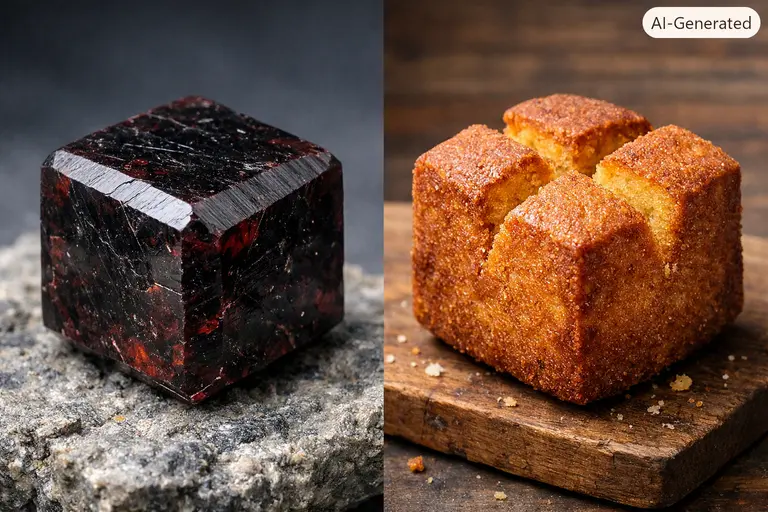
The cubic system, also known as the isometric system, carries the highest symmetry of all crystal families. In this group, three equal axes intersect at perfect right angles. In the world of snacks, the Vettu Cake offers a remarkably clear comparison.
Initially, the cook cuts the dough into even cubes and slices cross-shaped marks on the top surface. During the frying process, these specific cuts open into block-like faces that strongly resemble cubic crystals like garnet or spinel. Consequently, Vettu Cake serves as a delicious model for isometric symmetry. You can learn more about how Indian designers choose raw diamond and Polki jewelry, which often features these natural cubic forms.
Similarly, the tetragonal system relies on three right-angled axes; however, only two axes stay equal while the third differs in length. Kuzhalappam, a popular rice-flour snack from Keralam, illustrates this elongated geometry well. Artisans roll the dough into a long, hollow tube. Its symmetrical circular cross-section and elongated length perfectly echo the proportions of a tetragonal prism, such as zircon. Therefore, the snack makes the concept of unequal axes easy to picture.
Orthorhombic Models: Seven Crystal Systems in Keralam Foods
The orthorhombic system contains three unequal axes that still meet at right angles. This results in crystals that form rectangular prisms with different lengths, widths, and heights. Comparably, the beloved Pazham Pori (banana fritter) mirrors this system.
When a cook slices a ripe plantain before dipping it in batter, the resulting piece has a significant length, a moderate width, and a small thickness. Because these three dimensions all differ while remaining roughly rectangular, the fritter serves as an orthorhombic model. This focus on natural, irregular but structured shapes is a key theme in building India’s global brands through unique design.
Next, the hexagonal system consists of three equal horizontal axes set 120 degrees apart, plus one differing vertical axis. For this reason, Puttu works as a helpful teaching model. Its tall, cylindrical shape provides a clear vertical axis. While a cylinder is rounded, you can easily visualize it being divided into six sectors. Furthermore, Idiyappam’s overlapping rice noodles often resemble the tightly packed hexagonal arrangements found in minerals like emerald or aquamarine.
Slicing Trends: Seven Crystal Systems in Keralam Foods
By comparison, the trigonal crystal system is often described using rhombohedral symmetry. In this system, equal edges meet at equal angles that are not 90 degrees. Specifically, Keralam’s Diamond Cuts snack creates one of the strongest analogies for the seven crystal systems in Keralam foods.
Artisans slice sheets of dough diagonally in two directions. Consequently, each piece becomes a rhombus that resembles the rhombohedral forms seen in calcite or tourmaline. This geometric precision is as vital as the trade skills that stay ahead of AI in India that require a steady human hand.
By contrast, the monoclinic system has three unequal axes where one angle strays from the 90-degree standard. In practice, Kozhikodan Halwa becomes an effective model once a vendor slices it diagonally. The resulting block develops parallel faces with slanted ends, mirroring the skewed appearance of monoclinic crystals, such as kunzite. Although this resemblance comes from the cutting technique rather than the substance itself, it still helps explain a system that many beginners find tricky. For a deeper look at mineralogy, you can consult the International Mineralogical Association (IMA).
Parottas and the Seven Crystal Systems in Keralam Foods
Finally, the triclinic system carries the least symmetry of all seven families. Its three axes stay unequal, and none of them intersect at right angles. Fittingly, the Malabar Parotta captures this complexity well.
As a chef stretches, folds, and coils the dough by hand, they create a layered structure where no two pieces ever look exactly alike. This lack of repetitive symmetry is a defining trait of triclinic minerals like turquoise. Consequently, the Parotta reminds us that nature—and great food—often thrives on beautiful, complex asymmetry. This concept is explored further in our guide to hidden networks in nature and business.
Overall, science becomes much easier to grasp when we connect it to a familiar cultural experience. By linking each crystal system to a well-known Keralam dish, we show that geometry appears not only in rare minerals but also in the everyday objects shaped by human tradition. Therefore, teachers and students alike can use these culinary analogies to master the foundations of gemology.
FAQ About the Seven Crystal Systems in Keralam Foods
Are these foods actually made of crystals?
No, the comparison is purely geometric. We use the external shape and the way these foods are cut to help people visualize the mathematical “boxes” that gemologists use to categorize minerals.
Which crystal system is the most common in gemstones?
The Cubic and Trigonal systems are very common among popular gems. Diamonds belong to the Cubic system, while rubies and sapphires belong to the Trigonal system.
Why is it important to know these systems?
Knowing the crystal system helps gemologists predict how a stone will react to light. For example, it determines if a stone will show “pleochroism” or change color based on the viewing angle.
Can I find hexagonal shapes in other Kerala foods?
Yes, many traditional steamed cakes and certain varieties of Appam can be cut into hexagonal patterns to maximize space in a round steamer, similar to a honeycomb.
Is the Diamond Cuts snack actually shaped like a diamond?
In gemology, a “diamond shape” refers to the octahedron (Cubic system). However, in common language and in this snack, it refers to the rhombus shape, which actually models the Trigonal system.
Disclaimer
This article presents a creative educational interpretation. The comparisons rest solely on external shapes and do not imply that these foods possess actual crystal structures. The author has no financial affiliation with the food brands or scientific organizations mentioned. Always consult with a certified gemologist for official stone identification. Data reflects scientific and culinary standards as of July 2026.