
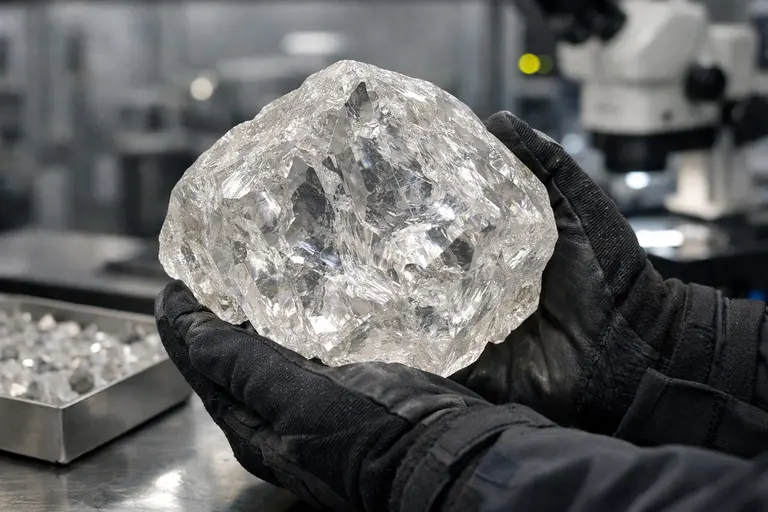
Introduction to the Lucara giant diamond discovery
Every Lucara giant diamond discovery makes global headlines because finding a rough gemstone over 1,000 carats is one of the rarest achievements in modern history. Lucara Diamond Corp, a Canadian firm, continues to achieve this milestone at its Karowe Mine in Botswana. Specifically, the site has produced ten such diamonds, a record no other mine has matched. Naturally, this consistency raises a fundamental question: does pure luck explain these finds, or has technology fundamentally changed the game?
In fact, the answer combines both geological fortune and cutting-edge engineering. While nature built these stones over billions of years, modern engineering now lets Lucara bring them to the surface completely intact. Meanwhile, India, which served as the world’s only diamond source for two millennia, no longer produces stones of this scale. Therefore, this article explains the mechanics of a Lucara giant diamond discovery, why Botswana keeps producing them, and why India eventually took a different path. To understand the wider context of rare mineral finds, you can explore more rare gemstone stories on our site.
The History of the Lucara giant diamond discovery
To begin with, Lucara operates the Karowe Mine, a site famous for producing exceptionally large, high-quality Type IIa diamonds. These stones lack measurable nitrogen impurities, which gives them superior chemical purity. In particular, the 2,492-carat “Motswedi,” recovered in August 2024, stands as the second-largest rough diamond ever found. This massive stone trails only the legendary 3,106-carat Cullinan Diamond discovered in 1905.
Before the Motswedi find, the mine yielded the 1,758-carat Sewelô in 2019 and the 1,109-carat Lesedi La Rona in 2015. Building on that momentum, Karowe delivered its tenth 1,000-carat-plus stone in July 2026, weighing an incredible 1,305.4 carats. Consequently, the company is investing heavily in the Karowe Underground Project. This expansion will extend mining operations beneath the current open pit. With production planned for early 2028, the mine’s life will likely reach 2040. For the latest updates on these recoveries, visit the Lucara Diamond Corp newsroom.
How XRT Technology Saves Massive Gemstones
For many decades, mining companies unknowingly destroyed enormous diamonds. This happened because ore passed straight through heavy primary crushers before the recovery process even began. Today, however, the process works differently because Lucara relies on X-ray Transmission (XRT) technology. This specialized equipment is the primary driver behind every modern Lucara giant diamond discovery.
Because diamonds carry a distinct atomic density compared with the surrounding kimberlite rock, the XRT scanners identify diamond-bearing material with surgical precision. Once the system flags a potential stone, automated air jets instantly remove the material from the conveyor belt. As a result, the large stone bypasses the crusher entirely. Therefore, XRT technology does not technically “find” diamonds in the ground; rather, it simply ensures they survive the extraction process whole. This level of oversight is handled by the same type of industry sheepdogs who maintain quality standards in other high-precision fields.
Why Botswana’s Geology Favors Massive Growth
Technology only tells half of the story, as Botswana also offers favorable geology for preserving giant diamonds. Specifically, scientists believe many of Karowe’s largest stones formed deep within Earth’s mantle, roughly 360 to 750 kilometers below the surface. In these extreme environments, pure carbon crystals grew over vast stretches of time under immense pressure.
From these depths, powerful kimberlite eruptions carried the diamonds upward quickly. These eruptions acted like natural high-speed elevators. A slower ascent could have allowed the extreme heat to turn the diamonds into graphite. Finally, the surrounding geology in Botswana remained stable for hundreds of millions of years. Consequently, the diamonds stayed preserved in their host rock until Lucara’s modern mining operations recovered them. This geological stability is a prerequisite for building global brands in the natural resource sector, as consistency in supply is vital.
India’s Legacy vs Lucara giant diamond discovery
By contrast, India tells a very different historical story. For more than 2,000 years, the subcontinent supplied the world’s only known diamonds. Legendary stones such as the Koh-i-Noor and the Hope Diamond both trace their origins back to the historic Golconda fields. However, most of India’s historic diamonds came from alluvial deposits rather than deep volcanic pipes.
Over millions of years, erosion carried these stones into riverbeds along the Krishna and Godavari rivers. Ancient miners recovered these stones from shallow ground until the deposits eventually ran out. In addition, India has identified only a few viable kimberlite pipes. Consequently, India lacks the large, primary “deep” sources that sustain a Lucara giant diamond discovery in 2026. To learn more about this fascinating history, you can read more on India’s gem heritage.
Could India Experience a Modern Diamond Revival?
Even though the historic riverbeds are largely depleted, another major Indian discovery remains possible. Developing a new mine typically takes 10 to 15 years of geological survey and environmental planning. Several promising deposits sit within ecologically sensitive regions; therefore, projects must balance economic gain against conservation.
The Bunder diamond project in Madhya Pradesh illustrates this tension clearly. While exploration confirmed a significant resource, regulatory hurdles and environmental concerns delayed development for years. Meanwhile, India leads the world in diamond cutting and polishing while also becoming a fast-growing producer of laboratory-grown diamonds. Therefore, India’s diamond future may rest as much on high-tech manufacturing as on finding new natural deposits. For a broader perspective on global trends, see the World Diamond Council overview of global production.
FAQ About the Lucara giant diamond discovery
Why does Lucara find more large diamonds than other mines?
The Karowe Mine contains a higher proportion of Type IIa diamonds, which tend to be larger. When combined with XRT technology that prevents crushing, the rate of Lucara’s giant diamond discovery increases significantly.
What exactly is XRT technology in mining?
XRT stands for X-ray Transmission. It uses sensors to measure how X-rays pass through materials. Because diamonds have a specific atomic signature, the system can “see” them inside the rock and sort them out automatically.
Is the Motswedi diamond larger than the Koh-i-Noor?
Yes. The rough Motswedi diamond weighed 2,492 carats. The Koh-i-Noor, in its current cut form, weighs 105.6 carats. Even in its original rough state, the Koh-i-Noor was estimated at around 793 carats.
Can I buy a 1,000-carat diamond?
Stones of this size are usually sold to high-end luxury houses like Louis Vuitton or Graff. They are then cut into smaller, yet still massive, polished gems or kept as museum-grade specimens.
Does modern technology create giant diamonds?
No. Giant diamonds form naturally over immense timescales. Technology simply improves the odds of a Lucara giant diamond discovery reaching the surface without being broken.
Disclaimer
This article serves educational and informational purposes only. Mining data and geological interpretations may change as new research emerges. The author has no financial affiliation with Lucara Diamond Corp. Readers should consult official reports from the Geological Survey of Botswana for the latest technical information.