Introduction
Lab grown diamond warning for every buyer. You see attractive prices. You see bright stones. But you don’t see the long-term impact on your money. As a gem expert, I want you to understand the buying logic behind lab-grown diamonds. This short guide explains the risks, the price drop, and the points you must check before you spend.
If you are new to diamond buying, you can also read my guide on What Every Malayali Gold Buyer Must Know for clarity on asset behaviour in South India.
Why This Lab-Grown Diamond Warning Matters Today
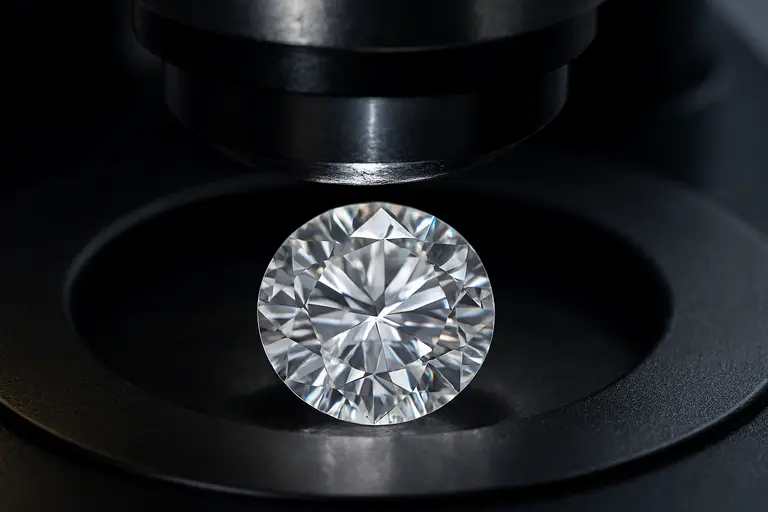
Initially perceived as scientific curiosities, lab-grown diamonds have evolved dramatically. Today, they are valued for affordability and ethical sourcing. LGDs offer identical physical properties to mined diamonds.
According to the latest DMCC Lab-Grown Diamond Report, the LGD market is projected to grow from $25 billion to nearly $100 billion by the 2030s. Both industrial applications and shifts in consumer lifestyle drive this growth.
Industrial Applications: Why This Lab-Grown Diamond Warning Still Applies
Industries widely use lab-grown diamonds for precision and performance. Their unmatched hardness makes them essential in manufacturing cutting tools and precision instruments.
You can read more about diamond hardness in my article on the Mohs Scale and Gem Durability.
This segment is mature. However, it reinforces that LGDs remain a marvel of engineering.
Jewellery and Lifestyle: A Lab-Grown Diamond Warning for Buyers
The appeal of LGDs in jewellery continues to grow rapidly. For example, LGDs now account for nearly half of all engagement ring stones in the U.S. (Source: JCK Online).
Designers incorporate them into watches and fashion accessories as production costs decrease.
However, buyers in Kerala and Tamil Nadu, where gold is worshiped as an asset, must adjust their mindset to this shift. If you want to compare asset behaviour, see my explanation on Why Gold Still Leads as an Investment.
Technology Applications and the Ongoing Lab-Grown Diamond Warning
One of the most exciting frontiers for LGDs is technology. Exceptional thermal conductivity lets engineers use lab-grown diamonds in semiconductors, quantum computing, and medical devices.
For a broader context, explore how diamonds support semiconductor research.
Therefore, even if retail prices fluctuate, the industrial future of LGDs remains strong.
Strategic Implications: A Practical Lab-Grown Diamond Warning
The expanding market poses challenges. As technology improves, production costs drop.
Therefore, consumers must note a key point: Lab-Grown Diamond prices have dropped significantly.
Supply in some sectors is growing faster than demand, which stabilizes or lowers the price per carat. For ongoing price behaviour, you can check LGD pricing updates on Rapaport.
A Gem Expert’s Lab-Grown Diamond Warning on Investment vs. Expense
Before you buy, you must use logic and common sense. Lab-Grown Diamonds, unlike Natural Diamonds or Gold, usually do not retain resale value. Most jewelers in South India do not offer a buy-back policy on LGDs.
For comparison, read my explanation on Gold Buyback Rules in Kerala to see why gold behaves differently.
My Verdict:
Buy LGD if you want a massive, beautiful stone for a wedding or party at a fraction of the cost. Enjoy it as you would enjoy a luxury watch or a car. But do not expect it to act as a financial safety net.
Final Thoughts on Lab-Grown Diamonds
The future of lab-grown diamonds lies in their multifaceted applications. They are a triumph of science. Innovative firms will drive the next phase of growth.
Finally, for consumers, LGDs offer a new era of affordable luxury, as long as you understand exactly what you are buying.
FAQ
What distinguishes lab-grown diamonds from mined diamonds?
LGDs are created using technology that replicates natural formation. They have identical physical and optical properties to natural diamonds but cost significantly less.
Learn how both compare in my guide on Natural vs Lab-Grown Diamonds.
Is a Lab-Grown Diamond a good investment?
Generally, no. LGDs are a consumption item (like a mobile phone), not an investment asset (like Gold). Their resale value is often negligible.
For stable investment understanding, read Why Gold Remains a Safe Asset.
Why is the LGD market growing?
Growth is driven by decreasing production costs, ethical consumer demand, and industrial uses.
Author Bio
P.J. Joseph, also known as Saju Elizamma, Gemstone & Gold Consultant serving Kerala, Tamil Nadu, and Karnataka.