
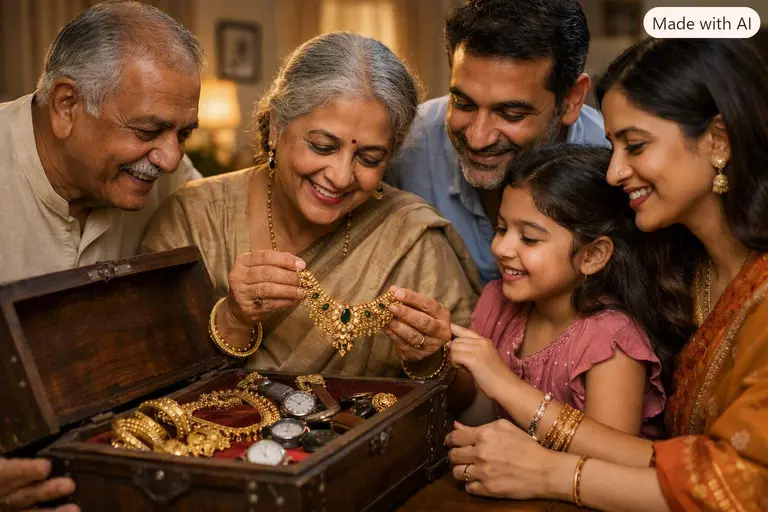
Introduction to Indian Families Cherishing Heirlooms
The enduring tradition of Indian families cherishing heirlooms remains a powerful force in the subcontinent’s culture even as modern lifestyles evolve. While economists often discuss the global transfer of financial wealth, the emotional and financial value of physical belongings like gold jewelry and luxury watches remains central to the Indian household. Consequently, every generation passes down more than just money; they hand over physical symbols of family history and personal achievement. Therefore, understanding this unique cultural habit helps us see how India balances rapid modernization with deep-rooted respect for ancestral legacy.
However, the Indian story differs sharply from the Western experience. While younger generations in many Western countries often sell or donate inherited items that no longer fit their minimalist lifestyles, the habit of Indian families cherishing heirlooms remains incredibly strong. Although urban lifestyles keep changing, these families still attach deep emotional and financial value to inherited items. Therefore, India demonstrates a pattern of adaptation rather than rejection. Readers can explore more cultural insights in our Lifestyle section and learn about gemstone traditions in our Gems and Gemology category.
Why Indian Families Cherishing Heirlooms Adapt to Urban Life
Indian families have traditionally treated inheritance as a collective responsibility. Consequently, most prized possessions stay within the family circle instead of entering the volatile resale market. Nevertheless, younger Indians often live very differently from their parents. Modern city apartments offer less storage space, and global careers demand higher mobility.
As a result, families are now finding creative ways to adapt inherited belongings. Specifically, many young professionals choose portable, easy-to-maintain possessions over bulky antique furniture. However, this practical approach does not reduce their intense emotional connection to their family history. For instance, a young professional might move from Kochi to Bengaluru for a job; they may not take an oversized teak swing, but they will certainly carry their grandmother’s gold bangles. This behavior ensures that the tradition of Indian families cherishing heirlooms survives even in the smallest high-rise apartments. To see how other high-end industries manage their heritage, you can read our guide on industry sheepdogs in tech and jewelry.
Jewelry Assets and Indian Families Cherishing Heirlooms
Gold holds a unique, almost sacred place in Indian households. Unlike many Western families, who sometimes view inherited jewelry only as a decorative accessory, Indian families value gold as a “liquid” financial safety net. This attachment stays especially strong in states such as Keralam, Tamil Nadu, and Karnataka, where gold connects directly to identity and religious ceremonies.
Redesigning Gems for Indian Families Cherishing Heirlooms
While the sentiment remains, fashion preferences have shifted toward the contemporary. Younger people often prefer lighter, more versatile designs for daily office wear. Therefore, many families are now “remaking” inherited ornaments. They take the raw gold from a heavy traditional necklace and forge it into a modern, minimalist pendant. Consequently, the gold remains in the family, but its form evolves to match current tastes. This focus on standardisation and purity is a core part of the Chow Tai Fook business model.
Why Indian Families Cherishing Heirlooms Value Emotional Worth
Furthermore, families increasingly recycle old gold to meet urgent financial needs or to fund new investments. Even so, the majority of families still choose to retain their gold rather than sell it to outsiders. They preserve both the emotional worth and the financial purity of the metal for the next generation. This long-term thinking is a hallmark of the world’s oldest company lessons for Keralam. For real-time data on global gold trends, you can visit the World Gold Council.
Why Indian Families Cherishing Heirlooms Choose Portability
Meanwhile, large wooden cabinets and brass utensils present a different logistical challenge. High-density cities like Mumbai and Delhi offer far less floor space than ancestral village homes. Consequently, many inherited furniture items no longer fit modern living rooms. As a result, some families move antique furniture to their “hometown” houses while keeping smaller treasures in the city.
In contrast, luxury watches occupy a unique and growing place among modern heirlooms. A well-made mechanical watch successfully combines craftsmanship, portability, and lasting market value. Therefore, many younger Indians treasure inherited timepieces even when their own aesthetic differs from that of their parents. For example, a vintage Rolex or Omega from a father’s collection often marks a significant career milestone for the son. This trend is part of building India’s global brands, where the appreciation for mechanical “phygital” assets is rising.
Regional Traits of Indian Families Cherishing Heirlooms
More importantly, geography continues to shape how Indian families cherish heirlooms in 2026. Southern states maintain some of the world’s strongest traditions around temple jewelry and silk sarees. In these regions, the “Great Stuff Transfer” involves the careful preservation of biological and mineral materials.
Meanwhile, metropolitan hubs face greater space pressure and choose to “digitize” their heritage. Many families now scan old photographs and documents into secure cloud storage while keeping the physical originals in high-security lockers. This modern approach is similar to the luxury vaults and fine dining trend, where security meets lifestyle. Overall, the state where a family resides dictates the method of preservation more than age alone.
FAQ About Indian Families Cherishing Heirlooms
Do younger Indians still find value in “old” jewelry?
Yes, absolutely. While they may not like the bulky styles, they value the gold purity and the emotional link to their ancestors. Redesigning is the most common way they keep the tradition alive.
What is the “Great Stuff Transfer”?
It refers to the transition of physical belongings (jewelry, furniture, art) from the Baby Boomer and Gen X generations to Millennials and Gen Z. In India, this is more about “re-purposing” than “decluttering.”
Should I insure my inherited heirlooms?
Yes. Professional valuation and insurance are essential, especially for gold and luxury watches. You should always obtain a certificate from a recognized body like the GIA for any significant gemstones.
Why are mechanical watches considered better heirlooms than smartwatches?
Mechanical watches can last for centuries with proper maintenance. In contrast, smartwatches become obsolete after a few years due to battery and software limitations.
How do I store inherited silk sarees in the Indian climate?
You should wrap them in soft muslin cloth and avoid using plastic bags. Periodically air them out in the shade to prevent moisture buildup and fungal growth.
Disclaimer
This article serves general educational purposes and reflects cultural observations as of August 2026. The author has no financial affiliation with the brands or organizations mentioned. Inheritance laws and tax regulations vary by religion and state in India. Accordingly, readers should consult with legal and financial professionals before making significant estate-planning decisions. Verify all gemstone and gold purity details through accredited laboratories.