Introduction
In the natural world, true blue is rare. However, two specific creations of nature captivate us with an identical, electric shade. Butterfly Pea vs Cobalt Blue Spinel represents a stunning parallel between botany and geology. One is a delicate flower (Sankhupushpam) found in almost every garden in Kerala. The other is a rare mineral found deep in the marble mountains of Vietnam.
At first glance, their vivid saturation draws immediate comparisons. Yet, beyond these vivid visuals, key differences emerge in their origins and properties. As a Gemologist with over 40 years of experience, I love finding these connections. In this article, we will explore their striking resemblances first, then dive into what sets them apart physically and chemically. Furthermore, understanding these links highlights Kerala’s rich herbal traditions alongside timeless gemstone allure.
Visuals of Butterfly Pea vs Cobalt Blue Spinel
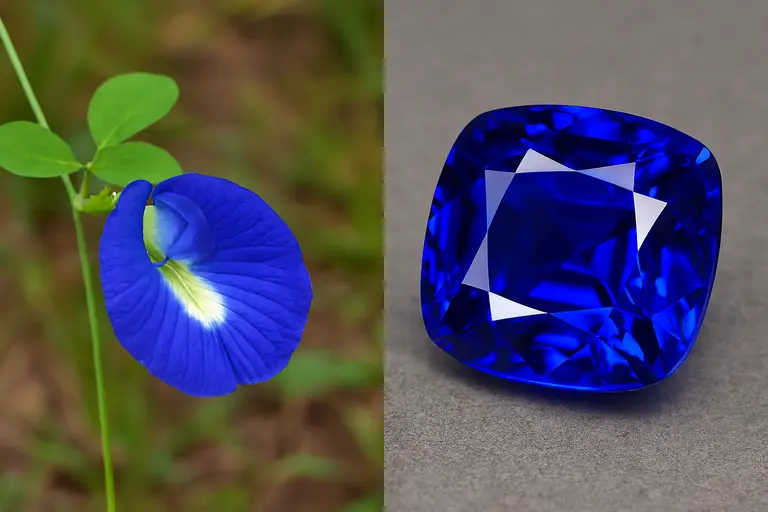
To begin with, let’s look at the color. Both Butterfly Pea flowers and Cobalt Blue Spinel share an eye-catching “Electric Blue” hue.
The Flower: Sankhupushpam
The Butterfly Pea flower (Clitoria ternatea) blooms with a vivid deep blue color. In Kerala, we know this well. When infused in hot water, it releases a dye that creates a “Blue Tea” so saturated it looks like ink. Similarly, the flower petals have a velvety texture that absorbs light, giving them a rich, matte appearance.
The Gem: Cobalt Spinel
On the other hand, Cobalt Blue Spinel is a prized gem. Primarily sourced from Vietnam (Luc Yen) and Sri Lanka, it dazzles with a “Neon” intensity. Unlike Sapphire, which can be dark or sleepy, Cobalt Spinel has an open, electric glow. Therefore, jewelers often use it as a high-performance alternative to top-tier Sapphire. If you are interested in blue gems, compare this to my guide on Kashmir Sapphire vs Grandala.
Chemistry of Butterfly Pea vs Cobalt Blue Spinel
Next, let’s get scientific. What causes this blue?
Biological Origin
The flower’s stunning blue derives from Anthocyanins, particularly Delphinidin pigments. According to experts at the University of Florida, plants produce this for protection against UV radiation and to attract pollinators. Thus, the color is organic and fragile.
Geological Origin
Conversely, the gem’s hue is inorganic. It stems from trace amounts of Cobalt substituting for Magnesium in the crystal lattice. This is rare. Usually, Iron makes stones blue (like Aquamarine). Cobalt makes them “Electric Blue.” As a result, Cobalt Spinel is one of the few gems that is colored by the same element used in “Cobalt Glass.” Read more about gem formation in my Colored Stone Grading guide.
Stability of Butterfly Pea vs Cobalt Blue Spinel
Moreover, the behavior of the color sets them worlds apart.
The Flower Changes Color
The Butterfly Pea is famous for its pH sensitivity. For instance, if you squeeze a few drops of lemon juice (Acid) into Blue Tea, it instantly turns Purple or Pink. This creates a fun, magical experience in mocktails. However, it proves the color is unstable. It reacts to its environment.
The Gem is Permanent
In contrast, Cobalt Blue Spinel is chemically inert. You can dip it in lemon juice, acid, or water, and it will remain that vivid blue forever. Consequently, this permanence makes it ideal for heirloom jewelry. It captures the color of the flower but freezes it in time.
Durability of Butterfly Pea vs Cobalt Blue Spinel
Furthermore, physical hardness dictates their use.
- The Flower: It is edible. In Kerala, we use Sankhupushpam roots and flowers in Ayurveda to boost memory and reduce stress. It is a “Consumable Gem.”
- The Gem: Spinel ranks 8 on the Mohs Scale. It is harder than Quartz and Emerald. Therefore, it is excellent for daily wear rings.
Comparison: Think of the flower as Kozhikode Halwa (a treat for the senses) and the gem as Synthetic Sapphire in Watches (a tool for endurance).
Buying Guide: Butterfly Pea vs Cobalt Blue Spinel
Practically, how do you acquire these blues?
Growing the Flower: It is a creeper vine. Plant seeds in a sunny spot in your Kerala garden. It requires little care and blooms year-round.
Buying the Gem: Sourcing ethical Cobalt Spinel requires care. Crucially, beware of “Cobalt Diffused” Sapphires sold as Spinels. Always look for a lab report from GIA or GRS. Genuine Cobalt Spinel is expensive (often $1,000+ per carat for fine neon colors), whereas the flower is free. For tips on avoiding fakes, read my Gemstone Buying Mistakes guide.
Conclusion on Butterfly Pea vs Cobalt Blue Spinel
Ultimately, the comparison of Butterfly Pea vs Cobalt Blue Spinel highlights nature’s versatility. Nature uses the same “Electric Blue” palette for two different purposes:
- To attract a bee (The Flower).
- To structure a crystal (The Gem).
In summary, enjoy the tea for its health benefits, and wear the gem for its beauty. Both are treasures of the earth.
FAQ: Butterfly Pea and Cobalt Spinel
What causes the blue color in Butterfly Pea flowers?
The blue comes from Delphinidin, an anthocyanin pigment. It is highly sensitive to pH levels, which is why the tea changes color when you add citrus.
Is Cobalt Blue Spinel a good Sapphire alternative?
Yes, absolutely. In fact, many collectors prefer it because it is usually untreated (natural), whereas most Sapphires are heat-treated. It has better brilliance and fire than many Sapphires.
Does Butterfly Pea color change permanently?
No. It is a chemical reaction. If you add an alkali (like baking soda) to the purple tea, it will turn blue again. It is a reversible reaction.
Where can I buy quality Cobalt Blue Spinel?
Look for stones sourced from Luc Yen, Vietnam. This mine produces the most famous “Neon Blue” stones.
Is Spinel a durable gem?
Yes. With a hardness of 8, it is very durable. It is suitable for engagement rings and daily wear jewelry, resisting scratches better than Tanzanite or Emerald.
Author Bio
P.J. Joseph, also known as Saju Elizamma, Gemstone & Gold Consultant serving Kerala, Tamil Nadu, and Karnataka.