Introduction
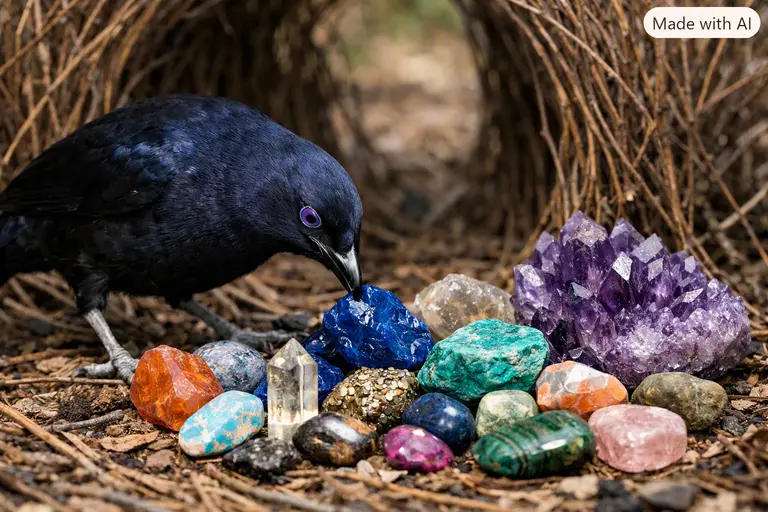
Can animals really recognize coloured stones and diamonds? Yes, but only in a limited sense. For instance, many animals notice colour, brightness, and unfamiliar shapes. However, no scientific evidence shows that an animal understands a diamond as a gemstone or knows its market price. Instead, animals react to food, mates, nests, and danger. For example, bowerbirds decorate courtship structures with colourful objects, while termites move soil that geologists later study. Therefore, animals offer clues, but only humans identify minerals with proper tests. We can discover so much about natural history simply by watching how wildlife connects with the environment. If you love exploring earth’s natural wonders, check out our guide on Gemology and Jewellery Education.
Can Birds Recognize Coloured Stones and Diamonds?
Although humans see colour through three types of cone cells, many birds possess four. Some species also detect ultraviolet light, which humans cannot see. As a result, a stone that looks plain to you may look quite different to a bird. Nevertheless, seeing a stone differently does not mean a bird knows what mineral it is. In other words, vision helps animals tell objects apart, but gemologists still need physical, optical, and chemical tests. Besides, the Gemological Institute of America (GIA) gem encyclopedia shows how experts identify gems. Similarly, plant and gemstone hunting reveals how nature leaves clever clues for gem seekers.
Do Bowerbirds Recognize Coloured Stones and Diamonds?
Bowerbirds, for example, offer the clearest case of birds picking objects by appearance. Because males want to impress females, they build structures called bowers and decorate them. Moreover, research on great bowerbirds shows that males choose colours partly by contrast with their feathers and the background. Likewise, experiments on satin bowerbirds show a strong preference for blue decorations. Still, these findings do not prove that bowerbirds recognize diamonds. Instead, the birds collect stones, flowers, shells, bones, and glass because these objects look striking. Therefore, bowerbirds act as skilled decorators, not natural gemologists.
Do Magpies Recognize Coloured Stones and Diamonds?
Although folklore says magpies steal jewels, University of Exeter researchers found no evidence of a special attraction to shiny objects. In fact, wild magpies touched a shiny object only twice in 64 tests. Instead, the birds often reacted with caution to unfamiliar items. Even so, a magpie may inspect a ring, but curiosity is not gem identification.
How Termites Help Recognize Coloured Stones and Diamonds
Overall, the strongest link between animals and minerals comes from termites and ants. However, these insects do not hunt for diamonds. Instead, they dig underground and carry soil to the surface while they build their homes. Geologists then collect samples from termite mounds and test them for unusual chemicals and indicator minerals. In this way, termites accidentally sample the ground below. To be clear, a termite never finds a diamond. Rather, it moves material, and humans examine that material for clues.
Can Termites Help Recognize Coloured Stones and Diamonds in India?
In India, for example, the Panna Diamond Belt in Madhya Pradesh produces diamonds. In addition, geologists there study minerals linked to diamond-bearing rocks. Pyrope garnet and ilmenite, for instance, often serve as indicator minerals. However, their presence alone does not prove that diamonds lie nearby. Therefore, do not believe claims that geologists spot a coloured stone on a termite mound and instantly find a deposit. Instead, they combine field sampling, mineral analysis, and geological mapping. Furthermore, drones now support this work, and our article on drones in diamond prospecting explains how.
Can We Recognize Coloured Stones and Diamonds via Mounds?
Termite-mound sampling also appears in Australia and parts of Africa. Researchers there study mound material because it can carry chemical signals from the ground below. As a result, termites can reveal geological information that soil and vegetation would otherwise hide. However, people should not exaggerate this method. In fact, most published successes involve gold, while diamond cases are less documented. After all, a termite mound is not a diamond detector.
What Animals Teach Us to Recognize Coloured Stones and Diamonds
In conclusion, animals remind us that nature holds clues we easily miss. For example, bowerbirds show how sharply animals respond to colour, while termites show how living creatures bring buried material upward. Above all, the lesson is careful observation. Appearance sparks curiosity, but evidence proves identity. Consequently, if you love gemstones, always test a stone before you trust your eyes or an animal’s reaction. Also, our beginner guide to coloured gemstones help you start learning.
Frequently Asked Questions
Can birds recognize diamonds?
Not really, although birds see colour, contrast, and sometimes ultraviolet light. However, no established evidence shows that they recognize diamonds or understand their value.
Do bowerbirds collect gemstones?
Yes, but only as decorations. For example, bowerbirds collect many colourful objects, including stones. Nevertheless, they choose items for courtship displays, not for mineral identity or money.
Can termite mounds help find diamonds?
Sometimes, but only in suitable regions. For instance, mound material may contain indicator minerals or chemical signs from below. Still, a mound alone never proves that diamonds exist underneath.
Can animals tell a diamond from another clear stone?
No, because reliable evidence does not support that idea. Animals may react to brightness or transparency, but that reaction does not equal mineral identification.
Why do geologists study animals?
Because animals move and expose soil during normal activity, scientists can use mounds and nests as extra geological samples.
Disclaimer
This article is for general education only, because animal behaviour, mineral exploration, and gem identification involve specialized sciences. In fact, termites, birds, and other animals do not identify diamonds or gemstones themselves. Likewise, indicator minerals can support exploration, but they do not prove the presence, quality, or value of a deposit. The author has no financial affiliation with the brands or organizations mentioned.