Introduction
What happens when gemology meets the kitchen? Ordinary ingredients can become sparkling diamond lookalikes, vibrant crystal clusters, and intricate ornamental pearls. Therefore, edible gemstones give everyday readers a fun way to explore colour, clarity, and texture through the lens of food science. However, each ingredient behaves differently, as sugar, agar-agar, and modelling pastes all follow distinct chemical rules. Consequently, the right choice for your project depends entirely on the aesthetic you want to achieve. If you enjoy gemology and jewellery education, this topic perfectly connects daily life with the science behind natural gemstones.
Which Ingredients Make the Best Edible Gemstones?
Using Isomalt for Edible Gemstones
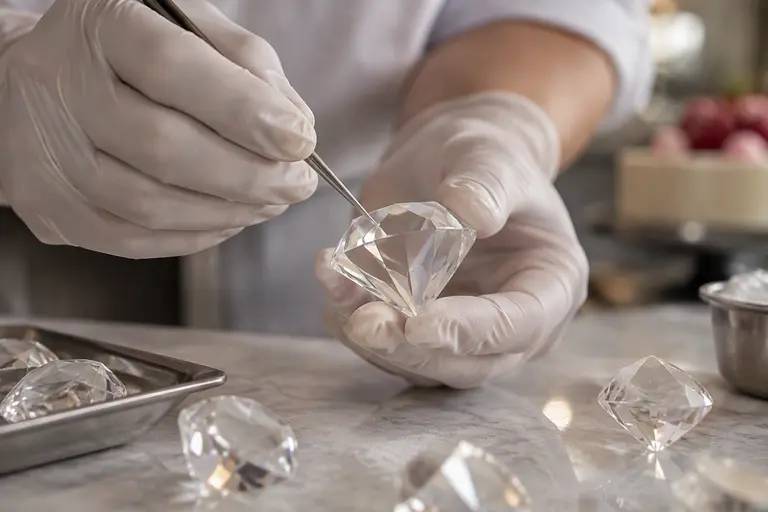
First, isomalt is a sugar alcohol that professional bakers use widely to create clarity. When cooks prepare it correctly, it sets into perfectly clear, glass-like pieces. As a result, skilled confectioners can craft faceted diamonds, ruby-red ornaments, and emerald-green designs.
Unlike ordinary sugar, isomalt resists crystallising and absorbs atmospheric moisture more slowly. Hence, it usually maintains a clearer finish than standard sugar. Nevertheless, extreme humidity can still turn finished pieces sticky or cloudy, so you must store them carefully. Furthermore, molten isomalt reaches very high temperatures, so you should always handle it with extreme care. Although it successfully imitates a gemstone’s look, it cannot replicate a real mineral’s complex structure or optical behaviour.
Agar-Agar and Edible Gemstone Crystal Candy
Agar-agar, a natural seaweed-based gelling agent, helps confectioners create “kohakutou”—a popular Japanese “amber candy” made of sugar and water. As the candy dries, a crisp, glass-like shell forms around a soft, jelly-like centre. Consequently, artists can sculpt pieces that resemble quartz clusters and amethyst geodes. However, these sweets copy only the external appearance, not the underlying geology. Humidity and drying time also drastically change the final result. For a fine commercial example, you can visit Silky Gem.
Fondant for Ornamental Edible Jewellery
Fondant and gum paste suit opaque decorations best. Artists mould them into pearls, ornate brooches, and intricate jewellery settings for decorative cakes. Moreover, food-safe lustre dust adds a realistic gold-like or silver-like finish. These materials shine on wedding cakes; still, they lack the durability of precious metals and the natural brilliance of cut gemstones.
Why Tofu Is Unsuitable for Edible Gemstones
Tofu holds plenty of moisture and remains soft. Although cooks can carve and colour it, tofu cannot form clear, hard, or finely faceted stones. Therefore, it suits temporary savoury plates much better than sweet confections. It also requires constant refrigeration. For realistic edible stones, you should choose isomalt, agar candy, or modelling paste instead.
Who Creates Gemstone-Inspired Art?
Anabela Chan and Food-Derived Jewellery
For instance, London designer Anabela Chan explores new materials through her “Fruit Gems” concept. In fact, she blends pigments derived from food waste with plant-based bio-resin to make gemstone-like jewellery. However, one distinction matters: these Fruit Gems are wearable, not edible. Their true value lies in innovation and the creation of sustainable alternatives to traditional materials. Moreover, food-derived ingredients do not automatically lower environmental impact; that claim needs specific evidence about sourcing, manufacturing, and disposal.
Crystal Candy Artists Crafting Edible Gemstones
Confectioners and cake artists also craft stunning gemstone-inspired sweets. For example, they combine coloured sugar, edible moulds, and careful shaping to build crystal candies and pearl decorations. In addition, these creations give birthdays and weddings sparkle without the high cost of real gems. Nevertheless, buyers should check ingredients before eating anything, because not every candy-like item is food-grade. Likewise, our gemstone buying guides show how genuine stones differ from these artistic copies.
What Gemologists Learn from Edible Gemstones
Overall, edible gemstones introduce the concepts of visual gemology quite neatly. For instance, clear isomalt mimics a faceted stone, while coloured crystal candy suggests a rough mineral. However, looks alone never prove identity or value. Natural minerals carry specific chemical compositions, crystal structures, and unique optical properties.
By contrast, confectioners copy only the colour, shape, and finish. Accordingly, these creations show why gemologists look far beyond sparkle. They also study transparency, lustre, inclusions, and material identity. Most importantly, an imitation can look beautiful without sharing any of the real material’s properties.
What Consumers Learn About Edible Gemstones
First, beauty does not guarantee high monetary value. A coloured sugar crystal may resemble a costly gem, yet its composition and purpose differ completely. Second, alternative materials push shoppers to question waste. Although food-derived jewellery shows creative reuse, its benefits depend on the entire production process. Finally, edible jewellery turns decoration into an experience. People admire it, enjoy its texture, and then eat it. Therefore, it cannot replace fine jewellery, but it can make an occasion memorable.
Frequently Asked Questions
Can people eat every gemstone-inspired ornament?
No. People should eat only food-safe products. Bio-resins, craft pigments, and non-food coatings can make an ornament unsafe for consumption.
Which ingredient works best for edible diamonds?
Isomalt usually works best for clear, faceted pieces. However, mould quality, colouring, and storage still shape the final result.
Can edible gemstones replace real jewellery?
No, because they serve as sweets and temporary decorations. They lack the lasting wearability required for real jewellery.
Is tofu useful for edible jewellery?
Yes, but only for temporary savoury displays. Its softness and opacity make it unsuitable for mimicking glass-like stones.
Disclaimer
This article offers general educational information. Use food-grade ingredients and approved colourants. Handle molten sugar carefully, as it can cause burns. Follow safe storage and hygiene practices. The author has no financial affiliation with the brands or organizations mentioned.