Introduction
Understanding colour vision and buying coloured gemstones both depend heavily on human perception. When you shop for rubies, emeralds, or sapphires, your unique sight shapes the entire experience. However, because not everyone perceives light the same way, the process of colour vision and buying coloured gemstones requires a thoughtful approach. Colour vision deficiency, often called colour blindness, changes how some people perceive hues and brightness. Therefore, both buyers and jewellers benefit from understanding these biological differences. This guide explains how perception influences the trade and offers practical tips for shopping with confidence. Learn more about the craft through our Gemology and Jewellery Education guide.
How Colour Vision and Buying Colored Gemstones Differ
Colour vision deficiency takes several forms. For example, deuteranomaly makes some greens look redder, while protanopia makes red and green hard to separate. Similarly, tritanopia affects blues, greens, yellows, and pinks. Moreover, every person experiences these conditions differently. As a result, two customers with the same diagnosis may describe the same ruby in different ways. For reliable medical information, visit the National Eye Institute.
How Professionals Grade Color Vision and Buying Colored Gemstones
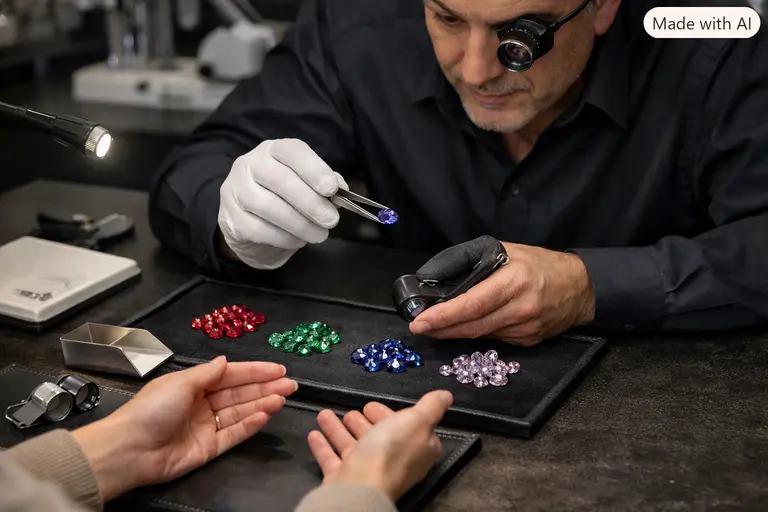
Professional graders never just glance at a stone and guess. Instead, they follow strict procedures. For instance, the Gemological Institute of America (GIA) grades diamond colour in a controlled viewing environment. Graders compare each diamond with reference stones, which they call masterstones, and they control the lighting and background. Additionally, several graders give independent opinions before the lab finalizes a result. These standards improve consistency, but they do not correct eyesight. Therefore, masterstones cannot guarantee accurate grading from someone with a colour vision deficiency. Ultimately, the type and severity of the deficiency, along with the job’s demands, decide whether a person can grade colour professionally.
Why Color Vision and Buying Colored Gemstones Are Harder
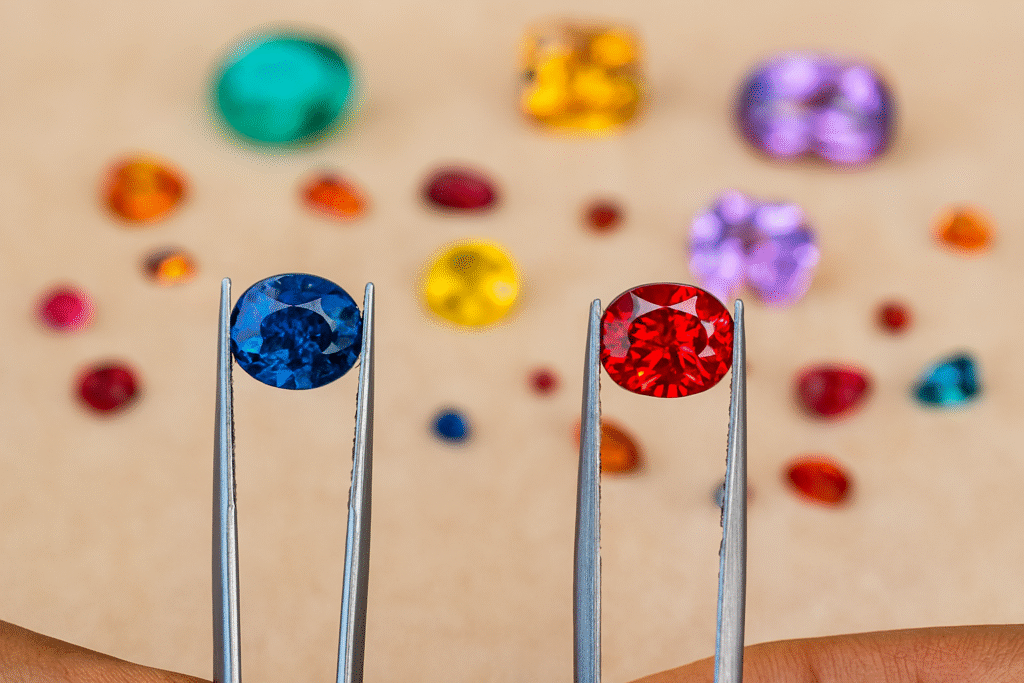
Coloured gemstones add another layer of difficulty because hue, tone, and saturation all shape their appearance. For instance, graders do not judge a ruby as simply light or dark red. Likewise, a sapphire can show subtle differences in all three qualities. Consequently, small colour shifts can change a stone’s value. In addition, laboratories use scientific instruments to identify stones and detect treatments. However, these tools support visual evaluation instead of replacing it. Explore more in our gemstone buying guides.
What Shoppers Need for Color Vision and Buying Colored Gemstones
If you have a colour vision deficiency, you can still love coloured gemstones. Your eyes may read a stone’s colour differently from the salesperson’s eyes, but that does not make your choice wrong. After all, you will wear the jewellery, not the salesperson. Nevertheless, you should protect yourself. First, ask the seller to describe the documented colour characteristics. Next, request a laboratory report for valuable stones. Then, compare the stones side by side under good lighting. Finally, take your time and bring a trusted friend for a second opinion if you like.
How Jewelers Respond to Color Vision and Buying Colored Gemstones
When a customer shares a colour vision difference, the jeweller should respond naturally and respectfully. For example, the jeweller can say, “Thank you for telling me. Would you like me to describe the documented colour details as we compare these stones?” Moreover, pity and medical questions have no place in this conversation.
Next, the jeweller should place the stones side by side and explain differences in hue, tone, and saturation. Above all, the jeweller should never say, “You cannot see the difference.” Instead, a better approach is to say, “These stones carry different documented colours. Let’s compare them together and see which one you prefer.” Likewise, jewellers should never spring surprise colour tests or mock unusual colour descriptions.
Does Color Vision and Buying Colored Gemstones Rely on Reports?
A laboratory report offers valuable facts. Depending on the lab, it may confirm a stone’s identity, treatment status, likely origin, and colour description. Still, a report cannot tell you whether a gemstone looks beautiful to you. Indeed, only your own eyes can answer that question. Therefore, the best purchase combines reliable documentation with a stone you genuinely enjoy. Remember this: the report supports the purchase, but it never replaces the experience of seeing the gemstone.
Frequently Asked Questions
Can someone with color vision deficiency buy colored gemstones confidently?
Yes. In fact, accurate information, fair comparisons, and trustworthy documentation help any buyer decide well. Therefore, you can understand the documented details and still trust your own response to the stone.
Can a person with color vision deficiency become a gemologist?
Possibly, depending on the role. For example, some tasks demand precise colour discrimination, while others focus on identification, microscopy, inclusions, or measurements.
Should a salesperson ask every customer about color blindness?
No. Sellers should not ask about a customer’s vision or health. However, if a customer volunteers this information, the seller should listen respectfully and adjust the presentation.
Can a laboratory report replace seeing a gemstone in person?
No. A report records important facts, but it cannot capture your personal visual experience. For this reason, you should always view the stone yourself whenever possible.
Disclaimer
Color vision deficiency varies widely, from mild to severe. This article offers general information about gemological evaluation and jewellery retail practices, and it does not provide medical or occupational-vision advice. Therefore, professional graders should follow the rules of their laboratory, grading system, and employer. Likewise, anyone who worries about their color vision should consult a qualified eye-care professional. The author has no financial affiliation with the brands or organizations mentioned.

Disclosure: This post contains Amazon affiliate links. If you make a purchase through them, I may earn a small commission at no extra cost to you.