Introduction
Every finished piece of jewellery begins with raw material and a plan. When considering jewellery careers, one must understand that each stage requires specific expertise. First, someone studies the gemstone. Next, someone decides how to shape it and design the setting. Finally, skilled hands turn that plan into a wearable object. Although different specialists traditionally handle each stage, one person can learn several of these skills at once. In fact, modern tools such as CAD software, 3D printing, and artificial intelligence now make these jewellery careers more achievable and versatile than before. By exploring the diverse career paths within this creative field, you can build a truly rewarding profession—start your journey today with Gemology and Jewellery Education.
What Do Professionals in Jewellery Careers Do?
What a Designer Does in Jewellery Careers
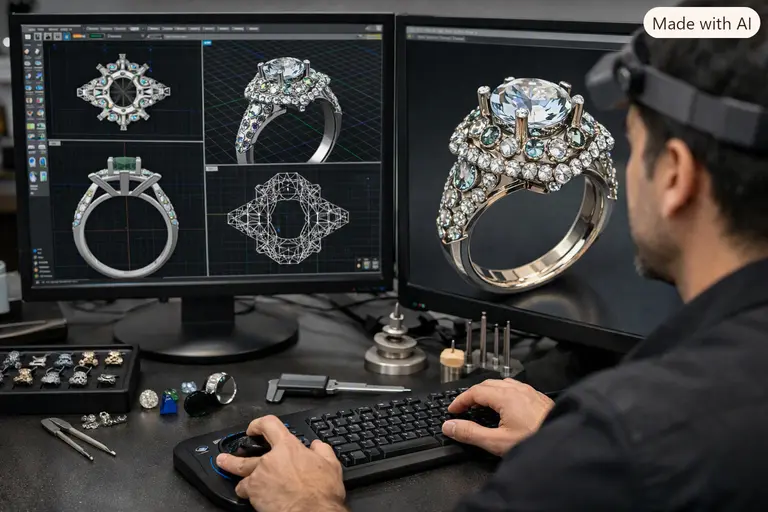
Fundamentally, a jewellery designer shapes the appearance, proportions, and character of a piece, typically by sketching by hand or building digital models with CAD software. Additionally, generative AI now helps designers produce visual concepts quickly. However, a striking AI image does not automatically become manufacturable jewellery. Indeed, GIA’s research on AI in jewellery design examines how designers use AI tools alongside traditional techniques while navigating the ethical and legal questions the technology raises. Consequently, most designers still need to translate an AI-generated concept into a practical model.
What a Goldsmith Does in Jewellery Careers
In practice, a goldsmith works directly with precious metals such as gold, platinum, and silver, forming, soldering, finishing, and creating settings. Meanwhile, modern workshops increasingly pair traditional bench skills with CAD, casting, and 3D printing. Even so, these tools still depend on a skilled person who understands how jewellery should function and feel when worn.
What a Gem Cutter Does in Jewellery Careers
Essentially, a gem cutter—also called a lapidary—transforms rough material into a finished stone by choosing an orientation, removing unwanted material, and polishing the surface. As a result, cutting demands far more than making a stone look attractive; the cutter must also weigh durability, inclusions, and optical performance.
What a Gemologist Does in Jewellery Careers
Broadly, a gemologist identifies gemstones and evaluates their characteristics, including natural, treated, and imitation gem materials. Importantly, however, gemological training does not automatically qualify someone to issue an independent laboratory report. Organizations like the GIA provide education and separate laboratory services to ensure impartiality.
What Traders Do in Jewellery Careers
Simply put, a gem trader buys and sells gemstones for a living, which calls for sharp knowledge of quality, supply, demand, and negotiation. Although digital tools can help with research, they cannot replace the relationships a trader builds through years of experience. A gemstone consultant, meanwhile, advises clients on quality, treatments, sourcing, or design. However, “gemstone consultant” is not one standardized qualification. Clients should always check a consultant’s education and defined scope of service.
Can One Person Learn All These Jewellery Careers Skills?
Certainly, one person can learn design, goldsmithing, cutting, gemology, trading, and consulting. That said, learning six disciplines differs greatly from mastering all six equally. For example, a professional might become highly skilled in gemology while gaining working knowledge of design and trading. Ultimately, a strong primary skill supported by secondary skills often delivers more value than shallow expertise spread across every area.
How Technology Is Changing Jewellery Careers Skills
Overall, technology is steadily making multidisciplinary work more realistic. For instance, CAD lets designers build precise digital models before production, while generative AI helps produce jewellery concepts fast. However, human expertise remains necessary to turn those concepts into wearable designs. Similarly, machine learning increasingly assists gemologists with identification, working alongside established methods rather than replacing professional judgment.
What Technology Cannot Replace in Jewellery Careers
Undoubtedly, technology reduces repetitive work and improves consistency, yet several human skills remain irreplaceable. For example, a machine can generate a digital jewellery model, but only an experienced craftsperson understands how a piece should feel on the hand. Therefore, technology works best as a force multiplier for human expertise, not a substitute for it.
The Best Path for Beginners in Jewellery Careers
Generally, a beginner should start with one solid foundation and gradually add related skills. For instance, gemology suits someone drawn to gemstones, while design suits a creative learner. Afterward, learn the language of neighbouring professions. A gemologist who understands cutting communicates better with a lapidary. Finally, use technology to extend your abilities rather than skip the learning process, since experience determines how well you use the tools.
Frequently Asked Questions
Can one person be a jewellery designer, goldsmith, gem cutter, gemologist, trader, and consultant?
Yes, one person can develop all these skill sets, though competence in one field does not guarantee mastery in the others.
Can AI replace jewellery professionals?
Not currently, since generative AI still functions as a tool rather than a replacement for trained professionals.
What should a beginner learn first?
Ideally, a beginner should start with one core discipline and then build working knowledge of related fields.
Is a gemstone consultant the same as a gemologist?
No, since a gemologist focuses on identifying gemstones, while a consultant provides broader advice, although one person can hold both types of experience.
What is the biggest advantage of learning several jewellery skills?
Above all, the advantage is understanding how each stage connects, which helps a professional communicate more effectively with designers, cutters, and traders alike.
Disclaimer
This article offers general educational information about careers in the gem and jewellery industry. Notably, professional titles and requirements vary by country and organization. Therefore, readers should verify credentials, reports, and valuations with qualified professionals before making important financial decisions. The author has no financial affiliation with the brands or organizations mentioned.