Introduction
Can artificial intelligence make gemstones, diamonds, jewelry, and watches more beautiful? Yes, in some ways, but not on its own. AI in the gemstone and jewelry industry now measures, compares, and simulates the physical traits that shape how a jewel appears. As a result, it helps cutters, gemologists, designers, and watchmakers make sharper decisions. However, beauty still means more than a number on a screen. For everyday buyers, this distinction matters most. AI can improve a diamond’s light performance or test a design before production begins. Even so, it cannot decide whether a ruby, a necklace, or a watch will speak to any one person. Therefore, AI has not replaced human judgment. Instead, it now works alongside it, as one more tool in a much older craft. Learn more about this balance in our guide on understanding jewelry craftsmanship.
How AI in the Gemstone and Jewelry Industry Improves Diamonds
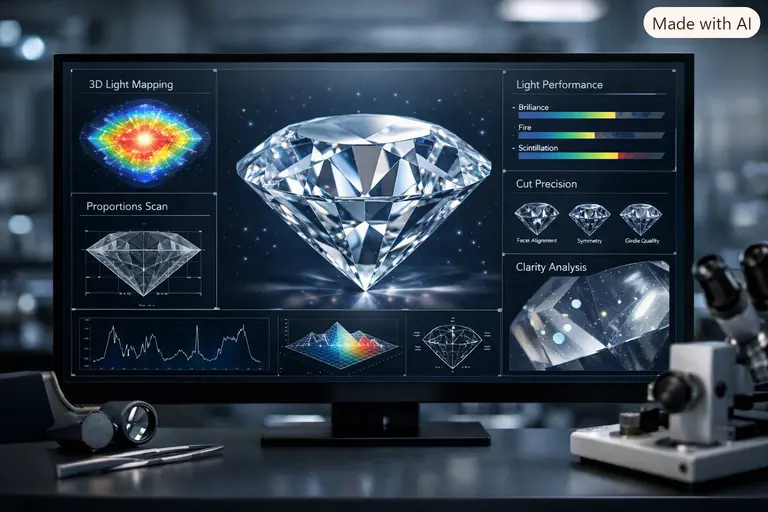
The Gemological Institute of America (GIA) partnered with IBM Research to build an AI-based clarity grading system, combining digital diamond images with a vast grading database to support faster, more consistent assessments. Meanwhile, Sarine Technologies applies optical scanning to analyze how light moves through a diamond. Its Sarine Light system studies brilliance, fire, sparkle, and light symmetry. Consequently, buyers gain real insight into how a stone behaves under light, beyond basic proportions. Still, a stronger light-performance score does not mean AI has found one universal formula for beauty. Different diamonds carry different visual personalities, and different people simply prefer different things.
Using AI in the Gemstone and Jewelry Industry for Cutting
AI and 3D scanning also help planners map how a rough gemstone should be cut. Thus, cutters can weigh trade-offs between weight retention, symmetry, and visible inclusions before anyone removes a single gram. Yet, coloured gemstones raise a harder challenge than diamonds do. Ruby, sapphire, emerald, and tourmaline often show colour zoning and distinctive internal effects. For that reason, maximum symmetry rarely produces the most attractive stone. Consequently, human experience still decides which qualities matter most for each rough.
Can AI in the Gemstone and Jewelry Industry Measure Beauty?
AI measures specific, defined traits tied to appearance, and it can turn those traits into a numerical score. However, buyers should separate measured characteristics from beauty as a personal experience. For example, GIA’s AGS Ideal Report adds detail about a diamond’s brightness, fire, and contrast, framing the report as a way to describe beauty more fully. Similarly, Sarine applies its own Light Performance scale. Therefore, shoppers should ask what a score actually measures and who built the methodology behind it. In short, an AI-generated beauty score works well once its limits are understood, but it should never stand in as the final word.
AI in the Gemstone and Jewelry Industry Design Process
AI also shapes jewelry design long before a piece reaches production. Designers now use digital modeling and generative tools to test proportions and stone layouts on screen. This catches manufacturing problems early and cuts down on costly errors later in the workshop. At the same time, jewelry involves far more than geometry. Comfort, balance, texture, and cultural meaning all shape the finished piece. So, a technically flawless design can still feel forgettable, while an unconventional one becomes memorable because it carries character.
AI in the Gemstone and Jewelry Industry: Luxury Watches
AI and digital tools have also entered watchmaking, supporting design exploration and quality control. However, this assistance does not replace traditional watchmaking skill. Hand-finishing, polishing, and careful adjustment remain forms of craftsmanship that no algorithm performs. Consequently, buyers should not assume an AI-assisted watch is inferior to a traditionally built one. Conversely, AI involvement does not automatically make a watch more desirable either. The real question is simple: what does the technology actually add to the finished product?
AI in the Gemstone and Jewelry Industry: Lab-Grown Diamonds
AI forms only part of a broader scientific toolkit used to identify diamonds and detect treatments, since spectroscopy and imaging still do most of the heavy lifting. Since 1 October 2025, GIA’s Laboratory-Grown Diamond Quality Assessment has classified eligible colourless to near-colourless lab-grown diamonds as Premium or Standard. It avoids using traditional natural-diamond grading terms. Therefore, buyers should never assume every lab report uses identical terminology.
AI in the Gemstone and Jewelry Industry: Authentication
AI also works alongside digital identification systems. Breitling’s Digital Passport, for instance, stores ownership records and service history, and owners can transfer it through a blockchain-based transaction. Even so, a digital passport does not guarantee that a watch can never be counterfeited. Buyers should still weigh the physical watch, its serial number, and the seller’s credibility.
Does AI in the Gemstone and Jewelry Industry Increase Costs?
Not necessarily. AI can lower certain development and manufacturing costs, but retail prices still depend on materials, rarity, craftsmanship, design, and demand. Consequently, no fixed rule says an AI-assisted product must cost less. Likewise, no fixed rule says a handmade product deserves a higher price by default.
How to Navigate AI in the Gemstone and Jewelry Industry
The simplest approach is to ask what the technology actually measured, changed, or verified. This applies whether that is a light-performance score or a generated design a human designer later reviewed. Most importantly, separate the physical object from its digital description. A diamond still carries its own colour, clarity, and cut. A watch still carries its own movement and finishing. AI can study these traits, but it cannot replace them.
Frequently Asked Questions
Can AI actually make a gemstone more beautiful?
Not by itself. AI helps a cutter or designer choose proportions and layouts that may improve appearance, but the final result still depends on human skill.
Can AI measure diamond beauty?
AI and optical systems measure defined traits such as brightness, fire, sparkle, and contrast. Even so, these measurements do not capture every possible meaning of beauty.
Should buyers pay more for an AI-designed jewel or watch?
Not automatically. Price should reflect the whole product, including materials, craftsmanship, design, rarity, and the real benefit the technology provides.
Is human craftsmanship becoming irrelevant?
No. AI supports measurement, modeling, and production, while skilled craftspeople continue to make the finishing decisions that technology cannot fully define.
What should buyers look for in an AI-assisted product?
First, identify exactly what the AI does. Then examine the product’s physical quality, the credibility of the report provider, and the seller’s documentation before comparing total value.
Disclaimer
This article is intended for general education and consumer awareness. AI systems, gemological instruments, and digital authentication platforms all differ in their capabilities and limits. Therefore, buyers should not rely solely on an AI-generated score or digital record for a significant purchase. An independent gemological report and a physical examination remain appropriate steps before buying high-value gemstones, diamonds, jewelry, or watches. The author has no financial affiliation with the brands or organizations mentioned.