
Introduction
Scrimshaw is a striking maritime art form. Western whalers created it during long voyages in the 18th and 19th centuries. Consequently, sailors engraved whale teeth, whale bone, and other hard materials with ships, whales, portraits, and nautical scenes. As a result, people around the world closely associate scrimshaw with whaling culture. India, however, follows a different path. Although India has no documented maritime scrimshaw tradition, it carries deep and lasting traditions of carving ivory, horn, and bone. Keralam horn carving, in particular, preserves a living craft that shares certain techniques with scrimshaw. Nevertheless, this craft remains culturally and historically distinct. This article explores the unique identity of this regional art form. You can explore how these traditions shape the region in our deep dive into Keralam’s traditional handicraft economy.
Keralam Carries a Living Horn-Carving Tradition
Indeed, Keralam has long carved ivory, horn, and bone into meaningful objects. In fact, Thiruvananthapuram and Thrissur became well-known centres for ivory carving, where artisans produced religious, decorative, and functional pieces. Over time, though, artisans adjusted to new realities in material supply and wildlife law. Today, therefore, buffalo horn stands as an established craft material in Keralam.
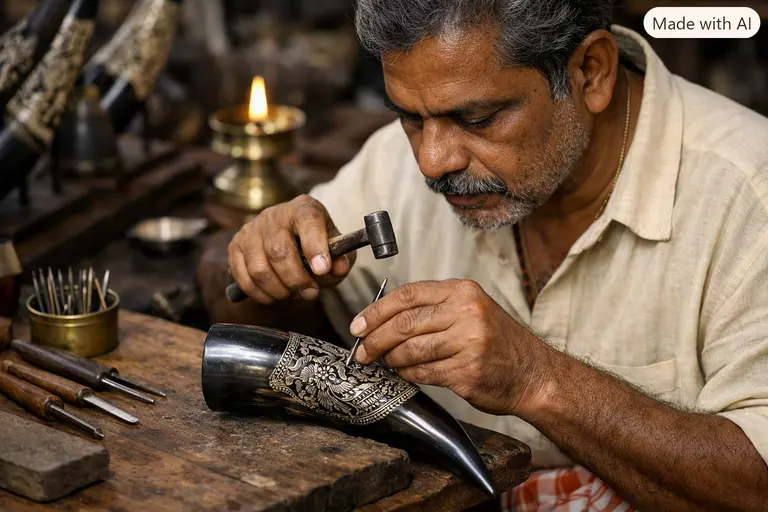
Indeed, the Handicrafts Development Corporation of Kerala names buffalo horn as a traditional craft. It notes that most of this work happens in the capital city. Artisans shape the horn into flowers, birds, animals, and fish, so each piece carries both decorative and practical value. Naturally, the process itself demands real skill. First, artisans remove the horn’s outer layer and shape its basic form. Next, they heat the material so it becomes pliable enough for detailed work. Afterward, they smooth the surface and add fine engraved designs.
The polish and finishing techniques
One especially interesting technique uses the milky kapadlaava, or jackfruit leaf, to polish the horn. Then, artisans apply burnt palm-leaf ash to darken the surface. Finally, they highlight select engraved areas with a mixture of white chalk and glue, which gives each finished piece its distinctive contrast. For readers who want the full craft documentation, visit the Encyclopedia of Crafts guide to Keralam horn carving.
Why Keralam Horn Carving Is Not Scrimshaw
At first glance, Keralam horn carving and scrimshaw might look alike, since both involve detailed engraving on animal-derived materials. Even so, their histories, materials, and cultural roots differ sharply. To begin with, scrimshaw grew out of Western whaling communities. Accordingly, its imagery usually reflects maritime life, including ships, whales, sailors, and ocean voyages.
Keralam horn carving, on the other hand, grew from regional Indian craft traditions. Its designs favour birds, animals, decorative objects, and miniature forms instead. Therefore, calling this craft “Indian scrimshaw” creates a misleading and inaccurate historical link. Instead, a fairer comparison simply notes that both traditions show how skilled artisans can engrave and decorate hard organic materials. In other words, the resemblance stays technical rather than historical.
From Ivory to Alternative Materials
Ivory once played a central role in Indian carving history. Craft records confirm that Thiruvananthapuram and Thrissur served as major ivory-carving centres, where artisans made religious and decorative pieces. However, the legal history of ivory deserves close attention. India passed the Wild Life Protection Act in 1972, and later amendments strengthened restrictions on wildlife articles and ivory. Notably, the 1991 amendment tightened rules around imported ivory and any articles made from it.
As a result, artisans increasingly turned to alternative materials for different kinds of work. In Keralam specifically, decorative carving shifted toward horn, while some artisans working on other carved objects moved toward wood instead. So, rather than describing this shift as the disappearance of Keralam carving, it makes more sense to view it as a thoughtful adaptation to changing legal and material conditions.
Bone Carving Traditions in Northern India
In fact, Keralam is not alone in preserving a living tradition of carving animal-derived materials. Lucknow, in Uttar Pradesh, offers an equally important contemporary example of bone carving. Specifically, a 2024 Indian Express report profiled artisan Jalaluddeen and his family, who continue this traditional craft using discarded buffalo bones. In particular, they produce decorative objects, home décor items, office accessories, and jewellery. First, they cut and clean the bone; then, they bleach it before carving the finished product. That same report also highlights real challenges, such as the difficulty of sourcing raw material and the labor-intensive nature of the work. Consequently, the tradition remains vulnerable.
Where Buyers Can Find Keralam Horn Crafts
To begin with, anyone interested in traditional horn crafts can start with government-supported outlets. Specifically, the Handicrafts Development Corporation of Kerala runs the SMSM Institute in Thiruvananthapuram, along with a network of Kairali showrooms. According to the corporation, these Kairali outlets sell handicrafts sourced directly from artisans, which supports the craft economy directly. That said, product availability changes often. So, buyers should contact an outlet first, rather than making a special trip to find one particular item. Most importantly, buyers should always confirm the material before purchasing any animal-derived object. Ivory and other protected wildlife materials carry strict legal restrictions, while horn and bone from domestic animals typically fall under different rules.
Why These Crafts Still Matter
Altogether, scrimshaw and Indian horn and bone carving both reveal an important truth about craft history. When artisans lose access to a traditional material, their skills rarely disappear overnight. Instead, they adapt those skills to new materials, new markets, and new legal conditions. In Keralam, the shift from ivory toward horn and other materials illustrates this adaptation especially well. Similarly, Lucknow’s bone carvers continue reshaping an inherited craft for contemporary buyers. For everyday readers, then, the real distinction is not simply old versus new. Instead, it lies between documented traditions and assumed connections. Keralam horn carving may resemble scrimshaw in technique, but it holds its own distinct identity.
Frequently Asked Questions
Is Keralam horn carving the same as scrimshaw?
No, it is not. Certainly, both traditions involve detailed engraving on animal-derived materials. However, scrimshaw developed within Western whaling culture, while the Keralam craft developed within Indian regional craft traditions.
Is horn carving still practised in Keralam today?
Yes, indeed. The Handicrafts Development Corporation of Kerala still recognises Buffalo Horn as a traditional craft and confirms that artisans mainly practise this craft in the capital region.
Does India still have bone carving traditions?
Yes, particularly in Lucknow. Specifically, artisans there continue using discarded buffalo bones to create decorative objects, jewellery, and other products.
Can old ivory carvings be freely bought and sold in India?
No. Indian wildlife legislation places significant restrictions on dealings in wildlife articles. Buyers should always seek current advice from the appropriate authority before buying, selling, or transporting such an object.
What comes closest to an Indian equivalent of scrimshaw?
No single Indian equivalent exists. Still, Keralam horn carving and northern Indian bone carving offer useful comparisons, since both involve detailed work on hard animal-derived materials.
Disclaimer
This article serves general educational purposes only. Craft practices, material sourcing, and wildlife regulations can change over time. Therefore, buyers should verify the current legal status and provenance of any animal-derived material before purchasing, selling, or transporting such an object. The author has no financial affiliation with the brands or organizations mentioned.