Introduction
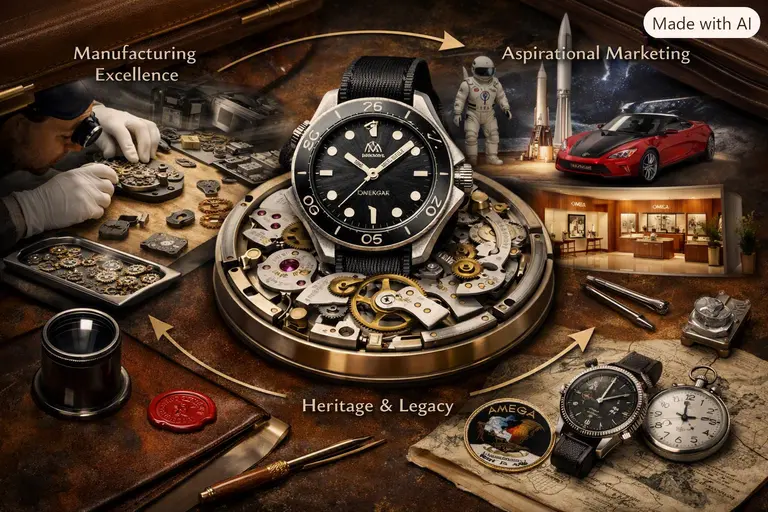
Omega has built one of the most resilient and successful business models in Swiss luxury watchmaking. Instead of relying purely on artificial scarcity, the Omega Watch Business Model blends industrial manufacturing scale, mechanical innovation, deep heritage, and aggressive worldwide marketing. Currently, Omega belongs to the Swatch Group, and this strategic ownership gives the brand access to a massive industrial network. As a result, Omega produces highly sophisticated mechanical watches on a significantly larger scale than many small, independent watchmakers could ever manage.
For the 99% of global consumers, this distinction matters immensely. The Omega Watch Business Model offers genuine Swiss luxury and global brand recognition, yet it does not position every single watch as an ultra-rare, unobtainable collectible. Therefore, more people can actually own a real piece of horological history. In this article, we will examine the specific pillars that support this business strategy and how it impacts the global market today.
Technology as a Pillar of the Omega Watch Business Model
First of all, Omega sells more than just a famous name on a dial. The brand consistently emphasizes technical precision and long-term reliability. For instance, Omega introduced its famous Co-Axial escapement in 1999. This technology was originally developed by the legendary British watchmaker George Daniels, and Omega later adapted it for large-scale industrial production. By reducing friction within the movement, the Co-Axial escapement allows for longer service intervals and better accuracy.
Moreover, the Omega Watch Business Model took another massive leap in 2015 with the introduction of the Master Chronometer certification. The Swiss Federal Institute of Metrology, known as METAS, independently tests these watches for precision, water resistance, and—most importantly—magnetic resistance up to 15,000 gauss. Consequently, buyers should understand that “Co-Axial” and “Master Chronometer” are distinct technical standards. Therefore, checking the specific calibre of a watch remains a vital step for any serious buyer.
How the Omega Watch Business Model Utilizes Swatch Group Scale
Overall, the Omega Watch Business Model combines skilled human craftsmanship with advanced modern automation. The brand’s headquarters and primary production facilities are located in Bienne, Switzerland. In 2017, Omega opened a state-of-the-art production building that brought assembly, quality control, shipping, and training under one roof. This facility features an automated storage system that holds more than 30,000 boxes of tiny components.
Therefore, Omega’s success does not depend on slow hand-assembly alone. Instead, the company pairs human expertise with high-tech automation to ensure consistency across thousands of units. Furthermore, Omega benefits significantly from the wider Swatch Group ecosystem. Because group companies like Manufacture Ruedin supply cases and Nivarox supplies springs, Omega can maintain a more stable supply chain than its competitors. This industrial synergy is a core reason why the Omega Watch Business Model remains so profitable.
The Role of Heritage in the Omega Watch Business Model
However, high-tech engineering alone does not fully explain Omega’s massive global appeal. The brand has masterfully turned its history into a powerful marketing story that resonates with collectors. Most importantly, the Speedmaster carries an exceptional space legacy. Omega officially states that the Speedmaster has flown on every NASA-piloted mission since 1965, including all six historic lunar landings.
Similarly, the Seamaster collection connects the Omega Watch Business Model with professional diving and deep-ocean exploration. Consequently, these collections give everyday buyers a narrative that goes far beyond technical specifications. Omega does not simply sell a timekeeping instrument; it sells a direct connection to human exploration and history. By focusing on these “pillar” collections—Speedmaster, Seamaster, Constellation, and De Ville—the brand maintains a consistent identity across different lifestyles.
Growth of the Omega Watch Business Model in India
In addition to its Western success, the Omega Watch Business Model has also strengthened its position in the Indian market. Swatch Group reported record sales and market-share gains in India in its most recent 2024 financial results. Omega is among the brands showing particularly strong growth as India’s luxury-watch market becomes increasingly sophisticated. A rising middle class and an increased appreciation for mechanical heritage fuel this growth.
Furthermore, Swatch Group maintains a dedicated Indian subsidiary, Swatch Group India Private Limited, which supports the brand’s distribution and after-sales service across the country. Therefore, buyers in India should always verify a retailer through Omega’s official boutique network before making a purchase. To learn more about identifying high-value luxury goods, you can read our guide to gemstone and luxury verification.
Verifying Authenticity: Protecting Your Investment
In the modern market, authenticating a luxury watch requires more than checking a single detail. For example, contemporary Omega watches include sapphire crystals, anti-reflective coatings, and silicon balance springs. However, these features vary by reference and production period. No single detail proves authenticity on its own.
Similarly, serial-number placement has changed between generations. Therefore, buyers should never dismiss a genuine vintage Omega simply because its number sits in an unfamiliar spot. Instead, you should compare the reference number, the movement calibre, and the purchase history together. A professional examination at an authorized service center adds an essential layer of protection for expensive timepieces. This culture of verification is a necessary part of the Omega Watch Business Model.
FAQ: Understanding the Omega Watch Business Model
Is Omega considered a true luxury watch brand?
Yes. Overall, Omega is a premier Swiss luxury brand built on high technical performance, significant heritage, and global brand recognition.
Who currently owns the Omega brand?
Simply put, Omega is a flagship brand of the Swatch Group, which operates a large portfolio of Swiss watch and jewelry manufacturers.
Are all Omega watches made in Switzerland?
Yes. Indeed, Omega runs its global headquarters and main production facility in Bienne, Switzerland, ensuring “Swiss Made” quality.
Does every Omega watch feature a Co-Axial movement?
No. While most modern models do, some vintage or specialized references may not. Therefore, buyers should check the specific reference details.
Who handles Omega distribution in India?
Specifically, Swatch Group India Private Limited supports the brand’s distribution, while authorized boutiques provide consumers with direct access to genuine products.
What is the safest way to buy an Omega watch?
First, buy only from an authorized boutique or a reputable retailer. Then, ensure you keep the original invoice and the multi-year warranty card safe for future service needs.
Conclusion
Overall, the Omega Watch Business Model succeeds because it perfectly blends industrial scale with genuine luxury positioning. On one side, the brand leans on advanced manufacturing, automation, and the massive Swatch Group network. On the other side, it uses space exploration, Olympic timekeeping, and popular culture to build emotional value. As a result, Omega offers more scale than the most exclusive independent watchmakers, yet it still carries the prestige people expect from a major luxury brand. For the 99% of watch enthusiasts, that balance is the real strength of Omega.
Disclaimer
This article is intended for general information and educational purposes only. Omega’s specifications, movements, documentation, and retail arrangements can vary by model, production period, and market. Therefore, buyers should confirm details through the exact reference and, when necessary, seek examination by Omega or a qualified independent watch professional. The author has no financial affiliation with the brands or organizations mentioned.