Introduction to Assam Matcha and Green Gemstones
India has entered an exciting new chapter in premium tea production. Chota Tingrai Tea Estate recently launched the first commercial version of the region’s specialty powder. The estate created this innovative tea from indigenous Camellia sinensis var. assamica, combining a rich heritage with carefully adapted Japanese processing techniques. Interestingly, the vibrant green color of Assam matcha and green gemstones shares a remarkable natural beauty that captures the eye immediately.
Although tea leaves and gemstones form through entirely different natural processes, they share remarkable similarities in color, rarity, and premium appeal. Therefore, comparing them offers an engaging way to understand why authentic matcha stands apart from ordinary green tea. Moreover, these similarities help consumers appreciate the meticulous care that high-end production requires. At the same time, they make it easier for buyers to recognize genuine products and avoid inexpensive imitations. To understand the science of these mineral colors, you can read our guide to green gemstones and identification.
Why Assam Matcha Resembles Green Gemstones
Premium Assam matcha undergoes a shading period of roughly three to four weeks before the harvest begins. During this time, growers block about 90 percent of the sunlight that reaches the tea plants. Consequently, the youngest leaves develop significantly higher chlorophyll levels. At the same time, they retain more L-theanine, an amino acid that gives the tea its smooth, umami-rich flavor. As a result, the finished powder displays a brilliant green color that resembles several famous minerals.
Chlorophyll in Assam Matcha and Green Gemstones
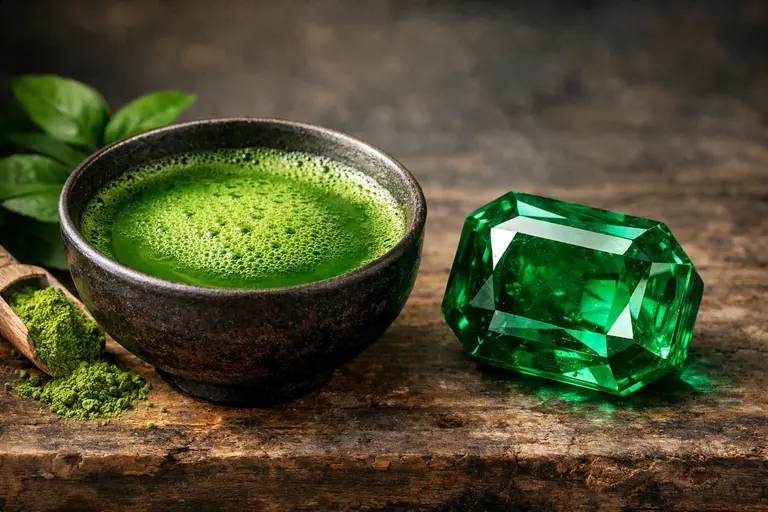
For instance, an emerald displays an intense green color because trace amounts of chromium or vanadium alter its crystal structure. Likewise, premium matcha achieves its vivid appearance through elevated chlorophyll levels. Similarly, jadeite resembles freshly whisked matcha, since both display a smooth, rich, and elegant green tone. In contrast, nephrite often shows deeper forest-green shades that echo the earthy undertones sometimes visible in Assamica-based products.
Meanwhile, peridot exhibits bright yellowish-green hues that resemble matcha viewed in direct sunlight. Likewise, green tourmaline presents multiple shades depending on how light passes through the crystal. Similarly, finely ground powder shows a shift in tone as light falls across its delicate particles. Even so, these comparisons remain visual analogies rather than scientific equivalences. For a deeper look at mineral optics, visit the Gemological Institute of America (GIA).
Shared Appeal of Assam Matcha and Green Gemstones
Tea and gemstones originate through completely different geological and biological cycles. Nevertheless, both owe their attractive colors to naturally occurring compounds. In gemstones, trace elements produce distinctive green colors. In contrast, the tea draws its appearance primarily from biological shifts during the shading period.
Therefore, although the science differs, both products show how natural processes create extraordinary beauty. Furthermore, each product needs favorable growing or geological conditions before it can reach a professional grade. In addition, both premium matcha and fine green gemstones attract people who value authenticity and craftsmanship. Although one comes from carefully cultivated gardens and the other from deep within the earth, both reward patience and expertise. You can learn more about global tea trends at World Tea News.
Quality Standards for Assam Matcha and Green Gemstones
Producing Assam matcha and green gemstones of high value demands exceptional attention to detail. First, growers shade the tea bushes for several weeks before the harvest. Next, they harvest only the youngest, carefully selected leaves. Afterward, processors remove the stems and veins before preparing the leaves for slow stone milling.
Processing Assam Matcha and Green Gemstones
Similarly, fine gemstones require millions of years to form naturally before miners extract them. Afterward, skilled professionals sort, cut, and polish each stone with remarkable precision. Consequently, neither high-quality tea nor gemstones reach the market quickly or cheaply. Furthermore, the inaugural commercial harvest in Assam yielded only about five kilograms. Therefore, its first release immediately attracted considerable attention because of its rarity. This level of precision is common in trade skills that stay ahead of AI in India.
Identifying Genuine Assam Matcha and Green Gemstones
As this specialty tea gains popularity, more products appear on store shelves. Unfortunately, not every powder marketed as matcha meets authentic production standards. Therefore, consumers should learn how to distinguish genuine quality from ordinary green tea.
First, examine the color carefully. Authentic premium powder displays a bright, vibrant green color because of the shading process. In contrast, ordinary green tea usually looks dull olive or yellow-green. Next, feel the texture. Genuine matcha offers an exceptionally soft, silky texture because producers grind the leaves into extremely fine particles. Conversely, lower-quality powders often feel coarse or slightly gritty. Then, brew the tea and evaluate its flavor. Premium matcha produces a smooth, creamy drink with pleasant umami, whereas imitations often taste bitter. This focus on sensory quality is similar to how master perfumers and gem graders evaluate their respective crafts.
GI Certification for Assam Matcha and Green Gemstones
At present, Assam matcha does not carry its own Geographical Indication (GI) registration. However, Assam Orthodox Tea has enjoyed registered GI protection since 2008. Even so, this protection does not automatically extend to newly developed powdered products. Nevertheless, the absence of a separate GI tag does not diminish its significance. Instead, it simply reflects the fact that commercial production remains a recent innovation.
As production expands, a separate GI registration may become possible in the future. Until then, consumers should buy from reputable producers that share transparent information about origin. This transparency is a core part of building India’s global brands in the luxury market.
FAQ About Assam Matcha and Green Gemstones
Which gemstone is the best color match for whisked matcha?
Jadeite is often considered the best match because of its vibrant, “creamy” green appearance that mirrors a well-prepared bowl of tea.
Does Assam matcha contain more caffeine than regular tea?
Yes. Because you consume the whole leaf in powdered form and the shading increases caffeine content, it provides a more sustained energy boost than steeped tea.
Is the green color in gemstones permanent?
Yes, the color in natural gemstones like emeralds and sapphires is part of their chemical structure and will not fade over time.
Why is stone milling important for matcha?
Stone milling keeps the temperature low during grinding. This prevents the delicate leaves from “burning,” which preserves the bright green color and sweet flavor.
Are there “simulant” green gemstones like there are fake teas?
Yes. Just as ordinary tea is sold as matcha, glass or synthetic stones are often sold as natural emeralds. Always check for certification.
Disclaimer
This article serves educational and informational purposes only. The author has no financial affiliation with Chota Tingrai or any tea brands mentioned. Comparisons between Assam matcha and green gemstones are visual analogies and not scientific equivalences. Always verify product authenticity before purchasing high-value items.