
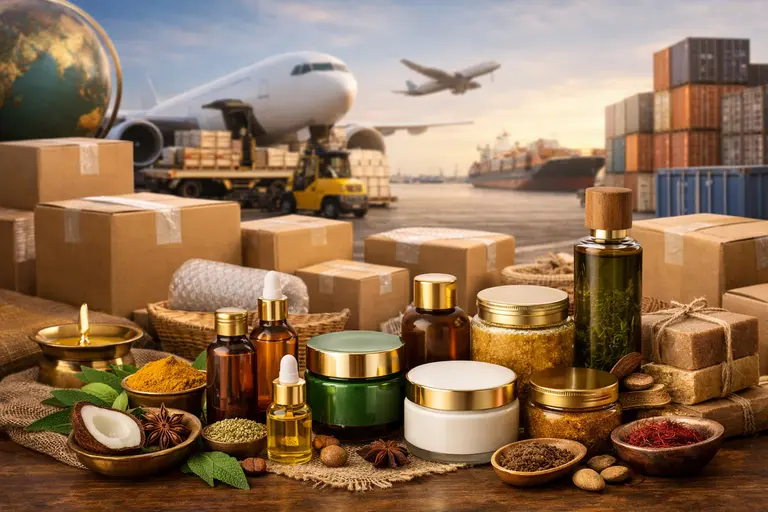
Introduction to the Indian Beauty Export Competition
The Indian beauty export competition against global giants like China is fundamentally reshaping the international cosmetics market. While China has dominated for years with its “C-Beauty” brands, India is now leveraging its rich Ayurvedic heritage and modern manufacturing to carve out a unique space known as “I-Beauty.” Consequently, this shift provides a massive opportunity for Indian entrepreneurs to reach a global audience that values wellness and scientific transparency.
India possesses a genuine opportunity to lead because it blends centuries of botanical wisdom with an increasingly sophisticated industrial sector. Additionally, India’s rich natural resources and strong cultural influence through digital creators provide a solid foundation for international growth. However, tradition alone cannot secure a win in this high-stakes race. India must instead strengthen its manufacturing capacity, back every claim with scientific research, and build brands that international buyers respect. If the industry maintains these priorities, India can become a premier exporter while giving global consumers better quality. To see how other traditional sectors are scaling, you can read our guide on flavours and gems of Keralam.
China’s Role in the Indian Beauty Export Competition
China’s cosmetics industry has expanded remarkably over the past decade. Initially, rather than targeting Western countries, many Chinese brands established themselves across Southeast Asia before pushing into Europe. Moreover, Chinese companies have poured resources into “digital sheepdogs”—advanced AI systems that manage supply chains and detect market trends in real-time. This level of oversight is similar to the industry sheepdogs in tech and jewelry that maintain market order globally.
As a result, they launch new products with incredible speed while keeping prices competitive. Furthermore, many Chinese brands now offer specialized certifications for diverse regional markets. In turn, these brands have secured a dominant position in fast-growing territories. Overall, China’s success reflects a deliberate strategy that combines innovation and manufacturing efficiency. For India to compete effectively, it must adopt a similarly disciplined approach to global logistics and product development.
Winning the Indian Beauty Export Competition via Ayurveda
India should avoid competing with China purely on high-volume, low-cost manufacturing. Instead, the country can carve out a distinctive global position through what experts call “Clinical Ayurveda.” This involves pairing traditional wellness with modern scientific proof. Ingredients such as turmeric, saffron, and ashwagandha already carry worldwide recognition; however, today’s consumers demand peer-reviewed evidence.
Consequently, Indian companies must back traditional knowledge with rigorous lab research and internationally recognized testing. Specifically, manufacturers can combine botanical ingredients with clinically proven actives such as niacinamide and hyaluronic acid. This balanced approach appeals to modern consumers who want both natural ingredients and visible results. This scientific validation is essential for building India’s global brands in the luxury sector. For official safety standards, you can visit the World Health Organization (WHO).
Quality Standards in the Indian Beauty Export Competition
A compelling brand story alone cannot win the Indian beauty export competition. International buyers expect consistent quality, reliable production, and strict regulatory compliance across every batch. Therefore, Indian manufacturers must keep upgrading their facilities to meet “Good Manufacturing Practices” (GMP). Meeting the requirements of demanding regions like Europe and North America will simplify the export process and reduce legal hurdles.
Moreover, transparent sourcing and rigorous quality control build consumer confidence. International buyers increasingly favor manufacturers who provide clear documentation and sustainable practices. At the same time, India can stand out by offering flexible production volumes. Many emerging beauty brands prefer partners who can produce smaller, high-quality batches rather than demanding massive minimum orders. This flexibility allows Indian firms to become valuable partners for independent beauty companies worldwide. You can track current export policies through the Ministry of Commerce & Industry, Government of India.
Global Markets and the Indian Beauty Export Competition
India does not need to challenge China in every single category. Instead, it should concentrate on segments where it already holds a natural edge. Indian manufacturers have deep experience creating products for diverse skin tones and tropical climates. Consequently, they are well-positioned to serve consumers across the Middle East, Africa, and Latin America who face similar environmental challenges.
Furthermore, India can deepen its presence in premium herbal skincare and specialized sunscreens for diverse complexions. While many Chinese brands have traditionally focused on specific East Asian skin types, India has a much broader internal demographic to draw research from. Therefore, India’s best strategy involves differentiation through inclusivity. This focus on individual biology is also a core part of biohacking for healthy aging, where personalized care is the ultimate goal.
The Role of Conglomerates and Innovation
Although no single Indian company yet matches China’s largest giants in volume, India already has strong contenders. Nykaa leads the domestic retail space while growing its private-label brands. Honasa Consumer has rapidly scaled brands like Mamaearth by blending digital marketing with consumer insight. Meanwhile, premium names like Forest Essentials have introduced luxury Ayurvedic skincare to international audiences.
Large groups such as Reliance Retail and Tata also bring substantial capital and global business networks to the table. Therefore, India’s advantage will likely come from collaboration among innovative brands and financially strong conglomerates. This “Honeybee” model of value transformation—as discussed in our guide on the three business models: ants, spiders, and honeybees—will be the engine of India’s export success.
FAQ: The Indian Beauty Export Competition
How exactly can India win the Indian beauty export competition?
India can win by prioritizing “Clinical Ayurveda.” By proving the efficacy of traditional herbs through modern lab testing, India can dominate the global wellness and “clean beauty” segments.
Are Chinese beauty products cheaper than Indian ones?
Generally, yes, because China has a more mature automated manufacturing infrastructure. However, India is becoming more competitive by offering better quality-to-price ratios in the mid-to-high-end segments.
Which markets are the primary targets for Indian beauty exports?
The Middle East, Southeast Asia, and Africa are the primary targets. These regions share similar skin concerns and climatic conditions with India, making I-Beauty products highly effective there.
Does the Indian government provide support for this competition?
Indeed, the government provides significant support through the “Make in India” initiative, export subsidies, and participation in international trade fairs via the GJEPC, Cosmoprof India, BeautySum India, and other export councils.
Can small startups participate in the Indian beauty export competition?
Absolutely. Small startups can leverage digital e-commerce platforms and contract manufacturers to reach global customers without building massive factories.
Disclaimer
This article serves general information and market analysis purposes only. Export figures and regulatory requirements can change rapidly. The author has no financial affiliation with the beauty brands mentioned. Always consult the Ministry of Commerce and independent market researchers before making significant business or investment decisions.