Introduction to Serendibite Gemstone Rarity
Most jewelry enthusiasts recognize diamonds, rubies, and sapphires immediately. However, very few have ever seen or even heard of serendibite, a mineral that defines serendibite gemstone rarity on a global scale. Its unusual chemistry and extreme scarcity turn it into a prized collector’s stone rather than a mainstream jewelry item. While a diamond might be a girl’s best friend, a serendibite is a gemologist’s ultimate trophy.
Exceptional gem-quality serendibite has reportedly commanded prices ranging from tens of thousands of dollars per carat to well over one million dollars per carat in outstanding cases. Still, these figures apply only to the finest stones with superior color, clarity, and documented provenance. If you enjoy learning about unique geological anomalies, then serendibite offers a fascinating mix of history and science. To see how this compares to other elusive minerals, you can read our guide on The World’s Rarest Gemstones.
Historical Origins of Serendibite Gemstone Rarity
Scientists first identified serendibite in 1902, after George Thurland Prior and Ananda Kentish Coomaraswamy examined an unusual specimen near Gangapitiya in Sri Lanka. Consequently, they recognized that the material represented a previously unknown mineral species. They named it serendibite after “Serendib,” the old Arabic name for the island of Sri Lanka. Indeed, this name honors the island’s long-standing reputation as a leading gemstone source for the ancient world.
Later, in the 1990s, miners recovered additional gem-quality material from secondary deposits in Sri Lanka’s Ratnapura area. As a result, the island holds a lasting claim to the gem’s story, since it produced the very first specimens known to science. This historical discovery laid the groundwork for our modern understanding of serendibite gemstone rarity. For more on the historical context of trade, see our article on Sanskrit gem knowledge and ancient trade.
Geological Factors in Serendibite Gemstone Rarity
Serendibite forms only under highly specialized geological conditions; therefore, it occurs in very few places worldwide. Specifically, it develops in “skarn” deposits. These form when granite magma intrudes into limestone or dolomite. During this intrusion, boron-rich fluids react with the surrounding carbonate rock through a process called boron metasomatism.
As these fluids alter the host rock, new minerals begin to crystallize. Under exceptionally rare conditions, several uncommon elements combine at precise temperatures and pressures to form serendibite. Its chemical formula, Ca₂(Mg,Al)₆(Si,Al,B)₆O₂₀, reflects this extreme complexity. Because of this intricate molecular structure, serendibite ranks among the rarest borosilicate minerals ever cut as a faceted gem. This process is far more demanding than the formation of synthetic gems in fiber optics, which humans can replicate in labs.
Sourcing Regions for Serendibite Gemstone Rarity
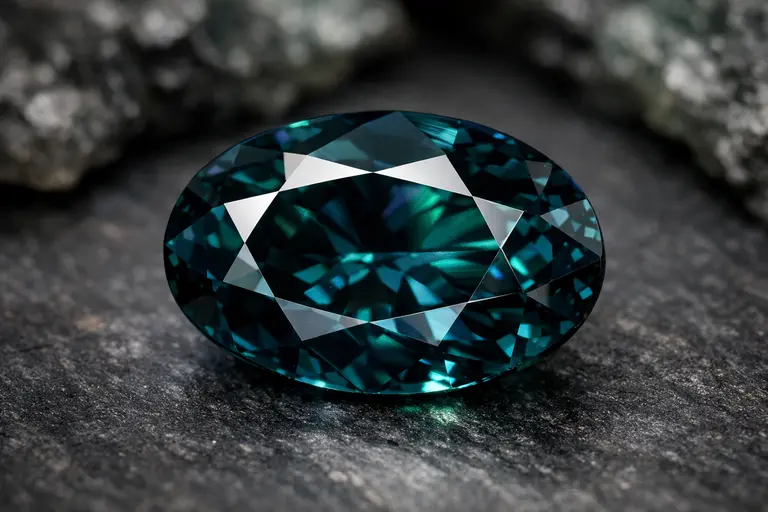
Sri Lanka remains the original and most important source of gem-quality serendibite. Specifically, the area around Ratnapura has yielded translucent greenish-blue and grayish-blue stones. In 2005, a breakthrough occurred when miners uncovered gem-quality serendibite in Myanmar’s famous Mogok Stone Tract.
Initially, many Burmese crystals look almost black to the naked eye. Yet, under strong transmitted light, they often reveal an attractive blue-green transparency. Additionally, minor occurrences exist in Madagascar, Canada, Russia, and the United States. However, these localities rarely yield material suitable for faceting. For official mineralogical data, you can consult the Mindat Mineral Database.
Lab Testing for Serendibite Gemstone Rarity
Identifying serendibite is notoriously tricky because gemstones like black tourmaline and dark spinel closely resemble it. Therefore, professional laboratory testing remains essential for any serious buyer. First, gemologists measure the refractive index, which typically falls between 1.701 and 1.706. Next, they study the stone’s pleochroism. Specifically, the stone can show shifting shades of blue and green when viewed from different angles.
Furthermore, serendibite carries a Mohs hardness of about 6.5 to 7. This helps distinguish it from softer imitations. Finally, advanced labs apply Raman spectroscopy or electron microprobe analysis for conclusive results. Consequently, gemologists rely on several combined tests rather than a single measurement. This level of oversight is handled by the same type of industry sheepdogs in tech and jewelry who protect the integrity of the high-end market.
Market Tips for Serendibite Gemstone Rarity
Because the gem is exceptionally rare, most buyers encounter it only through specialized dealers or high-end auction houses like Sotheby’s or Christie’s. If you are considering a purchase, you must first request a certificate from a respected lab, such as the GIA (Gemological Institute of America). Treat unusually low prices with suspicion, as genuine gem-quality serendibite always commands a massive premium.
Once you own a piece, you should favor pendants or earrings over daily-wear rings. This is because the gem’s moderate hardness makes it vulnerable to scratches from hard surfaces. Afterward, clean it only with warm water and mild soap. You should strictly avoid ultrasonic cleaners or sudden temperature changes, as these can trigger fractures in the crystal lattice. This focus on durability is similar to what we recommend in our steel jewellery buying guide.
FAQ About Serendibite Gemstone Rarity
Is serendibite rarer than a diamond?
Yes, in terms of geological occurrence and the number of faceted stones in existence, gem-quality serendibite is significantly rarer than a natural diamond.
Can I find serendibite in different colors?
Indeed, while many are dark or nearly black, serendibite can appear in greenish-blue, grayish-blue, and even rare violet-blue shades depending on its source.
What is the largest serendibite ever found?
Currently, the Medici Collection holds the Guinness World Record for the largest faceted serendibite, which weighs an incredible 140.76 carats.
Are there synthetic versions of serendibite?
No, there is currently no commercial synthetic serendibite on the market. Therefore, buyers should be more concerned about misidentified natural stones like tourmaline.
Why is boron important in its formation?
Boron is a rare element in the Earth’s crust. Its presence during the skarn formation process is the “secret ingredient” that allows the unique serendibite structure to crystallize.
Disclaimer
This article serves educational and informational purposes only. The author has no financial affiliation with the collections or dealers mentioned. Gemstone markets are volatile; therefore, you should obtain an independent laboratory report before making any significant investment. Always consult with a certified financial advisor before allocating capital to rare assets.