
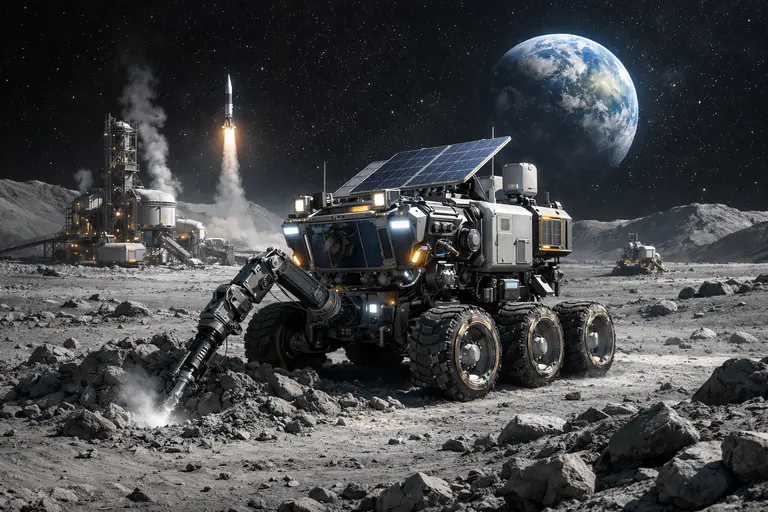
Introduction to the Lunar Resources Mining Race
The Moon is no longer just a place scientists observe from afar. Today, governments, space agencies, and private companies actively treat it as a potential source of valuable materials. This lunar resources mining race could eventually power future space missions and improve life on Earth. Over the past few decades, missions have confirmed the presence of rare minerals, water ice, and unusual industrial elements.
As a result, interest in lunar mining has grown rapidly and consistently across the globe. However, extracting resources from the Moon involves enormous technical and financial challenges. Even so, major organizations continue to invest in technologies that could one day make lunar mining a reality. This article explores the specific materials at stake, the key players involved, and the hurdles they must overcome. Understanding this competition is as complex as understanding the three business models: ants, spiders, and honeybees that drive modern markets.
Resources Driving the Lunar Resources Mining Race
Scientists and engineers focus on several key materials when they discuss lunar resources. Each material offers a distinct set of opportunities and challenges for the future.
Helium-3: A Prize in the Lunar Resources Mining Race
First, Helium-3 attracts significant attention. This rare isotope of helium is almost absent on Earth; indeed, total reserves amount to less than 10 kg globally. By contrast, billions of years of direct solar wind exposure have deposited an estimated 1.1 million metric tonnes into the lunar soil. Although it exists in low concentrations, scientists consider it a potential fuel for future nuclear fusion reactors. Consequently, it could generate clean energy without producing radioactive waste.
Rare Materials and the Lunar Resources Mining Race
Second, the Moon contains regions rich in Rare Earth Elements (REEs) such as yttrium and scandium. Manufacturers rely on these to produce smartphones and electric vehicles. China’s Chang’e-5 mission famously revealed Changesite (Y), a new phosphate mineral. More recently, in April 2026, Chinese scientists announced two further new minerals—magnesiochangesite-(Y) and changesite-(Ce). These discoveries prove how much remains to be learned from a single mission. This level of geological discovery is even more intricate than the silver supply chain from mine to jewelry.
Drivers of the Global Lunar Resources Mining Race
The growing interest in the lunar resources mining race extends well beyond scientific curiosity. In fact, several practical reasons drive governments to invest in lunar exploration today. To begin with, future Moon bases will need local supplies of water, oxygen, and building materials. Transporting every kilogram from Earth would cost an extraordinary amount of money. Therefore, sourcing materials directly from the Moon makes long-term missions far more practical.
Furthermore, water ice near the lunar poles offers two critical advantages. It can support human settlers while also providing hydrogen for rocket fuel. As a result, the Moon could eventually serve as a refueling point for missions heading to Mars. In short, resource utilization could become the central foundation of any sustained human presence beyond Earth. For more data on space governance, visit the United Nations Office for Outer Space Affairs (UNOOSA).
Leading Figures in the Lunar Resources Mining Race
Lunar mining requires expertise from several different industries; consequently, no single organization currently holds all the capabilities needed. Instead, the future economy will likely involve close collaboration between governments and private firms.
Government space agencies currently lead the way. NASA manages the Artemis program, which aims to return humans to the lunar surface. At the same time, China advances its plans through the International Lunar Research Station. Meanwhile, private companies are developing specialized equipment. For example, Interlune, founded by former Blue Origin president Rob Meyerson, has become the first private company to extract and sell Helium-3. They plan to supply customers by 2029. Additionally, firms like SpaceX and Blue Origin are developing the heavy-lift rockets needed to deliver mining infrastructure.
India’s Progress in the Lunar Resources Mining Race
Although the United States and China dominate many discussions, India has emerged as a genuinely important participant in the lunar resources mining race. India demonstrated its growing capabilities through the Chandrayaan program. Most notably, Chandrayaan-3 achieved a historic soft landing near the lunar south pole in August 2023.
During the mission, the Pragyan rover confirmed the presence of sulfur, aluminum, calcium, and titanium. Looking ahead, India plans to launch Chandrayaan-4, a complex sample-return mission, in 2028. Furthermore, India and Japan are jointly developing the LUPEX mission (Chandrayaan-5) for 2027–28. This mission specifically targets water ice in permanently shadowed craters. Nevertheless, India still needs to develop heavier launch vehicles and resource-processing technologies. Even so, ISRO has firmly established itself as a key player in the future space economy.
Engineering Hurdles in the Lunar Resources Mining Race
Despite the growing enthusiasm, commercial lunar mining remains far from practical today. In fact, several serious challenges stand in the way of success. To start with, launch costs remain high, even as companies work actively to reduce them. Moreover, the lunar environment is extremely harsh. Temperatures swing dramatically, and abrasive lunar dust can damage machinery.
Power supply presents another major obstacle because a lunar night lasts approximately 14 Earth days. Consequently, mining systems must survive extended periods without sunlight. Furthermore, engineers must design all equipment to operate autonomously, as real-time human control is impossible over such distances. This level of automation is even more demanding than the trade skills that stay ahead of AI in India.
FAQ About the Lunar Resources Mining Race
What is the most valuable resource on the Moon?
Many experts believe Helium-3 is the most valuable because of its potential in nuclear fusion. However, water ice is the most important for immediate survival and rocket fuel production.
Can private companies own land on the Moon?
Under current international law, specifically the Outer Space Treaty, no nation can claim sovereignty over the Moon. However, new frameworks like the Artemis Accords aim to allow companies to extract and own lunar resources.
When will we see the first actual lunar mine?
While small-scale extraction tests are happening now, large-scale industrial mining is unlikely to begin before the 2040s or 2050s.
How does India’s ISRO contribute to this race?
ISRO provides essential data on surface composition and water ice through its Chandrayaan missions. Their low-cost, high-efficiency approach makes space resources more accessible.
Is lunar mining bad for the environment?
This is a growing debate. While it protects Earth’s environment by shifting mining elsewhere, critics worry about permanently scarring the lunar landscape and disrupting scientific research.
Disclaimer
This article is for educational purposes only. The author has no financial affiliation with the space agencies or companies mentioned. Resource estimates and mission timelines are based on current research and may change as new discoveries are made. Consult official space agency reports for the most up-to-date data.