Introduction to EDXRF Gemstone Testing
Most people judge a gemstone simply by how it looks to the naked eye. They check the color, admire the sparkle, and trust the verbal promises of the seller. However, in 2026, a powerful scientific tool called EDXRF Gemstone Testing (Energy Dispersive X-ray Fluorescence) goes much deeper than the human eye ever can. Specifically, this technology reads the unique chemical fingerprint locked inside every precious stone.
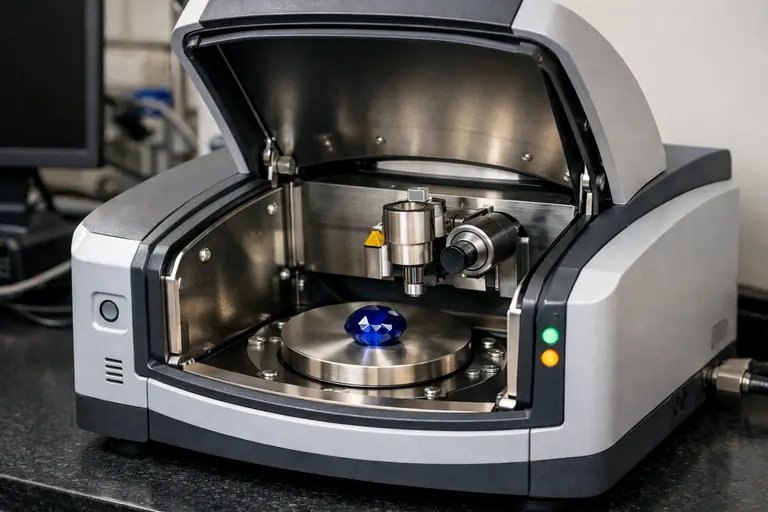
In simple terms, an EDXRF machine fires controlled X-rays at a gemstone. As a result, the atoms inside the stone release their own specific X-ray signals. Because every element—from iron to titanium—releases a unique energy pattern, scientists can identify exactly which elements are present in the gem’s structure. Therefore, the gemstone reveals its true chemical identity rather than just its outward appearance. You should also read our guide on gemstone buying mistakes to understand how combining science with market knowledge protects your assets.
The Mechanics of EDXRF Gemstone Testing
Think of this process as a high-speed conversation between X-rays and atoms. First, the spectrometer sends high-energy X-rays into the gemstone. Next, those X-rays knock electrons loose from atoms deep inside the crystal lattice. Then, other electrons rush in to fill those empty spaces. During this rapid movement, the stone emits fluorescent X-rays that the machine measures and records as data.
Analyzing Atomic Peaks in EDXRF Gem Analysis
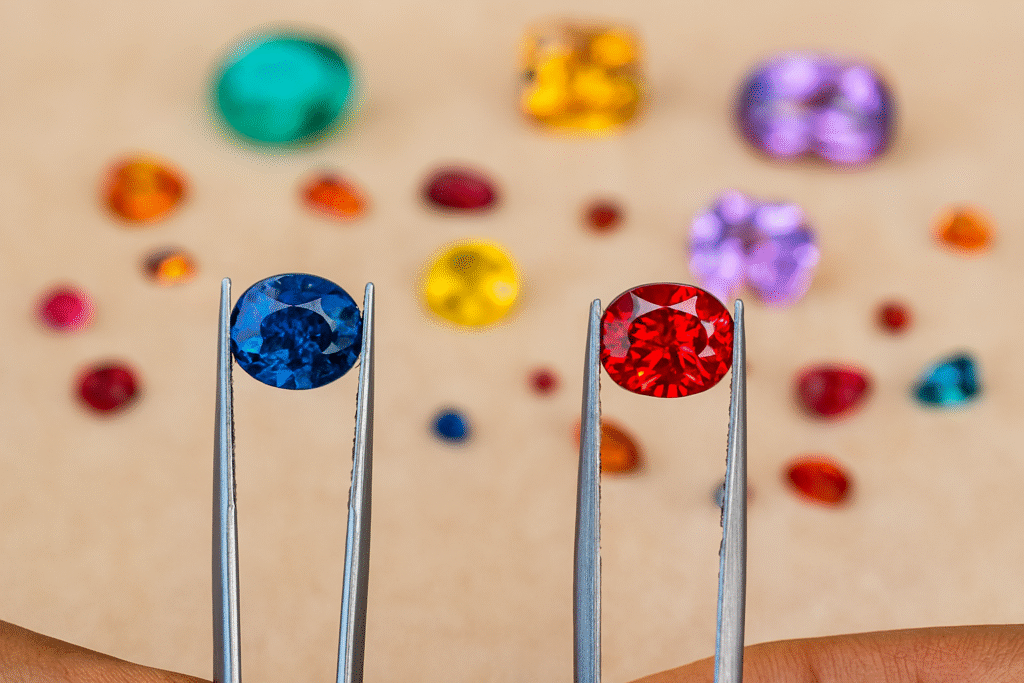
Each element produces a unique “peak” on the resulting digital readout. Consequently, scientists can identify what the stone consists of, right down to the microscopic trace elements. For example, a ruby and a blue sapphire are both made of the same base mineral: corundum (aluminum oxide). Nevertheless, tiny amounts of chromium turn the stone red, while iron and titanium create the classic blue. In other words, these microscopic impurities create the colors people pay thousands of dollars for. Furthermore, you can read more about X-ray fluorescence principles at Gems & Gemology.
Trace Element Analysis in EDXRF Gemstone Testing
Two gemstones can look almost identical on the surface; even so, their internal chemistry can tell completely different stories. This is precisely why EDXRF Gemstone Testing is so valuable for everyday buyers who cannot afford to be misled.
First and foremost, trace elements often reveal truths that visual inspection misses entirely. Chromium creates the vivid red in a ruby, while vanadium can influence the “cool” bluish-green in certain rare emeralds. Moreover, specific trace-element patterns can support geographic origin research. For instance, a ruby from Myanmar (Burma) often shows a different iron-to-gallium ratio than a ruby found in Mozambique. Consequently, chemistry acts as a geological passport. To explore the foundational science of these stones, visit the Gemological Institute of America.
Identifying Treatments with EDXRF Testing
Treatment detection remains one of the most practical benefits that EDXRF Gemstone Testing offers regular consumers in 2026. In fact, many gems currently on the market have undergone treatments to improve their appearance, and sellers do not always disclose this information.
For instance, “lead-glass-filled” rubies contain significant amounts of detectable lead (Pb). Because lead is a heavy element, the EDXRF machine catches it quickly and reliably. Similarly, unusually heavy elements can indicate the presence of surface coatings or fillers that significantly reduce a stone’s natural value. You may also read our article on Understanding BIS Hallmark to see how certification protects you from purity fraud in metals as well.
Detecting Synthetic Gems via EDXRF Methods
Modern synthetic gemstones can look almost identical to natural ones. As a result, even an experienced jeweler might struggle to tell them apart without instruments. Fortunately, EDXRF Gemstone Testing can help by detecting manufacturing residues. Many lab-growth processes, such as the “flux-growth” method, leave behind trace amounts of metals like platinum or molybdenum.
Still, identifying synthetic gems through this method alone is rarely definitive. Instead, gemologists combine elemental data with growth-structure analysis and luminescence studies for more reliable answers. Therefore, EDXRF works best as part of a complete identification toolkit. In practical terms, this means you benefit most when reputable labs use multiple scientific methods together rather than depending on just one instrument.
Non-Destructive Benefits of EDXRF Gemstone Testing
One of the greatest strengths of this technology is that it does not harm the gemstone at all. Unlike some older testing methods that required scratching or dissolving part of the stone, EDXRF Gemstone Testing examines gems safely. In addition, the testing typically takes only a few minutes. Because of this non-destructive advantage, major auction houses and international jewelry screeners use the technology consistently. For everyday owners, this matters enormously because it protects both the sentimental and financial value of a family heirloom while still providing the “Green” light of authenticity.
Limitations of EDXRF Gemstone Testing
Although the technology is powerful, it does not catch every possible treatment. First, EDXRF struggles with ultra-light elements such as lithium and beryllium. Consequently, it may miss “beryllium diffusion” treatments in sapphires, which are common in today’s market. Second, the machine primarily reads the surface and near-surface composition. Therefore, a very thick coating can sometimes hide what lies deeper inside the stone.
Because of these limitations, professional gemologists always pair the X-ray data with refractive index measurements and microscopic examination. Ultimately, EDXRF Gemstone Testing is a strong and reliable scientific voice—but it works best when it is part of a larger, well-rounded testing conversation.
FAQ: EDXRF Gemstone Testing
Is EDXRF Gemstone Testing safe for my jewelry?
Yes. It is a non-contact, non-destructive method. The X-rays do not change the color or structure of your stone, making it perfectly safe for high-value items.
Can EDXRF detect if my diamond is lab-grown?
While it can find trace elements used in some growth processes, gemologists usually use “Photoluminescence Spectroscopy” or specialized UV imaging for a definitive lab-grown diamond result.
Why is trace element analysis so important for rubies?
It helps determine if the stone was heated or filled with lead glass. Furthermore, it provides the chemical evidence needed to suggest a specific country of origin.
How long does a test take?
In a professional laboratory environment, the actual scan takes between two and ten minutes per stone, providing a very fast turnaround for the client.
Can I use EDXRF for gold testing as well?
Yes. In fact, many Indian jewelers and assaying centers use EDXRF to verify gold and silver purity alongside the mandatory HUID hallmark system.
Disclaimer
This article is for educational purposes only and does not replace professional gemological certification. Gemstone identification requires multiple testing methods to be 100% certain. Always consult a qualified gemological laboratory before making significant investment decisions. The author has no financial affiliation with any laboratory equipment manufacturers.