Introduction
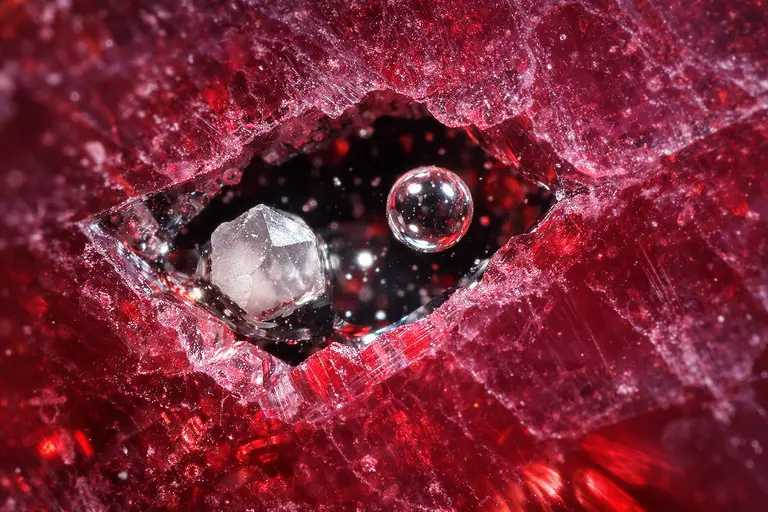
Most people admire a ruby solely for its deep, vivid red color. However, in 2026, savvy collectors realize that what lives inside the stone often tells a far more important story. A Three-Phase Ruby Inclusions specimen is essentially a microscopic cavity that holds three distinct things at once: a solid crystal, a liquid, and a gas bubble. Geologists frequently call these features “time capsules” because they form naturally during the ruby’s birth millions of years ago deep inside the Earth’s crust.
At first glance, a buyer might view these as a flaw or a blemish. In reality, however, these inclusions carry priceless information regarding where the ruby originated and whether humans later altered its structure. Furthermore, understanding this tiny feature helps everyday buyers make significantly smarter financial decisions. You should also read our guide on gemstone buying mistakes to understand how perfection in the gem world can sometimes hide a synthetic truth. Simply put, the smallest internal detail can hold the greatest evidence of value.
How Three-Phase Ruby Inclusions Form Naturally
First, it helps to understand the intense geological environment required to create these wonders. As a ruby grows under extreme heat and pressure, a tiny pocket of mineral-rich fluid sometimes becomes trapped inside the developing corundum crystal. Specifically, as the Earth’s crust cools over millions of years, the chemistry inside that trapped pocket begins to change.
Because the original fluid can no longer stay in one uniform state as temperatures shift, it separates into three parts. First, a solid “daughter” crystal—often a mineral like halite or sylvite—precipitates inside the cavity. Second, a liquid remains surrounding the new crystal. Finally, a gas bubble appears as the internal pressure drops. Consequently, this tiny cavity freezes a specific geological moment in time. In other words, think of it as a sealed message in a bottle. Instead of words, it carries the pressure, history, and temperature data of an ancient world. To explore the foundational science of these stones, visit the Gemological Institute of America.
Why “Perfect” Rubies Can Be Misleading
Next, we must consider a common misconception that often costs buyers thousands of dollars. Most people assume that a flawless, “eye-clean” ruby is automatically more valuable. However, this thinking can lead to dangerous errors in judgment. For instance, synthetic rubies produced in laboratories often appear remarkably clean and consistent under magnification.
Natural rubies, on the other hand, almost always contain internal features shaped by chaotic geological forces. Therefore, the presence of Three-Phase Ruby Inclusions actually supports a conclusion of natural origin. When a trained professional identifies these jagged, fluid-filled cavities, they gain a high degree of confidence that the stone is a product of nature. Of course, no single inclusion serves as absolute proof on its own. Instead, it acts as one vital clue within a larger scientific investigation. Consequently, buyers who understand this shift in mindset are far better equipped to avoid overpaying for lab-grown imitations.
Identifying the Components of the Cavity
Inside the microscopic cavity, each of the three phases tells a different part of the story. The liquid usually consists of saline water or liquid carbon dioxide. The gas bubble, which often moves when you tilt the stone, provides a visual record of pressure changes. The solid crystal often reveals the specific minerals present in the host rock where the ruby grew. In marble-hosted rubies from Vietnam or Myanmar, these daughter crystals might consist of native sulfur or diaspore. By studying these parts, gemologists can pinpoint the exact mine where the ruby was found.
Detecting Heat Treatment through Damaged Inclusions
Another critical lesson for any jewelry buyer involves the detection of human intervention. Currently, the vast majority of rubies in the commercial market undergo heat treatment to improve their color and remove cloudiness. In the gem trade, this practice is widely accepted as long as the seller discloses it clearly. However, aggressive heat treatment often destroys the delicate balance inside Three-Phase Ruby Inclusions.
Specifically, the damage occurs because gas bubbles expand and rupture when exposed to high temperatures. The trapped liquids may evaporate or leak through tiny tension cracks created by the heat. Furthermore, the jagged internal walls of the cavity might begin to melt and round out, losing their natural, angular appearance. As a result, a well-preserved, sharp-edged three-phase inclusion suggests that the ruby’s natural internal structure remains largely intact. For buyers who prioritize “unheated” stones, this microscopic detail is worth a fortune. You can find more information on treatment standards at the GemResearch Swisslab.
Why Documentation is Still Essential
Additionally, you should avoid over-relying on a single visual clue. Although fluid inclusions provide excellent evidence, professional laboratories utilize much more advanced tools to reach a final verdict. Specifically, they use Raman spectroscopy and trace element analysis to verify the results of the microscopic exam.
Moreover, no reputable gemologist bases a final judgment on one inclusion alone. Instead, they look for a combination of features, such as “silk” needles, color zoning, and chemical fingerprints. Consequently, you should always request a certified report from a reputable laboratory like GIA or Gübelin before making a high-value purchase. Because a certification combines multiple lines of evidence into one trustworthy document, it remains the most reliable tool for the 99% of buyers. In summary, inclusions open the door to the truth, but official certification closes the deal with certainty.
FAQ: Three-Phase Ruby Inclusions
What is a three-phase inclusion in a ruby?
It is a microscopic, fluid-filled cavity that contains a solid crystal, a liquid, and a gas bubble all at once. It forms during the natural growth of the gemstone.
Are these inclusions common in all rubies?
No, they are relatively rare. While they are a famous “signature” of Colombian emeralds, they only appear in certain rubies, typically those found in marble-hosted deposits like those in Myanmar and Vietnam.
Does a three-phase inclusion prove a ruby is unheated?
If the inclusion is sharp, angular, and the gas bubble is intact, it is a very strong indicator that the stone has not been subjected to high-heat treatment.
Can I see these inclusions with my naked eye?
Generally, no. You typically need a 10x jeweler’s loupe or a gemological microscope to identify the three distinct phases inside the cavity.
Why do they increase the value of a ruby?
They prove natural origin and often suggest a lack of heat treatment. In the 2026 market, “completely natural” stones command a significant price premium over treated or synthetic ones.
Disclaimer
This article serves general educational purposes only and reflects gemological practices as of May 2026. It does not replace professional laboratory certification. Always verify a ruby’s authenticity and treatment history through a qualified lab before purchasing. The author holds no financial affiliation with the labs mentioned.