
Introduction to Colored Stone Grading
Colored stone grading serves as a vital language in gemology, enabling buyers and sellers to communicate quality effectively. However, unlike the straightforward D-to-Z scale for diamonds, the world of colored gems lacks universality, linearity, and full objectivity. Instead, multiple systems from labs like GIA blend standardized terms with expert judgment, introducing nuance and subjectivity.
For South Indian markets—which favor vivid Rubies (Kempu) and Emeralds for astrology—understanding this process is the key to building trust. In this guide, we will explore how grading works, why it is an art as much as a science, and practical tips for confident purchases.
How Colored Stone Grading Works
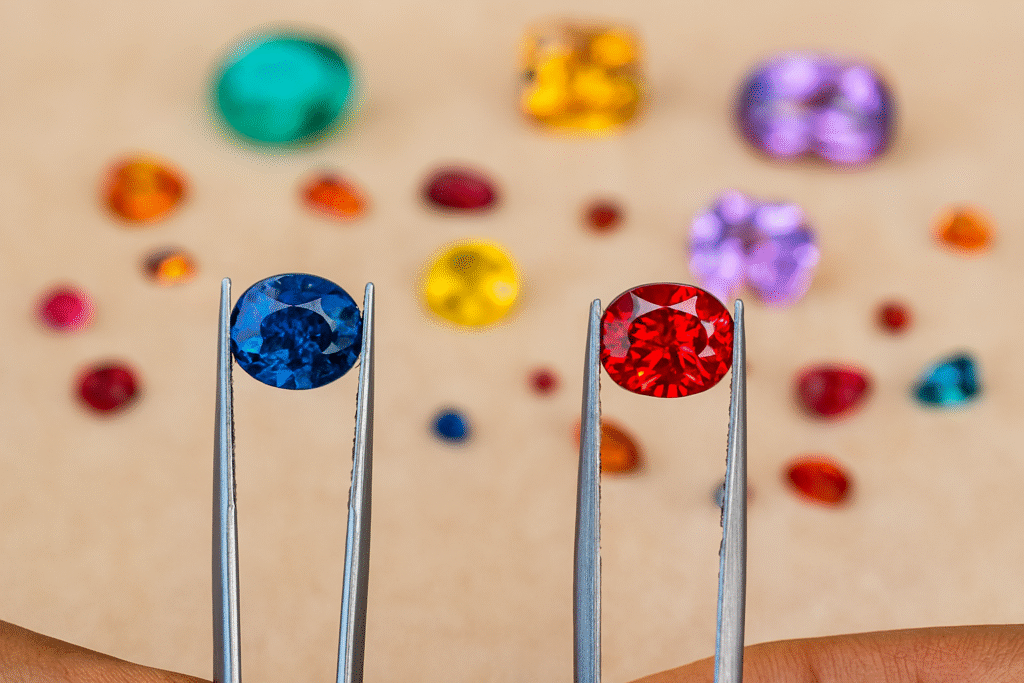
To begin with, grading colored gems focuses on the presence and quality of color, reversing diamond standards that measure color absence. Primarily, experts assess three specific factors:
- Hue: The main color (e.g., Blue in Sapphires), often with secondary modifiers (e.g., Violetish-Blue).
- Tone: This gauges lightness or darkness, ranging from “Colorless” to “Black.”
- Saturation: This rates intensity, from “Grayish/Brownish” to “Vivid.”
In addition, factors like clarity, cut, and carat weight matter, but in colored stones, Color is King. For example, a smaller, vivid Burmese Ruby can outweigh a larger, duller stone in value. You can read more about how origin affects value in my guide on Kempu Ruby: Tamil Nadu vs Kerala.
According to GIA’s Colored Stone System, these elements create a descriptive profile rather than a single grade. Furthermore, while tools like standardized lighting ensure consistency, human perception still plays a key role. Consequently, top-tier reports detail these traits photographically to ensure transparency.
Colored Stone Grading Challenges: The Human Element
Despite structured approaches, limitations persist in the trade. First, no single global standard exists. Organizations like CIBJO and Gemworld International use varying terms. What one lab calls “Vivid,” another might call “Fancy Intense.” This lack of uniformity can hinder direct comparisons.
Moreover, subjectivity arises in visual assessments. Light sources, viewing angles, and optical traits like Pleochroism (e.g., a Tanzanite shifting from blue to violet) cause variations. As a result, even experts may differ slightly in their descriptions. This emphasizes that gemology is a blend of Art and Science.
In addition, natural uniqueness complicates matters. Unlike diamonds, where inclusions are seen as flaws, in colored stones, they are often welcomed. For instance, the “Silk” inclusions in Kashmir Sapphires create a velvety glow that actually boosts value.
Colored Stone Grading, Origin, and Treatments
Origin and treatments add critical layers to the grading process. Provenance is powerful. A “Colombian” Emerald signals prestige, just as a “Burmese” Ruby does. However, enhancements—such as heat treatment for Rubies/Sapphires or oiling for Emeralds—must be disclosed per FTC Guidelines.
Therefore, full lab reports act as “passports,” noting these factors. In South India, where families buy gems for investment alongside gold, understanding treatments ensures ethical buys. If you are worried about buying fake or heavily treated stones, check my Gemstone Buying Mistakes to Avoid.
Why Reputable Lab Reports Matter in Colored Stone Grading
Labs like GIA, IGI, and GII provide reliable descriptions with photos and protocols, fostering market confidence. Thus, they bridge the gap between the expert’s eye and the buyer’s wallet.
Recently, GIA announced major updates to its reporting services for 2026, including new origin reports for Opals and Peridots. You can read the full news in my update: GIA Origin Reports 2026.
Ultimately, grading establishes a shared language. But remember: No piece of paper can predict the exact market price, much like a wine appraisal. Purchases demand expertise, trust, and personal taste. As standardization advances, colored gems retain their poetic variability.
Colored Stone Grading FAQ
What is the main difference between colored stone and diamond grading?
Colored stone grading emphasizes color presence (hue, tone, saturation), while diamond grading measures color absence (D-Z scale). In colored gems, beauty (Color) trumps perfection (Clarity).
Are inclusions bad in colored stones?
No. Inclusions are often tolerated or even desirable—like “silk” in Sapphires or “horsetails” in Demantoid Garnets—unlike diamonds, where clarity is stricter.
Do all labs grade colored stones the same way?
No. Systems vary (e.g., GIA vs. CIBJO). Therefore, it is essential to carefully compare reports and prioritize reputable sources, such as GIA or IGI.
How do treatments affect colored stone value?
Treatments must be disclosed. While minor traditional treatments (like heating) are common, undisclosed significant treatments (like glass filling) drastically reduce value.
Why is origin important in grading?
It influences prestige and price. For example, a Ruby from Burma commands a premium over a Ruby from Mozambique due to historical rarity, even if they look similar.
Author Bio
P.J. Joseph, also known as Saju Elizamma, Gemstone & Gold Consultant serving Kerala, Tamil Nadu, and Karnataka.