Summary
Wishful thinking in gem identification can mislead even skilled buyers. This article explains how confirmation bias causes costly errors and offers practical steps to stay objective when testing gemstones.
Introduction
Wishful thinking in gem identification can quietly distort your judgment.
When you want a gemstone to be valuable, your mind filters out clues that say otherwise.
This mental bias—known as confirmation bias—makes you believe what you hope is true instead of what your tools reveal.
Recognizing this bias early protects your credibility, accuracy, and profit in the gem trade.
Why Wishful Thinking Is Dangerous in Gem Identification
In gem testing, emotion often competes with evidence.
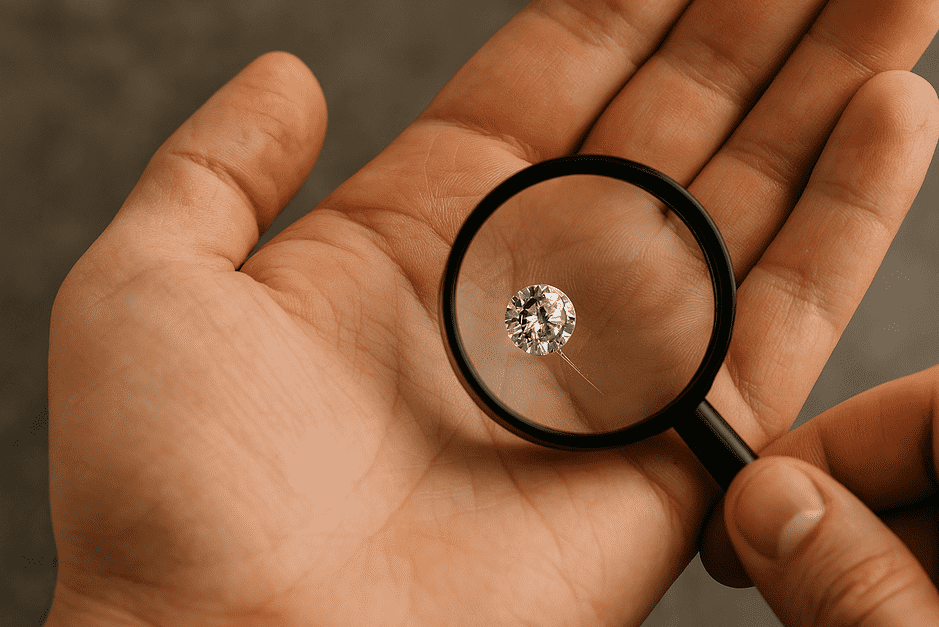
You may look through the loupe and see what you want to see.
That’s how confirmation bias shapes interpretation and leads to misidentification.
When bias replaces observation, your conclusions lose reliability.
Common Examples in Gem Testing
- Believing every green stone must be emerald
- Assuming a strong sparkle means diamond
- Treating an inclusion as proof of natural origin
- Ignoring synthetic growth features
- Expecting an heirloom to be valuable just because it’s old
These errors come from wishful thinking in gem identification and can cause serious financial loss.
The Cost of Ignoring Evidence
If you let emotions guide your work, you risk:
- Overpaying for imitation or treated stones
- Missing synthetic indicators
- Passing false information to clients
- Losing credibility as a gem expert
Each mistake weakens your reputation. Accuracy builds trust.
How to Avoid the Trap
- Ask: What evidence goes against my belief?
- Use more than one testing method—refractometer, spectroscope, microscope.
- Keep written records of every observation.
- Get an independent opinion from another gemologist.
- Take time to analyze results before making a claim.
To strengthen your testing skills, read How to Use a Spectroscope in Gemology
Also, visit the Gemological Institute of America (GIA) and Gem-A Learning Hub for professional references and study material.
Recognizing Bias Early
When identifying a gemstone, pause and look for details that disagree with your first impression.
That habit keeps your analysis grounded and prevents costly misjudgments.
A Question for You
When you last identified a gem, did you search for evidence against your initial thought?
That single step can save your money and your reputation.
FAQ
Q1: What is wishful thinking in gemology?
It’s the tendency to believe a gemstone is valuable based on desire rather than evidence.
Q2: How does confirmation bias affect gem testing?
You focus on details that support your hopes and ignore clues that contradict them.
Q3: How can I avoid bias during identification?
Use multiple testing tools, write down all findings, and ask another gemologist for a second opinion.

- Easy Use – Turn on, wait for heating up ready, hold(finger on heat-conducting plate), use the probe to make 90-degree co…
- Intuitive Design – Sound beep and LED lights straightforwardly indicates test result(beep & light: diamond, continuous b…
- Good Material – It is made of solid durable ABS housing, high sensitivity alloy probe, rubber protective cap, well heat-…