Introduction to India’s Jewellery Makers 2050
The landscape for India’s Jewellery Makers in 2050 is changing much faster than early industry analysts expected. In fact, over the next 25 years, the primary question will no longer be “What will people wear?” but rather “Who will actually make it—and how?” Today, organized brands, tech-driven startups, and re-skilled traditional artisans are all stepping onto the same high-tech stage. Together, they are building a future where human intuition and intelligent machines work side by side. Most importantly, this future intends to serve the everyday middle-class buyer with unprecedented precision. You should also read our guide on gemstone buying mistakes to understand how quality standards remain vital even in a world dominated by high-tech manufacturing.
Organized Retail and India’s Jewellery Makers 2050
For several decades, small family-run jewellers dominated local markets across the subcontinent. However, this balance is now shifting steadily toward larger, organized players. Organized retail has grown significantly, and experts project it will capture nearly half of the market by 2029.
Brands like Tanishq and Malabar Gold have already become trusted household names. They invest heavily in hallmarking and certification, which builds immense confidence among first-time buyers. Meanwhile, digital-first players like BlueStone and CaratLane focus on lightweight designs and online customization. As a result, more young buyers in Tier-2 and Tier-3 cities are moving their budgets toward branded showrooms. Consequently, the industry is becoming more transparent and standardized than ever before. To learn more about current retail data, you can visit the India Brand Equity Foundation (IBEF).
Tech Innovation for India’s Jewellery Makers 2050
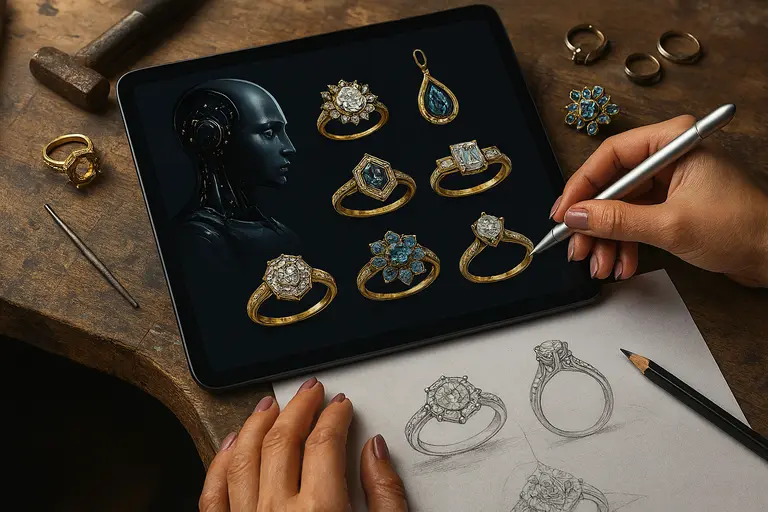
Traditionally, jewellery designs moved from a hand-drawn sketchbook to the workbench through manual labor. Today, that journey passes through sophisticated software and high-speed machines. Design teams now utilize AI-assisted tools to generate and refine complex motifs within seconds. Specifically, AI reduces development time by learning directly from global sales trends. Therefore, brands can launch dozens of new collections each year with minimal trial and error.
Robotic Precision for Jewellery Makers 2050
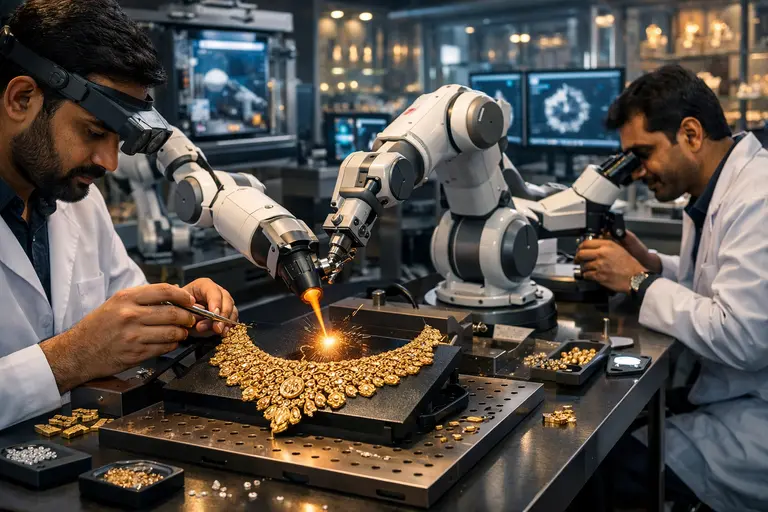
Following the design phase, 3D printing and robotic assembly are introduced into the process. Instead of carving every wax model by hand, India’s Jewellery Makers in 2050 will print final parts using direct metal laser sintering. Because modern printers work at resolutions below 50 microns, they produce intricate “jali” and temple patterns with flawless accuracy. Consequently, complex bridal designs are no longer reserved for the elite; they are becoming accessible in mid-priced collections. This digital workflow also reduces precious metal waste, making the entire production cycle more sustainable for the planet.
Diamond Trends for India’s Jewellery Makers 2050
While gold remains the favorite metal for most Indians, the gemstone landscape is shifting toward the laboratory. Above all, lab-grown diamonds (LGDs) are emerging as a massive market force. In 2023, India produced over three million of these stones, accounting for a significant share of global output.
From a consumer’s perspective, LGDs offer extraordinary value. They carry the same physical and chemical properties as mined diamonds but cost significantly less. Furthermore, more brands are now launching LGD engagement rings targeted specifically at budget-conscious urban youth. Therefore, within the next 25 years, shoppers may be able to routinely choose between mined and lab-grown stones based on their personal ethics. You can explore the scientific standards for these stones at the Gemological Institute of America.
Buying Journeys from India’s Jewellery Makers 2050
Alongside the manufacturing revolution, the way people buy jewellery is also evolving. Customers now discover new designs on social media and test them virtually using Augmented Reality (AR) tools. As these tools improve, virtual try-on will become a mandatory part of the buying journey.
Because digital previews reduce the need for massive physical inventory, many brands are experimenting with leaner models. A buyer confirms a design online, and the piece is then manufactured on demand using robotic 3D printing. As a result, retailers can offer massive catalogues without locking up capital in unsold stock. Additionally, categories such as men’s jewellery and gender-neutral minimalist pieces are expanding rapidly. Consequently, the market is becoming more inclusive and diverse than at any point in history.
Re-skilling India’s Jewellery Makers 2050
Behind the high-tech shine, the industry faces a real human challenge. Many traditional workshops struggle to attract younger artisans. However, technology is increasingly becoming part of the solution rather than the problem. As factories adopt automated processes, new roles are appearing in CAD design and robotic quality control.
With proper training, traditional “karigars” can move into these hybrid roles and earn significantly higher wages. Therefore, India’s Jewellery Makers in 2050 will be skilled teams that blend ancestral hand-finishing with fluency in digital tools. In short, the artisan of the future will not disappear; they will simply upgrade their skills to master the machines. For further reading on skill development, check out our guide on Understanding BIS Hallmark and how it impacts modern manufacturing standards.
FAQ: Understanding India’s Jewellery Makers 2050
Will small family jewellers disappear completely by 2050?
No. Many will survive by specializing in high-trust local repairs and bespoke custom work that requires a personal touch. However, they will likely use shared digital manufacturing hubs to stay competitive with larger brands.
Are lab-grown diamonds considered “real” diamonds in 2050?
Yes. They are chemically, physically, and optically identical to mined diamonds. The industry has fully integrated them, though they must always be disclosed to the buyer.
Will AI robots make jewellery cheaper for the average Indian buyer?
Yes. Automation and 3D printing reduce labor costs and material waste. Consequently, high-quality, intricate designs will become more affordable for middle-class consumers.
How will 3D printing affect traditional Indian styles like Kundan?
Artisans will use 3D printing to create the complex base frames (ghat). Then, they will hand-set the stones and apply the enamel. This hybrid approach preserves the “soul” of the craft while increasing production speed.
Is men’s jewellery a significant part of the future market?
Absolutely. Men’s jewellery is currently one of the fastest-growing segments. By 2050, it is expected to be a major retail pillar alongside traditional bridal wear.
Disclaimer
This article reflects current data and reasonable industry projections from sources including IBEF, Wazir Advisors, iNDEXTb, sector reports, and market research as of 2024–2026. Actual outcomes may vary due to economic, regulatory, technological, and cultural changes. This content is for general information purposes only and does not constitute financial, investment, or purchase advice.