Introduction to Sambar Colour and Gemstones
Sambar looks remarkably different depending on where you prepare it. One bowl might glow with a bright, fiery red, while another appears as a deep rust-brown or muted chestnut. These distinct colour differences tell a real regional story across the four states of South India. Because this dish covers such a wide visual range, comparing Sambar Colour and Gemstones provides a simple and practical way to understand these culinary variations.
You do not need to possess expert knowledge about minerals or cooking science to appreciate this guide. Instead, think of this as a visual framework that connects everyday food with familiar gemstone hues. Among all minerals, carnelian comes closest to the general palette of this dish. However, specific regional styles often match other stones more precisely, such as sard, spessartine garnet, or Tiger’s Eye. You should also read our guide on gemstone buying mistakes to understand how light and saturation affect your perception of both gems and gourmet food.
Factors Influencing Sambar Colour and Gemstones
Sambar obtains its unique colour from the specific ingredients and the exact cooking method utilized, rather than from a single fixed recipe. First, the quantity of tamarind builds significant visual depth. When a cook adds more tamarind pulp, the gravy often turns darker and shifts toward reddish-brown or brown-red tones.
Next, the specific choice of dried chilli shapes the overall saturation. Different chillies deepen or brighten the gravy depending on their natural capsanthin pigment and heat levels. In addition, the roasting process changes everything. When a chef roasts spices or coconut for a longer duration, the golden tones shift toward chestnut or dark brown. Finally, the choice of cooking fat—such as sesame oil, coconut oil, or ghee—subtly affects the final luster and translucency. Consequently, there is no single “correct” shade. Instead, there is a full regional spectrum that mirrors various gemstones. To see the scientific breakdown of South Indian ingredients, you can explore South Indian cuisine on Wikipedia.
Tamil Nadu Styles in Sambar Colour and Gemstones
Tamil Nadu sambar covers several distinct styles, so it does not possess one fixed shade. Most everyday Tamil versions appear as a medium orange-brown. However, tamarind-heavy styles, such as Arachuvitta sambar, develop much deeper rust-red or reddish-brown tones.
For this reason, the gemstone “sard” often becomes the best comparison for a traditional Tamil preparation. Sard is the darker, brownish-red variety of the chalcedony family. It closely mirrors the richness of concentrated tamarind. Furthermore, almandine garnet can suit richer Tamil versions because of its deep, intense red colour. Although almandine often leans toward purplish-red, it still reflects the intensity of a deeply spiced Madurai or Chennai preparation. On the other hand, lighter homemade versions align better with red aventurine. In short, the Tamil style ranges from warm orange-brown to deep sard-like tones depending on the spice blend. For more on these mineral variations, visit the Gemological Institute of America.
Karnataka Varieties and Gemstone Sambar Hues
Karnataka and Udupi sambars tend to look deep and vivid, creating a striking visual impact on the plate. In these classic versions, cooks typically use Byadgi chillies, turmeric, lentils, and jaggery together. Byadgi chillies contribute intense red tones rather than bright orange. They achieve this because they carry a rich natural pigment despite having a relatively mild heat level.
Moreover, the addition of turmeric provides a warm, golden undertone that noticeably lifts the overall colour. Because of this specific combination, dark carnelian often becomes the strongest gemstone comparison for Karnataka sambars. Additionally, spessartine garnet can resemble some richer Udupi styles, particularly when the stone shows warmer orange-to-red “mandarin” flashes. Furthermore, the inclusion of jaggery adds a glossy, syrupy finish to the gravy. This effect mimics the “vitreous” luster of a high-quality gemstone. You may also read our article on Understanding BIS Hallmark to see how purity and quality standards apply to the vessels used in serving these traditional feasts.
Kerala Varutharacha in the Sambar Colour Guide
Kerala sambar falls into two distinct visual categories, and most observers overlook this distinction. Standard Kerala home-style sambar appears orange-brown or reddish-brown, mirroring the palettes of neighboring states. However, Varutharacha sambar looks dramatically different. This happens because cooks stir in a deeply roasted, ground coconut paste at the final stage.
When coconut browns during the roasting process, the entire dish shifts toward a dark, earthy brown or chestnut hue. Consequently, Tiger’s Eye becomes the most powerful visual comparison for Varutharacha Sambar. Tiger’s Eye displays layered golden-brown and chestnut tones that reflect the roasted coconut character perfectly. Likewise, fire agate can reflect the deeper, darker tones of this specific Kerala style. Therefore, you should always view Kerala preparations in these two separate gemstone categories to identify them correctly.
Carnelian as the Best Sambar and Gemstone Match
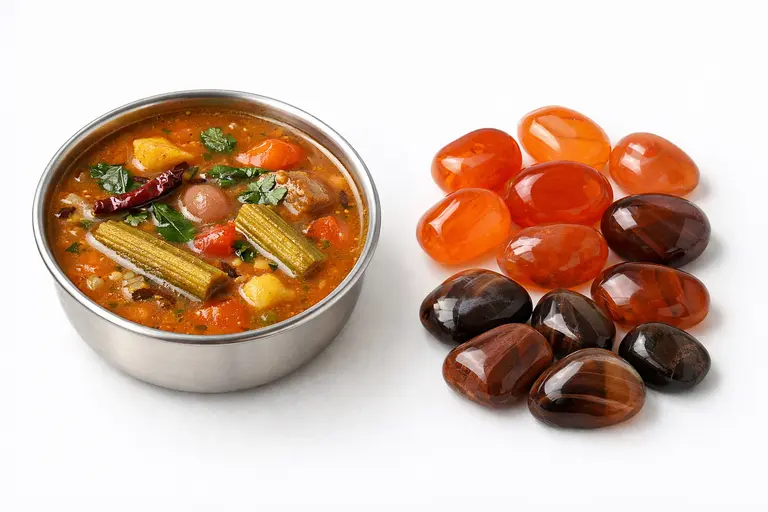
For broad comparisons across all states, carnelian remains the most versatile visual match for Sambar Colour and Gemstones. Carnelian naturally spans a massive range, from pale translucent orange to fiery red-orange and dark brownish-red. Because of this wide natural spectrum, it covers the majority of sambar styles comfortably.
For example, lighter carnelian matches the turmeric-bright styles found in Brahmin households. Darker, sard-toned carnelian suits the tamarind-rich preparations of the Tamil heartland. However, carnelian does not always provide the single closest match for every specific bowl. For the darkest Kerala versions, Tiger’s Eye or brown jasper appears far more realistic. In summary, carnelian works best as the all-around comparison, while other stones provide the regional nuance.
FAQ: Sambar Colour and Gemstones
Which gemstone best matches traditional sambar overall?
Red-orange to brown-red carnelian usually offers the closest overall match. This is because its natural variety mirrors the different spice and tamarind levels found in South Indian kitchens.
Why does Udupi sambar have such a deep red colour?
The use of Byadgi chillies is the primary reason. These chillies are famous for their deep red colour and low heat, which gives the gravy its Spessartine-like glow.
How does tamarind affect the gemstone comparison?
More tamarind pushes the colour from a light orange (Carnelian) toward a dark, earthy brownish-red (Sard or Jasper). Therefore, the “age” and concentration of tamarind are vital factors.
What stone matches Kerala’s roasted coconut sambar?
Tiger’s Eye is the best match. Its golden-brown bands perfectly resemble the texture and tone of the Varutharacha (roasted coconut) paste.
Does the choice of oil change the gemstone match?
Yes. Ghee creates a bright, reflective surface similar to a sunstone, while sesame oil adds a darker, richer finish that leans toward sard.
Disclaimer
This article uses gemstones as visual tools to describe regional Sambar Colour and Gemstones in a simple and relatable way. Because spice blends, roasting depth, and household recipes vary widely across South India, actual colours may differ from these descriptions. These gemstone comparisons serve as descriptive references rather than scientific standards. The author has no financial affiliation with the institutions linked.