Introduction
In the hierarchy of watches, there is luxury, and then there is Richard Mille. While Rolex is a symbol of success, Richard Mille is a symbol of “I have so much money I don’t care about tradition.” The Richard Mille Business Model has revolutionized the industry by doing the exact opposite of what a watch brand “should” do.
Unlike traditional brands that emphasize gold weight and history, this company thrives on extreme lightness and futurism. For instance, it produces only about 5,000 to 5,300 watches each year. Moreover, the average price exceeds $200,000. Therefore, demand far outstrips supply, creating a cult-like following among the global elite. In this article, I will explore the pillars of this strategy. As an expert in luxury assets, I will explain why a watch made of “plastic” (Carbon) costs more than a house.
Artificial Scarcity in the Richard Mille Business Model
First and foremost, artificial scarcity forms the cornerstone of the Richard Mille Business Model. Traditional luxury brands produce hundreds of thousands of units. In contrast, Richard Mille deliberately limits output. As a result, each watch becomes a rare collector’s item.
This strategy elevates the brand’s prestige. For example, limited editions often sell out before they are even announced publicly. Moreover, this scarcity builds long-term value. Buyers often wait 3-4 years on backorder lists. Consequently, resale prices frequently surpass retail costs. According to industry reports, some models appreciate by 50% or more within years. You can compare this supply/demand curve to the Patek Philippe Business Model.
“A Racing Machine on the Wrist”
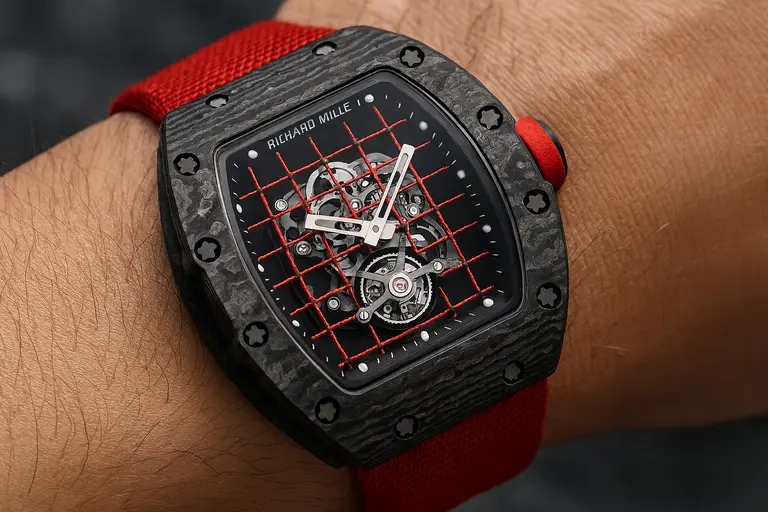
Next, let’s look at the product philosophy. Richard Mille famously calls his watches “A Racing Machine on the Wrist.” This means prioritizing performance over fragility. For example, they use aerospace-grade materials like Carbon TPT, Grade 5 Titanium, and Graphene.
As a Gemologist, I find this fascinating. Traditionally, luxury meant “Gold and Diamonds.” However, Richard Mille proved that “Lightness” is the ultimate luxury. Some models weigh less than 40 grams (including the strap). Therefore, they endure extreme conditions—from Formula 1 races (Charles Leclerc) to tennis Grand Slams (Rafael Nadal). If you want to know about traditional luxury materials, check my guide on Synthetic Sapphire in Watches.
Marketing the Richard Mille Business Model
Furthermore, the brand has mastered the art of visibility. A Richard Mille watch is recognizable from 50 feet away due to its Tonneau (barrel) shape. Consequently, it acts as a “Billionaire’s Handshake.” When two people meet and see the watch, they instantly know they belong to the same elite club.
Strategic partnerships amplify this. Rather than generic sponsorships, the brand collaborates directly with athletes who wear the watch while playing. For instance, Rafael Nadal smashed a tennis ball at 100mph while wearing a $1 Million Tourbillon. This real-world exposure proves resilience. It is the ultimate “Torture Test.”
Vertical Integration and Quality
Besides marketing, vertical integration underpins operational strength. Richard Mille controls research, development, and manufacturing in-house (often via their factory, ProArt). This ensures unwavering quality. For example, the process discards about 40% of pieces that fail exacting standards. Therefore, only flawless watches reach boutiques.
Additionally, this model fosters innovation. Proprietary movements and materials emerge from dedicated labs. In turn, the brand stays ahead of competitors like Hublot, which also uses fusion materials. Moreover, as a privately owned entity, Richard Mille ignores conglomerate pressures for volume. Instead, it pursues high-margin, low-volume hyper-luxury.
Retail Strategy of the Richard Mille Business Model
Crucially, the Richard Mille Business Model relies on a Direct-to-Consumer (DTC) approach. Initially, the brand relied on third-party dealers. However, it shifted to owning its boutiques worldwide. This change allows complete control over the customer experience.
Furthermore, DTC maximizes profit margins. By eliminating middlemen, Richard Mille retains the full retail revenue (which is massive on a $300,000 watch). In India, you see this exclusivity. There are no “dealers”; you must go through official channels, often waiting years for an allocation.
Conclusion on the Richard Mille Business Model
Ultimately, Richard Mille is not selling time. We have iPhones for that. Richard Mille is selling entry into the world’s most exclusive club. By combining the scarcity of Kashmiri Saffron and Padparadscha with the technology of F1 cars, they have created the ultimate status symbol for the 21st century.
In summary, love them or hate them, you cannot ignore them.
FAQ: Richard Mille Business Model
How many watches does Richard Mille produce yearly?
Richard Mille crafts around 5,000 to 5,300 watches annually. This extremely low number is intentional to maintain the “Hyper-Luxury” status of the Richard Mille Business Model.
Why is the Richard Mille Business Model expensive?
Primarily due to R&D costs, material science (Carbon/Titanium), and the high failure rate in manufacturing complex parts. Also, the brand positioning demands a high price to ensure exclusivity.
What materials define Richard Mille?
They feature high-tech options like Carbon TPT, Quartz TPT, and Ceramic. These make the watches ultra-lightweight and shock-resistant.
Does Richard Mille own its retail stores?
Yes. The DTC (Direct-to-Consumer) boutique strategy ensures personalized experiences and allows the brand to control who buys the watches (vetting clients).
Is it a good investment?
Historically, yes. Due to the massive gap between supply and demand, many models trade on the secondary market for significantly more than their retail price.
Author Bio
P.J. Joseph, also known as Saju Elizamma, Gemstone & Gold Consultant serving Kerala, Tamil Nadu, and Karnataka.