Introduction
In the mineral kingdom, names can be deceiving. Rhodochrosite vs Rhodonite are two of the most visually striking pink gemstones in the world. Both stones draw their names from the Greek word Rhodon, meaning “Rose.” Furthermore, both owe their warm, rosy hues to the presence of the element Manganese.
As a result, they are frequently confused with one another in jewelry markets and gemstone collections alike. However, despite their surface-level similarities, they are fundamentally different minerals with distinct compositions, hardness levels, and color patterns. As a Gemologist, I see one as a delicate “carbonate” and the other as a durable “silicate.” In this guide, we will explore these differences, the legend of the “Inca Rose,” and practical tips for collectors. Ultimately, understanding these nuances protects you from making a costly mistake.
Similarities of Rhodochrosite vs Rhodonite
To begin with, let’s look at the shared traits. Fundamentally, both belong to the Manganese mineral family. This shared chemistry gives each stone its characteristic pink-to-red coloration. Beyond their color, the two gems share several other notable qualities.
For instance, both stones display a Vitreous (glassy) to Pearly luster. Additionally, both are commonly found in massive forms suitable for carving. In the realm of Gemstone Therapy, both stones are associated with the Heart Chakra, symbolizing love, compassion, and emotional healing. Thus, spiritually, they serve similar purposes, even if geologically they are strangers.
Origins of Rhodochrosite vs Rhodonite
Understanding where a stone is born helps us understand its nature.
Rhodochrosite: The Hydrothermal Rose
Technically, Rhodochrosite is a Manganese Carbonate mineral. Primarily, it forms through hydrothermal processes in low-temperature ore deposits (often silver mines). Miners most famously source it from Argentina, where it develops in striking concentric banded formations known as “Inca Rose” (Rosa del Inca). Legend says these stones are the solidified blood of ancient Incan rulers. Furthermore, Colorado, in the United States (specifically the Sweet Home Mine), produces the world’s finest transparent, deep-red crystals. These are so rare that they rival Kashmiri Saffron and Padparadscha in value.
Rhodonite: The Metamorphic Rock
On the other hand, Rhodonite is a Manganese Silicate. It forms within manganese-rich metamorphic rocks under high heat and pressure. Its primary sources include Russia, where large decorative blocks were historically used to build pillars for the czars. Additionally, other significant sources include Australia, Brazil, and Sweden. Because Rhodonite forms under tougher conditions, it is physically tougher than its carbonate cousin.
Color Patterns: The Key Visual Difference
One of the most reliable ways to tell Rhodochrosite vs Rhodonite apart is by examining their “Inclusions.”
Rhodonite: The Black Veins
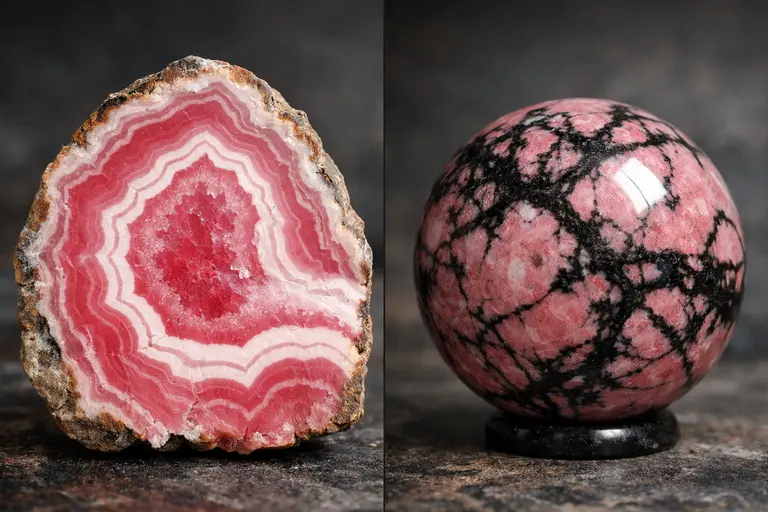
Typically, Rhodonite displays a rose-pink to deep-red body color accented by distinctive Black Dendritic Veins or spots. Manganese Oxide causes these dark markings. Consequently, Rhodonite has a bold, earthy aesthetic. It looks like pink marble with black cracks. If you like dendritic patterns, compare this to Moss Agate and Cabbage Thoran.
Rhodochrosite: The White Swirls
In contrast, Rhodochrosite features vibrant red or pink tones with White, Cream, or Pale Pink Banding. Importantly, it rarely shows black markings. Therefore, a quick look at the veining pattern alone resolves the mystery:
- Black Veins = Rhodonite.
- White Swirls = Rhodochrosite.
Identifying Rhodochrosite vs Rhodonite
In addition to visual inspection, practical tests help distinguish them.
First, the Hardness Test is highly effective.
- Rhodonite: Mohs hardness of 5.5 to 6.5. It can scratch window glass.
- Rhodochrosite: Much softer at 3.5 to 4. It cannot scratch glass, but it can be scratched by a copper coin. Consequently, this difference is crucial for jewelry durability.
Second, the Acid Test provides a definitive distinction. Because Rhodochrosite is a carbonate (like Calcite or Pearls), it will effervesce (fizz) when touched with warm, diluted hydrochloric acid. Rhodonite, being a silicate, does not react. As an expert, I advise against doing the acid test on finished jewelry, as it will damage the polish!
Jewelry Uses for Rhodochrosite vs Rhodonite
The hardness difference dictates how you should wear them.
Rhodochrosite in Jewelry
Due to its low hardness and perfect cleavage, Rhodochrosite is fragile. Ideally, it is best suited for Pendants and Earrings that do not suffer impact. Lapidaries often facet high-quality transparent red crystals for collectors, but they are too soft for daily rings. Treat it with the same care you would give Thewa Jewelry (glass) or Ammolite Gemstone.
Rhodonite in Jewelry
By contrast, Rhodonite offers greater durability. It is popular in Beaded Bracelets and carvings. Its earthy appearance pairs beautifully with Silver or oxidized metal for a “Boho” look. Therefore, if you want a pink stone ring for daily wear, Rhodonite is the safer choice.
Consumer Tips: Buying Smart
When shopping, follow these guidelines.
- Check the Veins: Pink with Black? It’s likely Rhodonite. Pink with White? It’s likely Rhodochrosite.
- Price: Transparent red Rhodochrosite is an Investment Grade gem ($1000+ per carat). Opaque Rhodochrosite is a craft material ($10-50 per carat).
- Provenance: Ask if the Rhodochrosite is “Sweet Home Mine” (USA) or “Capillitas“ (Argentina). The former is for gem investors; the latter is for lapidary art.
Finally, store Rhodochrosite separately. Since it is soft (Mohs 4), harder stones like Quartz (Mohs 7) or Diamond (Mohs 10) will scratch it instantly in a jewelry box.
Conclusion: The Rose of the Inca vs. The Rose of Russia
In summary, the comparison of Rhodochrosite vs Rhodonite reveals two different expressions of nature’s “Rose.” One is soft, banded, and associated with the Incas. The other is hard, veined, and associated with the Russians. Ultimately, both are beautiful. Just make sure you pay the right price for the right stone.
FAQ: Rhodochrosite vs Rhodonite
Is Rhodonite or Rhodochrosite harder?
Rhodonite is harder. It has a Mohs hardness of 5.5 to 6.5, making it durable enough for beads and carvings. Rhodochrosite is soft (3.5 to 4) and fragile.
How can I tell them apart at home?
Look at the patterns. Rhodonite almost always has Black veins (Manganese Oxide). Rhodochrosite has White zigzag bands (Carbonate layers).
Are these stones treated?
Generally, no. They are usually sold as natural. However, lower-quality porous material might be stabilized with resin or wax to improve durability for cutting.
Which is better for jewelry?
Rhodonite is better for bracelets and rings due to its toughness. Rhodochrosite is better for pendants or collector’s display pieces due to its fragility.
What is the price range for Rhodochrosite?
It varies wildly. Opaque banded “Inca Rose” is affordable (20-100). However, transparent gem-quality red crystals from Colorado can cost $500-1000 per carat.