Introduction
In the misty East Khasi Hills of Meghalaya, there is a place that defies the stereotype of rural India. Mawlynnong Cleanest Village—popularly known as “God’s Own Garden”—has earned a distinction that continues to inspire communities across Asia. Cleanliness is often treated as a matter of big budgets and municipal trucks. However, this small community of roughly 500 residents proves that mindset matters more than money.
With no smart technology and no external intervention, they have maintained a standard of hygiene that rivals Singapore or Zurich. As an expert in heritage and sustainability, I find their model fascinating. It is not enforced by law; it is enforced by culture. In this article, we will explore how they did it, why it works, and what the rest of India can learn from their bamboo bins and blooming gardens.
History of Mawlynnong Cleanest Village
To begin with, the story of Mawlynnong stretches back to the 19th century. Historically, a devastating Cholera outbreak forced the Khasi community to confront the life-or-death consequences of poor hygiene. That crisis, rather than fading into history, catalyzed a permanent transformation. Consequently, cleanliness stopped being a chore and became a covenant—a shared commitment to survival.
Remarkably, today, this identity is passed down with quiet pride. Unlike cities where cleaning is “someone else’s job,” here it is everyone’s job. Therefore, the title of Mawlynnong Cleanest Village is not just a marketing slogan; it is a hard-won legacy.
System of Mawlynnong Cleanest Village
One of the most instructive aspects of the model is its governance. Instead of relying on government sweepers, the village relies on the Dorbar (Village Council). Crucially, this democratically elected body manages cleaning schedules and holds residents accountable.
How it works:
- Daily Ritual: Neighbors sweep public paths twice daily.
- Equality: Everyone participates, from children to elders.
- Women’s Leadership: As a Matrilineal Society (where lineage is traced through the mother), Khasi women occupy positions of real power, guiding sanitation initiatives and managing eco-homestays. Thus, the community functions like a well-oiled machine.
Infrastructure in Mawlynnong Cleanest Village
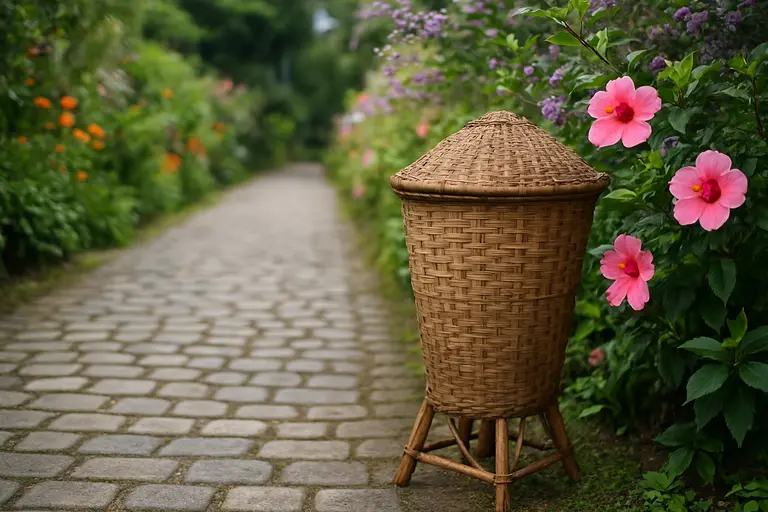
Furthermore, the infrastructure is ingenious in its simplicity. Rather than importing plastic bins, Mawlynnong built its zero-waste system from local materials. Specifically, residents place handwoven bamboo baskets, shaped like cones and called Khoh, every 30 meters.
But, why bamboo?
- Sustainable: It grows abundantly in the region.
- Biodegradable: When the bin breaks, it returns to the earth.
- Aesthetic: It blends seamlessly into the garden landscape.
Beyond collection, the village has mastered waste transformation. Functionally, organic waste goes into compost pits to become manure for agriculture. Meanwhile, non-biodegradable waste is carefully transported away. This closed-loop approach means that very little actually becomes “trash.” If you are interested in eco-friendly crafts, compare this to the sustainability of Manipur Lotus Silk.
Education: Catching Them Young
Perhaps the most forward-thinking element is the educational model. The school board formally embeds cleanliness in the school curriculum. Before school each morning, children sweep the streets and empty communal bins. This ingrains the habit so deeply that by adulthood, littering feels unnatural.
Consequently, this generational strategy solves the problem of “Behavioral Drift.” By making hygiene a daily ritual, Mawlynnong ensures that the standards do not slip with time. Like gem cutting, precision must be a habit, not a one-time effort. Read more in Colored Stone Grading.
Economics of Mawlynnong Cleanest Village
Moreover, the commitment has paid financial dividends. Mawlynnong, the Cleanest Village, has transformed into a thriving Eco-Tourism hub. Visitors arrive from across the globe to walk its spotless lanes and see the famous Living Root Bridges nearby (bio-engineering marvels grown from Ficus trees).
As a result, per capita income has risen by approximately 60%. Crucially, youth migration to cities has slowed. Young people now see economic opportunity at home, running homestays and guide services. Environmentally, they harvest rainwater and protect sacred groves. This aligns with the principles of Future of Single Mine Origin Gold—where ethical practices lead to premium value.
Replicating the Model
What gives the model its greatest value is scalability. Encouragingly, villages like Shikdamakha in Assam and Baghuwar in Madhya Pradesh have begun adopting similar community-driven models. This suggests that the principles are transferable. Ultimately, Mawlynnong proves that India does not need to wait for a government scheme to clean up. We just need the community’s will.
Conclusion: A Mirror for India
In summary, Mawlynnong Cleanest Village, is a mirror. It shows us what is possible when a community unites. It did not become clean because of a fine; it became clean because of pride. Ultimately, the state of our streets reflects the state of our values.
FAQ: Mawlynnong Cleanest Village
Why is Mawlynnong called Asia’s cleanest village?
It earned the title from Discover India magazine in 2003 due to its impeccable sanitation standards, zero-waste systems, and 100% toilet coverage long before national campaigns.
What is the role of women in the village?
As a Matrilineal society, traditionally, women hold property rights and significant decision-making power. They lead the cleanliness drives and manage the economic aspects of tourism.
Can other villages replicate this model?
Yes. The model relies on low-cost solutions like bamboo bins and community labor, not expensive technology. Therefore, any village with strong leadership can adopt it.
How did they achieve full toilet coverage?
They reached 100% coverage by 2007, years ahead of the Swachh Bharat Mission. Effectively, the community council mandated it as a priority for public health.
What economic benefits has cleanliness brought?
It created a tourism economy. Locals now earn significant income from homestays, handicraft sales, and guided tours, reducing poverty and migration.