Introduction
The Longines Business Model explains exactly how a watchmaker can dominate the ‘accessible luxury’ market. You have probably seen a Longines watch on someone’s wrist and wondered what makes it different from a ₹500 quartz piece—or from a Rolex. Typically, the answer lies in a carefully engineered strategy that places Longines right in the “Sweet Spot” of the global watch market. Unlike the extreme scarcity of the Richard Mille Business Model, this company wants you to buy their watches today.
The Longines Business Model breaks down exactly how the brand operates, who it sells to, and why it has survived for over 190 years. As an expert who tracks luxury assets, I see Longines as the ultimate “Gateway” brand. In this article, we will examine how they utilize their extensive archives, their relationship with the Swatch Group, and why they dominate the entry-level luxury sector. Whether you are buying your first serious watch or analyzing retail trends, this is a masterclass in market positioning.
What Is “Accessible Luxury” in the Longines Business Model?
To begin with, we must define their territory. Actually, Longines operates as a core brand inside the Swatch Group, the world’s largest watchmaking conglomerate. Within that portfolio, Longines occupies a deliberate middle position.
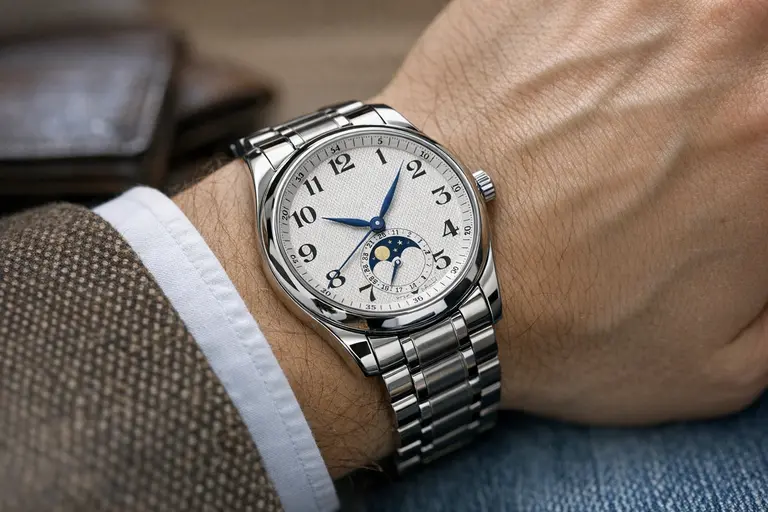
On one side sit everyday Swiss brands like Tissot and Hamilton. On the other side sit premium names like Omega and Breguet. Consequently, Longines lives perfectly between the two—and that gap is highly profitable. Typically, the brand targets a price range of roughly $1,500 to $3,500 (approximately ₹1,25,000 to ₹3,00,000 in India, subject to exchange rates).
At this level, buyers receive a genuine Swiss movement, a heritage name, and an elegant design, all without paying Rolex prices. Industry analysts frequently describe this segment as offering the best quality-to-value ratio in Swiss watchmaking. For most working professionals, this is the first price point where a watch feels like a real investment. Read more about how Indian buyers view investments in my Resident vs NRK Jewelry Buyers guide.
Swatch Group and the Longines Business Model
Longines does not operate as a standalone company. Instead, it functions as a highly optimized brand unit inside the Swatch Group. This structure gives it significant advantages over independent brands.
The Movement Strategy
First, it uses proprietary ETA calibres. ETA is the movement manufacturer owned by the Swatch Group. While Longines no longer builds its own movements from scratch, ETA modifies these engines exclusively for Longines. For example, they add advanced Silicon Balance Springs to ensure the watches are highly anti-magnetic and accurate. Therefore, this keeps production costs controlled without compromising quality.
The R&D Shift
Furthermore, since the 1980s, Longines has moved away from independent Research and Development. This shift followed the restructuring that came after the “Quartz Crisis.” Today, the brand focuses primarily on design, heritage storytelling, and marketing. The heavy manufacturing infrastructure belongs to the wider group. According to industry estimates, this efficiency allows Longines to sell roughly 1.5 million watches per year and generate over $1.2 billion in annual sales. Compare this high-volume approach to the low-volume Sartory Billard Watches model.
Distribution in the Longines Business Model
Next, let’s look at distribution. The Longines Business Model uses a “Franchise-First” retail strategy.
According to estimates, approximately 140 global boutiques carry the brand. However, only around 18 operate as company-owned stores. The rest run as franchise outlets. This approach keeps capital investment low while expanding the brand’s physical footprint rapidly across the globe.
Beyond boutiques, Longines maintains a massive presence through third-party retailers and airport duty-free shops. This wholesale network is especially important in high-traffic travel locations. Here, the brand effectively serves as a gateway watch—the first serious Swiss timepiece that an aspirational traveler considers. Key markets include China, Switzerland, Germany, and the United States. To learn more about how Swiss brands distribute globally, visit the Federation of the Swiss Watch Industry.
Brand Identity of the Longines Business Model
Moreover, Longines uses the tagline “Elegance is an Attitude”—a registered slogan that defines every marketing decision. Rather than competing on hyper-technical complexity like MB&F Watch Brand, Longines consistently leads with timeless style.
The Museum of Saint-Imier
Additionally, Longines leans heavily on its history. With over 190 years of continuous records and a dedicated watch museum in Saint-Imier, Switzerland, the brand has a “cheat code” for design. They regularly launch the Heritage and Spirit collections, which draw directly from their archives. Because they have a physical ledger recording almost every watch they have ever made, their vintage reissues are incredibly authentic. Unsurprisingly, watch enthusiasts appreciate this authenticity, while casual buyers simply like the classic look.
Sports Timekeeping
On top of that, Longines maintains strong public visibility through official sports timekeeping. It serves as the official timekeeper for prestigious equestrian events (Horse Racing), alpine skiing, and gymnastics. These partnerships reinforce precision without requiring flashy celebrity endorsements.
Conclusion on the Longines Business Model
In short, Longines builds watches that most professionals can afford after saving for a few months. It provides Swiss craftsmanship at a price that does not require a six-figure salary. Ultimately, the brand sits at a realistic price point where quality and budget meet. For anyone entering the world of serious watchmaking, Longines remains the ultimate starting line.
FAQ: Longines Business Model
Is Longines considered a luxury watch brand?
Yes, but it belongs to the “Accessible Luxury” segment. It is not ultra-premium like Patek Philippe or Rolex, but it is a genuine Swiss luxury brand with impeccable heritage credentials.
Who owns Longines?
The Swatch Group owns Longines. It operates as one of several brand units within the group, sitting comfortably above Tissot and just below Omega in the corporate hierarchy.
Does Longines make its own movements?
No, not entirely. Longines uses ETA calibres (a movement maker also owned by the Swatch Group). However, ETA modifies these movements exclusively for Longines, often adding high-tech silicon components.
How much does a Longines watch cost in India?
Longines watches in India typically start from approximately ₹1,25,000 and can go up to ₹3,00,000 and beyond, depending on the collection (like the Spirit or Master Collection).
Is Longines a good first serious watch?
Absolutely. Actually, watch communities widely recommend Longines as one of the best entry points into Swiss watchmaking. It offers strong value, authentic heritage, and elegant design without the massive markup of other brands.
Disclaimer
This article is for general informational purposes only. Sales figures, boutique counts, and revenue data are based on industry estimates and have not been independently verified or officially confirmed by Longines or the Swatch Group. Prices in INR are approximate and subject to exchange rate fluctuations. This content does not constitute financial, investment, or purchasing advice. The author has no commercial affiliation with Longines, the Swatch Group, or any retailer mentioned. Always verify current pricing and product details directly with authorised dealers before making a purchase decision.