Introduction
For centuries, alchemists searched for the “Philosopher’s Stone”—a magical substance that could turn base metals into gold. Today, if you have been shopping for jewelry, you may have come across the term “Lab-Grown Gold” and wondered if they finally succeeded. Is it real gold? Is it cheaper? And is it better for the planet?
The truth is, the answer depends on what a seller means when they use the phrase—and unfortunately, that meaning is often misleading. Unlike Natural Diamonds Over Lab-Grown (where the lab product is real), “Lab-Grown Gold” is mostly a marketing buzzword. In this article, I will break down the science of Lab-Grown Gold Explained. As a Gemologist, I will clarify the difference between Nuclear Physics (making gold) and Recycling (reusing gold), helping you shop with confidence.
What Is Lab-Grown Gold, Really?
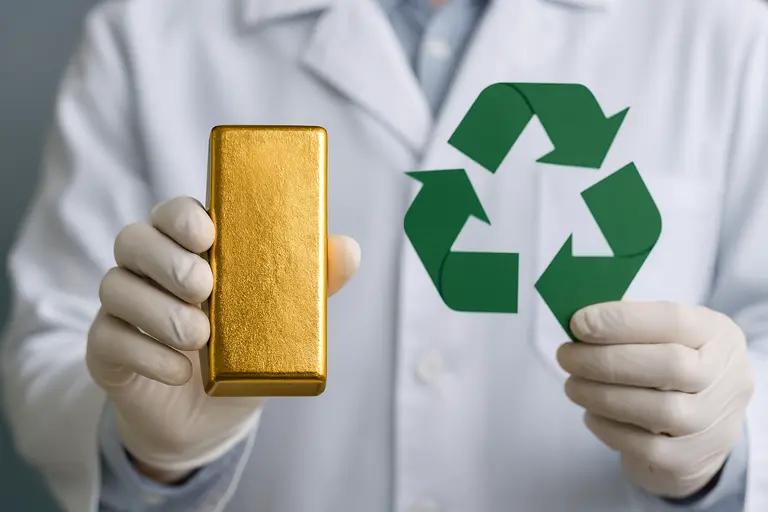
In most cases, when a brand says “Lab-Grown Gold,” they are simply using a fancy label for Recycled Gold. Rather than being newly mined from the earth, this gold has been reclaimed from sources such as old jewelry, electronic waste (computers), or industrial byproducts. Refiners then process it back to its pure state (24K) and repurpose it into new pieces.
However, it is important to understand that True Lab-Grown Gold—gold actually manufactured atom-by-atom in a laboratory—does technically exist. Scientists can create gold through a process called Nuclear Transmutation. This involves bombarding the nucleus of another element, such as Mercury or Bismuth, with neutrons to change its atomic structure into Gold (Au).
As IDEX reported in July 2025, the U.S. startup Marathon Fusion has been working on this. Nevertheless, making gold this way requires a tremendous amount of energy (particle accelerators). Worse still, the gold produced is often unstable and remains Radioactive for up to 18 years. As a result, true lab-grown gold is neither practical nor commercially available for everyday jewelry. It costs millions of dollars per ounce to produce.
Comparison: Lab-Grown Gold vs. Lab-Grown Diamonds
It is natural to wonder whether gold can follow the same path as the Future of Lab-Grown Diamonds. However, the two materials form in very different ways.
- Diamond: Unlike gold, diamonds are made of carbon—one of the most abundant elements on Earth. Today, scientists can actually replicate the Earth’s intense heat and pressure using specialized presses to grow diamonds in a lab.
- Gold: Gold is a chemical element (Au) that was forged billions of years ago during supernova explosions and neutron star collisions.
Because recreating a Supernova on Earth is impossible, true Lab-Grown Gold has not—and likely will not—become a mainstream product. Therefore, when you buy a “Lab-Grown Diamond,” you get a real diamond. When you buy “Lab-Grown Gold,” you are usually getting Recycled Gold.
Recycled Gold: The Sustainable Choice
Since true lab-grown gold remains out of reach, Recycled Gold is the most practical alternative. The process begins with collecting gold from existing sources—your grandmother’s broken chain, old circuit boards, or dental fillings. Manufacturers melt down the scrap gold and use specialized refining techniques to remove impurities, successfully restoring it to its 24K purity.
Crucially, recycled gold is chemically identical to freshly mined gold. It holds the same value per gram and carries the same karat ratings. Furthermore, many consumers consider it more responsible. It reduces the demand for new mining, which can be environmentally destructive. That said, be careful. As I discussed in Future of Single Mine Origin Gold, some “Recycled” gold can be a way to launder unethical gold. Always check the certification.
Decoding the Terminology
To help you shop, here is a breakdown of the confusing terms in the market.
Solid Gold (22K, 18K, 14K)
Pure gold alloyed with other metals for strength. The “Karat” tells you the percentage of gold. Read my guide on 14K Gold Jewellery for Indian Buyers to see which is best for you.
Gold Vermeil
A layer of gold applied over Sterling Silver. It is thicker than plating but still not solid gold.
Gold Plated
A thin layer of gold over base metal (Brass/Copper). It has no resale value.
“Lab-Grown” (Marketing)
Usually means Recycled Gold. Ask the seller to clarify the source.
True Lab-Made Gold
Gold produced via Nuclear Transmutation. Not available for sale.
Is It Worth Buying?
For most shoppers, Recycled Gold is an excellent choice. Because it is chemically the same as mined gold, you sacrifice nothing in quality. Moreover, if sustainability matters to you, choosing recycled gold reduces your carbon footprint.
It is also worth noting that Recycled Gold does not cost less than Mined Gold. Unlike Lab-Grown Diamonds, which are cheaper, Gold is a commodity. Its price tracks the global market (London Bullion Market). Do not expect a discount simply because a piece is labeled as “Lab-Grown” or “Recycled.”
Insurance and Value
Does the origin affect your insurance? Not at all. Because Recycled Gold is identical to Mined Gold, it carries the same market value. At insurers like BriteCo, insurers base coverage on the appraised value (weight x purity), regardless of whether the gold came from a mine in Africa or a recycling plant in Mumbai. As long as you have proper documentation, your jewelry is fully protected.
Conclusion: Alchemy vs. Reality
Ultimately, Lab-Grown Gold Explained reveals that science has limits. We can grow crystals (Diamonds), but we cannot easily create elements (Gold). In summary, if a jeweler tries to sell you “Lab-Grown Gold,” realize that you are buying Recycled Gold with a fancy name. It is a good product, but it is not magic. It is just smart recycling.
FAQ: Lab-Grown Gold Explained
Is Lab-Grown Gold real gold?
Yes. Whether the term refers to Recycled Gold (common) or Transmuted Gold (scientific rarity), it is chemically identical to mined gold (Au).
Can gold actually be made in a lab?
Yes, technically. Nuclear transmutation can convert Mercury into Gold, but the process is prohibitively expensive and produces radioactive material. It is cheaper to mine it from the ground.
Does recycled gold cost less?
No. The market prices gold by weight and purity, not origin. Recycled gold trades at the same global spot price as newly mined gold.
Is Lab-Grown Gold better for the environment?
Generally, yes. If it refers to Recycled Gold, it avoids the environmental damage of open-pit mining. However, the refining process still uses chemicals.
Does it have a karat count?
Yes. Recycled gold is refined to 24K and then alloyed to 22K, 18K, or 14K, just like mined gold.
Credits
This article draws on reporting originally published by IdexOnline in association with BriteCo.
Credit to BriteCo for first sharing What is Lab-Grown Gold (And What It Really Means for Jewelry).
This story is adapted from BriteCo, a specialized insurance technology company that provides standalone coverage for fine jewelry, luxury watches, and wedding events, with additional SEO and contextual research by Saju Elizamma.