
Introduction
Why does a person often value a physical object more simply because they helped build it? This psychological phenomenon, now increasingly vital to the IKEA Effect India business landscape, suggests that personal labor significantly increases an item’s perceived value. Specifically, Michael Norton, Daniel Mochon, and Dan Ariely first identified this pattern in 2011. Their research proved that people rate self-made products much higher than identical ready-made ones because the labor itself creates a deep sense of ownership and pride. You can read the full research breakdown in the Harvard Business School article on the IKEA Effect.
However, modern brands should not simply push more labor onto their customers. Instead, customers need a meaningful role and a successful result to feel the psychological payoff. Recent studies link this boost in value to feelings of competence rather than effort alone. Consequently, the IKEA Effect Co-Creation India strategy is now reshaping how jewelry, watchmaking, food, and technology brands interact with the Indian market. Businesses across the subcontinent are beginning to emphasize guided co-creation over plain do-it-yourself labor to build deeper brand loyalty.
Understanding the IKEA Effect in Consumer Psychology
Simply put, people place greater value on a product once they help create it successfully. For instance, assembling a mechanical watch builds immense pride, and designing a unique ring makes jewelry feel deeply personal. Furthermore, the act of creation transforms a generic item into a “one-of-one” masterpiece in the mind of the consumer.
Still, we must realize that simple customization and the IKEA effect are not identical. A customer who merely selects a gemstone participates in co-creation, yet they may not feel the same psychological reward as someone who physically assembles the item. Therefore, brands should not assume that every customized product automatically triggers this effect. To truly activate it, the consumer must contribute effort that results in a finished, functional product.
How Jewelry Brands Leverage Co-Creation in India
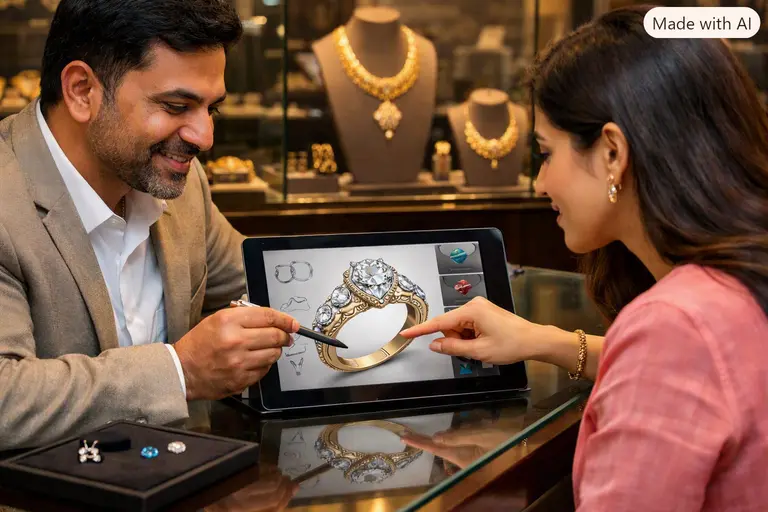
Indeed, the jewelry industry offers a powerful opportunity for this model because customers already connect these purchases with identity and celebration. For example, a buyer could choose the specific gemstone, the metal type, and the custom engraving. As a result, the finished piece becomes a reflection of the buyer’s personality rather than a mass-produced commodity.
In fact, Indian jewelers such as CaratLane and BlueStone already offer sophisticated personalization tools that demonstrate genuine co-creation. Likewise, international brands like Pandora allow customers to combine individual charms to design their own bracelets. Indian jewelers could extend this further by letting a customer preview 3D design digitally and approve a master mold before production begins. In this scenario, the customer supplies the taste while the jeweler supplies the technical skill. For more on how to identify the quality of stones used in these projects, visit our gemstone identification guide.
Watchmaking and the IKEA Effect: From Assembly to Ownership
Mechanical watches create a direct opportunity for the IKEA Effect Co-Creation India trend because customers can physically build a complex, functioning object. DIY Watch Club, for example, sells specialized assembly kits that turn watch ownership into a hands-on learning experience.
However, delicate mechanical movements can easily overwhelm beginners. If a customer fails to assemble the watch, the IKEA effect disappears and is replaced by frustration. Therefore, Indian luxury retailers could host supervised “assembly workshops” in major cities. In these sessions, the professional watchmaker becomes a teacher rather than a distant manufacturer. By guiding the customer through the process, the brand ensures a successful completion, which is the “golden rule” of the IKEA effect.
The Fine Line Between Effort and Frustration
Brands must remember that the IKEA effect only works if the task is manageable. If a project is too difficult, the customer feels incompetent. Specifically, researchers found that if the labor is too high and the result is poor, the consumer’s self-esteem drops, and they may actually value the product less. Thus, the “Co-Creation” part of the IKEA Effect Co-Creation India model must involve expert guidance to ensure a high-quality finish.
Food and Technology: The Participation Premium
In addition to luxury goods, food and beverage brands already invite participation through various models. For example, diners at “hot-pot” or “do-it-yourself” grill restaurants cook parts of their own meals. Still, participation does not automatically improve the taste; instead, it makes the overall dining experience feel more personalized.
Consider the famous Betty Crocker story. Legend claims early cake mixes failed because bakers felt they were “cheating” by only adding water. Consequently, sales improved once the company required a fresh egg to be added. While General Mills notes a more nuanced history, the lesson remains: a meaningful contribution makes a ready-made experience feel authentic. Indian food brands could apply this by offering “finishing kits” for premium chocolates or spice-blending sessions for artisanal coffee.
Similarly, the technology sector offers a massive opportunity for the IKEA Effect Co-Creation India strategy. Custom PC building allows customers to choose every component and assemble the machine themselves. Once the computer boots up successfully, the owner feels a level of pride that no pre-built laptop can provide. Therefore, technology firms should provide the tools for assembly while ensuring the software setup remains seamless.
Does the IKEA Effect Work for Indian Consumers?
Yes, available evidence suggests the effect is universal, though careful interpretation matters. Specifically, a 2022 study examined 128 British and Indian children aged five to six. During the experiment, researchers observed the IKEA effect equally in both groups. This suggests that the psychological urge to value one’s own labor is a fundamental human trait that crosses cultural boundaries. Researchers have also explored how social environments alter this bias, which is discussed in the PubMed central paper on collaboration and culture on the IKEA effect.
However, since this specific study involved children, it cannot fully confirm how every Indian adult consumer behaves. Even so, the findings suggest that the phenomenon is not limited to Western cultures. Therefore, the more useful question for Indian businesses is how to design participation that modern customers genuinely enjoy. Guided co-creation fits India best because customers here traditionally value a blend of personal creativity and professional craftsmanship.
Strategies for Indian Businesses to Implement Co-Creation
Ultimately, Indian businesses do not need to copy the IKEA retail model literally. Instead, they should apply the underlying psychology of the IKEA Effect Co-Creation India phenomenon. To do this successfully, businesses should follow these three steps:
- Offer a Meaningful Role: Ensure the customer’s contribution actually changes the final product.
- Keep the Challenge Manageable: Avoid tasks that are so difficult they lead to failure.
- Ensure a Professional Result: The final product must look and function like a high-end item.
Consequently, a jewelry brand should avoid overly complex settings for beginners. Similarly, a technology company should provide pre-configured software to ensure the hardware assembly is the “hero” moment. That feeling of accomplishment creates a level of value that a fully finished product cannot match alone.
FAQ: Mastering the IKEA Effect Co-Creation India
Is the IKEA effect a scientifically established fact?
Yes. Specifically, Norton, Mochon, and Ariely demonstrated it through multiple experiments involving furniture assembly, origami, and LEGO construction.
Does the IKEA effect work in every industry?
The principle can extend to almost any category where customers contribute meaningfully and finish the task successfully. However, it is most effective in industries where “ownership” and “pride” are central to the brand.
Why is “successful completion” so important?
The original research found that if a participant failed to finish their task, they did not value the product more. In fact, they often valued it less. Therefore, brands must ensure their customers succeed in their co-creation efforts.
How can Indian jewelry brands use this today?
Indian jewelers can move beyond simple orders by hosting design workshops where customers choose raw stones and participate in the polishing or final setting process under expert supervision.
Disclaimer
This article discusses consumer psychology and business strategy for general informational purposes only. The IKEA effect does not guarantee higher sales or brand loyalty in every instance. Individual consumer responses vary based on demographic and personal factors. The author has no financial affiliation with the brands or organizations mentioned.