
Summary
Even a tiny chip can halve your emerald’s value. Learn how to inspect your stone for cracks, edge wear, and abrasions before you buy — straight from 40 years in the gem trade.
From My Desk as a Gemologist
A client once brought in a sparkling emerald he bought abroad for ₹3 lakh. Under a loupe, a small chip on the crown edge brought its price down to ₹1.2 lakh.
That moment taught him what every gem buyer eventually learns — condition decides value.
Why Emeralds Damage Easily
Emeralds rank 7.5–8 on the Mohs hardness scale, softer than rubies and sapphires.
They often contain tiny natural fissures (jardin), making them prone to cracks and chips.
Even gentle wear can lead to:
- Small chips along facet edges
- Surface-reaching cracks
- Abrasions around the girdle
Each flaw interrupts light flow, reducing brilliance and price.
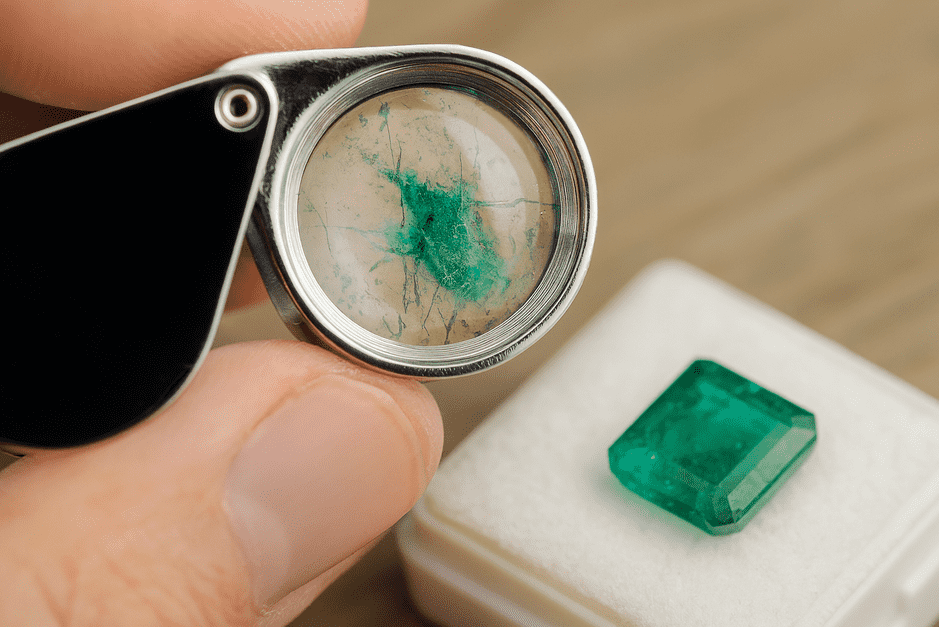
How to Check an Emerald for Damage
You can inspect your emerald at home or in-store before purchase:
- Hold it under a bright, focused light.
- Tilt it slowly and watch for broken reflections.
- Use a 10x loupe to check facet junctions and corners.
- Gently run a fingernail along the edge; rough spots mean wear.
- Always view the gem before oiling or setting, since oil can hide fractures.
Every professional buyer starts with edge inspection — color and origin come later.
How Damage Affects Emerald Value
A single chip can drop value by 40–60% overnight.
Even top-grade Colombian or Zambian emeralds can’t escape the penalty of visible damage.
The key is simple:
Inspect before you invest.
Want to understand clarity grading better?
Explore Natural vs Synthetic Gems and Gemstone Treatment Myths.
You can also read Understanding Gem Cuts to see how shape influences how chips appear — or hide.
For long-term care, visit Caring for Your Emerald Jewelry.
To check gold purity on your jewelry, read Understanding BIS Hallmark.
See Also: GIA – Emerald Care & Cleaning
FAQ
Q: Can polishing fix emerald chips?
Yes, if the chip is shallow. But re-polishing can reduce carat weight and symmetry.
Q: Does oiling remove or hide cracks?
It fills them temporarily. Once oil dries, the damage becomes visible again.
Q: Should I buy a discounted emerald with small chips?
Only if you plan to keep it. Reselling a damaged stone is difficult.
Q: Which labs report emerald damage?
GIA and IGI list surface-reaching cracks or chips under comments in their certificates.
India Regional Cultures: A Complete Diversity Guide
India regional cultures are as diverse as its landscapes. This guide explores traditions, languages, and unique identities across the country. India Speaks FAQ on regional cultures reveals remarkable diversity across the subcontinent. Each state tells a unique story of tradition, heritage, and identity.
This India Speaks FAQ on regional cultures explores how geography, history, and local customs shape the cultural differences across India’s states and territories.
Understanding these regional differences helps you appreciate India’s true cultural richness.
What Makes India’s Regional Cultures Unique?
Each state develops its own distinct language, cuisine, and customs over centuries. Local history shapes traditions and daily life. Geography influences everything from clothing styles to building designs and lifestyle choices.
Examples of regional adaptation:
- Kashmir’s wooden homes with sloped roofs handle heavy snowfall
- Kerala’s houseboats work perfectly with extensive waterways and monsoon climate
- Rajasthan’s thick-walled buildings stay cool in desert heat
These regional adaptations show how different communities respond to their environment while keeping cultural identity.
How Do Regional Foods Reflect India’s Cultural Diversity?
Regional cuisine connects directly to local climate and crops. Coastal regions favor rice cultivation and seafood preparation. Northern states rely on wheat-based breads like roti, naan, and paratha.
Cooking methods vary significantly across regions:
- Mustard oil dominates Bengali cuisine
- Coconut oil is essential in Kerala cooking
- Ghee remains the preferred fat in Rajasthani dishes
When you travel across India, pay attention to these culinary differences. They reveal stories about the land, climate, and cultural preferences. India Speaks FAQ on regional cultures shows these food traditions matter.
Why Are Languages Central to Regional Identity in India?
India speaks through 22 official languages and hundreds of regional dialects. Each language carries unique cultural meaning. Language shapes traditional songs, folk tales, religious festivals, and social customs.
Language examples and their cultural significance:
- Tamil expresses the rich Dravidian heritage of South India
- Punjabi reflects Sikh traditions and agricultural lifestyle
- Bengali carries the literary legacy of Nobel laureate Rabindranath Tagore
- Hindi serves as a connecting language across northern states
Learning even a few local words helps you connect with regional communities. It shows respect for local culture.
What Role Do Festivals Play in India’s Regional Cultures?
Festivals serve as powerful expressions of regional identity. They bring communities together through shared traditions and celebrations. Each region celebrates differently based on local customs, crop cycles, and religious practices.
Regional festival examples:
- North India illuminates Diwali with millions of oil lamps and fireworks
- South India honors Pongal with harvest rituals celebrating farmers and nature
- West Bengal transforms during Durga Puja with art installations, classical music, and community feasting
Each festival reflects the unique cultural values and historical experiences of its region.
Which festival would you want to experience firsthand?
How Does Traditional Clothing Vary Across Indian Regions?
Climate conditions and available resources influence regional clothing styles across India. These variations demonstrate practical adaptation to different environments while maintaining aesthetic preferences.
Regional clothing examples:
- Rajasthan’s desert climate inspires bright turbans, flowing skirts, and mirror-work textiles that reflect heat
- Kerala’s humid tropical climate favors white cotton sarees with golden borders worn during festivals
- Nagaland’s mountainous terrain produces distinctive shawls featuring tribal symbols and geometric patterns
Each style represents clan identity and cultural heritage specific to its region.
How Do Regional Crafts and Arts Represent Cultural Identity?
Traditional crafts carry centuries of accumulated skill and cultural meaning. They serve as living expressions of regional identity. These art forms express creativity through traditions passed down through generations.
Regional craft examples:
- Bihar’s Madhubani paintings feature mythological themes and geometric patterns created by women during festivals
- Kerala’s Kathakali dance combines dramatic storytelling, classical music, and elaborate costumes
- Odisha’s traditional metalwork, particularly brass and bronze artifacts, carries deep ritual meaning in temple worship
Supporting these regional crafts helps preserve cultural heritage. It provides sustainable livelihoods for traditional artisans.
Why Should You Explore India’s Regional Cultures?
Exploring regional cultures offers experiences beyond visiting monuments and tourist attractions. You engage directly with daily life, authentic cuisine, and living languages.
Regional travel provides meaningful context rather than surface-level tourist highlights.
Benefits of regional cultural exploration:
- You connect with local communities on a personal level
- You taste authentic dishes prepared with traditional methods
- You hear regional languages and dialects in natural settings
- You witness festivals and ceremonies as they happen in daily life
Each regional visit deepens understanding of India’s diversity. It helps you appreciate how different communities adapt to their environments while keeping distinct cultural identities.
India Speaks FAQ on regional cultures demonstrates what makes the country culturally rich and endlessly fascinating for travelers and cultural enthusiasts.
Which region would you choose to explore first?