Summary
Even a tiny chip can halve your emerald’s value. Learn how to inspect your stone for cracks, edge wear, and abrasions before you buy — straight from 40 years in the gem trade.
From My Desk as a Gemologist
A client once brought in a sparkling emerald he bought abroad for ₹3 lakh. Under a loupe, a small chip on the crown edge brought its price down to ₹1.2 lakh.
That moment taught him what every gem buyer eventually learns — condition decides value.
Why Emeralds Damage Easily
Emeralds rank 7.5–8 on the Mohs hardness scale, softer than rubies and sapphires.
They often contain tiny natural fissures (jardin), making them prone to cracks and chips.
Even gentle wear can lead to:
- Small chips along facet edges
- Surface-reaching cracks
- Abrasions around the girdle
Each flaw interrupts light flow, reducing brilliance and price.
How to Check an Emerald for Damage
You can inspect your emerald at home or in-store before purchase:
- Hold it under a bright, focused light.
- Tilt it slowly and watch for broken reflections.
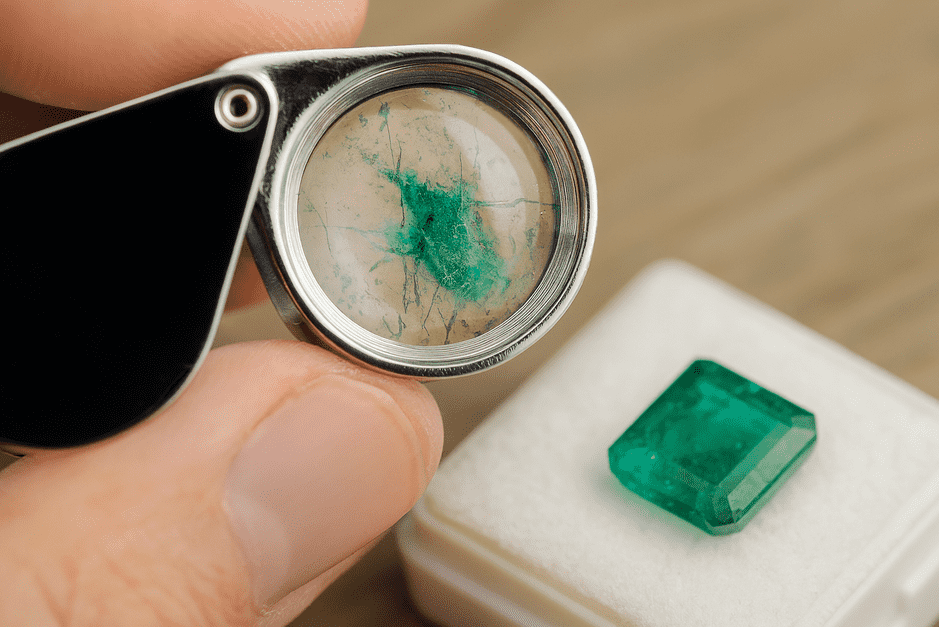
- Use a 10x loupe to check facet junctions and corners.
- Gently run a fingernail along the edge; rough spots mean wear.
- Always view the gem before oiling or setting, since oil can hide fractures.
Every professional buyer starts with edge inspection — color and origin come later.
How Damage Affects Emerald Value
A single chip can drop value by 40–60% overnight.
Even top-grade Colombian or Zambian emeralds can’t escape the penalty of visible damage.
The key is simple:
Inspect before you invest.
Want to understand clarity grading better?
Explore Natural vs Synthetic Gems and Gemstone Treatment Myths.
You can also read Understanding Gem Cuts to see how shape influences how chips appear — or hide.
For long-term care, visit Caring for Your Emerald Jewelry.
To check gold purity on your jewelry, read Understanding BIS Hallmark.
See Also: GIA – Emerald Care & Cleaning
FAQ
Q: Can polishing fix emerald chips?
Yes, if the chip is shallow. But re-polishing can reduce carat weight and symmetry.
Q: Does oiling remove or hide cracks?
It fills them temporarily. Once oil dries, the damage becomes visible again.
Q: Should I buy a discounted emerald with small chips?
Only if you plan to keep it. Reselling a damaged stone is difficult.
Q: Which labs report emerald damage?
GIA and IGI list surface-reaching cracks or chips under comments in their certificates.
Small Luxury Hotels FAQ
Introduction
This small luxury hotels FAQ answers common questions about boutique stays. It explains definitions, differences with large chains, and which services to expect. In addition, it covers family options, sustainability, and tips on finding the right property.
What defines a small luxury hotel?
- Fewer than 100 rooms.
- Personalized attention and privacy.
- Strong links to local design.
- Locations in unique urban or rural areas.
As a result, travelers often choose them for a more intimate experience. Moreover, their distinctive style sets them apart from standardized hotels.
Why choose a small luxury hotel?
Personal service
Staff remember guest details, therefore creating a sense of familiarity.
Calm spaces
Unlike large hotels, these properties feel quieter, so you can relax more easily.
Local culture
For example, menus highlight regional produce, and interiors reflect local crafts.
In addition, many guests return because the experience feels authentic.
How do small luxury hotels differ from large chains?
Guest experience
Small hotels provide tailored attention, while chains rely on uniform systems.
Property identity
Each boutique hotel has its own theme. On the other hand, large chains repeat formats worldwide.
Dining approach
Menus change seasonally and locally. Therefore, guests enjoy fresh variety instead of standard global menus.
Are small luxury hotels only for leisure stays?
Business features
- Lounges double as meeting rooms.
- Private dining options support work dinners.
Digital needs
- Fast Wi-Fi supports remote work.
- Quiet spaces help concentration.
Because of these advantages, small luxury hotels appeal to both business and leisure travelers.
What services can you expect?
- Concierge services for tours and dining.
- Fine dining menus with seasonal ingredients.
- Spa and wellness treatments.
- Added extras like minibars and welcome gifts.
Moreover, services shift depending on location. For example, a city hotel might offer cultural tours, while a rural retreat offers farm experiences.
Are small luxury hotels family-friendly?
Options for families
- Connecting rooms for parents and children.
- Child-friendly amenities such as menus or games.
Adults-only stays
- Some properties focus on privacy.
- Guests find peaceful, child-free environments.
Therefore, always check booking policies, because each hotel sets its own approach.
Do these hotels support sustainability?
Sourcing and dining
Farm-to-table meals reduce transport impact. In addition, guests enjoy fresher produce.
Environmental focus
Plastic use is restricted, while refillable bottles are encouraged. Smart energy systems reduce wastage.
Local involvement
Hotels support the community by hiring regionally. As a result, growth extends beyond the property.
How do you find the right small luxury hotel?
Define needs
Decide if food, spa, culture, or privacy is your top priority.
Check guest feedback
For example, repeat reviews about service often signal consistency.
Compare value
Packages may include meals, transfers, or early check-in. Therefore, higher prices can still deliver stronger value.
Are small luxury hotels worth the price?
Value of service
Guests pay for attention, comfort, and privacy. Moreover, experiences feel tailored and unique.
Extras add value
Some hotels include exclusive experiences or benefits. Finally, weigh these extras against nightly rates.
As a result, many travelers feel these hotels justify their price when quality matters most.