Summary
Even a tiny chip can halve your emerald’s value. Learn how to inspect your stone for cracks, edge wear, and abrasions before you buy — straight from 40 years in the gem trade.
From My Desk as a Gemologist
A client once brought in a sparkling emerald he bought abroad for ₹3 lakh. Under a loupe, a small chip on the crown edge brought its price down to ₹1.2 lakh.
That moment taught him what every gem buyer eventually learns — condition decides value.
Why Emeralds Damage Easily
Emeralds rank 7.5–8 on the Mohs hardness scale, softer than rubies and sapphires.
They often contain tiny natural fissures (jardin), making them prone to cracks and chips.
Even gentle wear can lead to:
- Small chips along facet edges
- Surface-reaching cracks
- Abrasions around the girdle
Each flaw interrupts light flow, reducing brilliance and price.
How to Check an Emerald for Damage
You can inspect your emerald at home or in-store before purchase:
- Hold it under a bright, focused light.
- Tilt it slowly and watch for broken reflections.
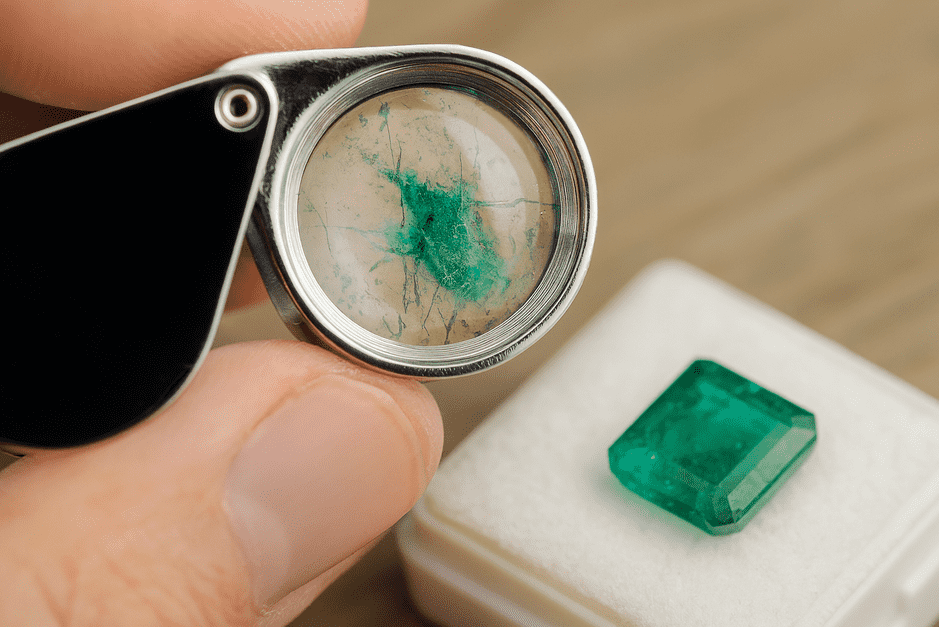
- Use a 10x loupe to check facet junctions and corners.
- Gently run a fingernail along the edge; rough spots mean wear.
- Always view the gem before oiling or setting, since oil can hide fractures.
Every professional buyer starts with edge inspection — color and origin come later.
How Damage Affects Emerald Value
A single chip can drop value by 40–60% overnight.
Even top-grade Colombian or Zambian emeralds can’t escape the penalty of visible damage.
The key is simple:
Inspect before you invest.
Want to understand clarity grading better?
Explore Natural vs Synthetic Gems and Gemstone Treatment Myths.
You can also read Understanding Gem Cuts to see how shape influences how chips appear — or hide.
For long-term care, visit Caring for Your Emerald Jewelry.
To check gold purity on your jewelry, read Understanding BIS Hallmark.
See Also: GIA – Emerald Care & Cleaning
FAQ
Q: Can polishing fix emerald chips?
Yes, if the chip is shallow. But re-polishing can reduce carat weight and symmetry.
Q: Does oiling remove or hide cracks?
It fills them temporarily. Once oil dries, the damage becomes visible again.
Q: Should I buy a discounted emerald with small chips?
Only if you plan to keep it. Reselling a damaged stone is difficult.
Q: Which labs report emerald damage?
GIA and IGI list surface-reaching cracks or chips under comments in their certificates.
Introduction
This comprehensive Watch Buying Guide answers the most common questions about timepieces.
Whether you’re purchasing your first watch or adding to your collection, these expert insights help you make informed decisions.
From understanding movement types to choosing the right size for your wrist, you’ll find everything needed before making a purchase.
What Types of Watches Should You Consider? – Watch Buying Guide Insights
Understanding the five main categories helps narrow your options:
- Mechanical watches – Use springs and gears. No battery needed.
- Quartz watches – Battery-powered; most accurate.
- Automatic watches – Wind themselves from wrist movement.
- Digital watches – Display time numerically on a screen.
- Smartwatches – Connect to your phone and track fitness data.
Accuracy Expectations – Watch Buying Guide Tips
- Quartz watches – Lose about 15 seconds per month.
- Mechanical watches – Lose 20–40 seconds per day.
- Atomic watches – Lose 1 second every 100 million years.
- Your phone’s clock stays perfectly accurate.
Water Resistance Considerations
Water resistance ratings affect usage scenarios:
- 30m – Handles rain and handwashing
- 50m – Safe for swimming
- 100m – Suitable for snorkeling
- 200m+ – Scuba diving
Replace gaskets every 2–3 years to maintain resistance.
Maintenance Schedule – Watch Buying Guide Advice
- Quartz watches – Battery replacement every 1–3 years.
- Mechanical watches – Full service every 3–5 years.
- Service costs: $200–800 depending on the brand.
Watch for stopping, running fast/slow, or condensation under the crystal.
Pricing Strategy
- Budget watches – Plastic cases, basic movements
- Mid-range watches – Steel cases, reliable mechanisms
- Luxury watches – Precious metals, hand-finished details
Remember: craftsmanship, materials, and brand prestige drive prices.
Sizing Advice
- 6–7 inch wrists – 38–42mm
- 7–8 inch wrists – 40–44mm
- 8+ inch wrists – 42–46mm
Ensure lugs don’t overhang wrist edges.
Complications to Prioritize
- Date display – Useful daily
- GMT hand – Second time zone
- Chronograph – Stopwatch
- Moon phase – Decorative
- Annual calendar – Adjusts month lengths
More complications = more things that can break.
Maintenance Tips
- Clean with a soft cloth
- Avoid extreme temperatures & magnets
- Wind manual watches daily
- Use watch winders for automatics
- Don’t adjust date between 9 PM–3 AM
Investment Potential
- Most watches lose value after purchase
- Only select Rolex, Patek Philippe, Audemars Piguet models appreciate
- Vintage watches from 1960s–70s show strong growth
- Buy watches you enjoy wearing, not solely for investment
Essential Tools
- Spring bar tool
- Case back opener
- Soft polishing cloth
- Watch cushion
- Demagnetizer
Where to Purchase
- Online – Better selection, often cheaper
- Physical stores – Try before buying
- Authorized dealers – Full warranties
- Grey market – Discounts, limited warranty
- Forums/eBay – Vintage pieces, verify authenticity
Learn More: