Introduction
The Girard-Perregaux Business Model proves that in 2026, independence is the ultimate luxury. Unlike many historic brands that are swallowed by fashion conglomerates, GP went the other way. After the Sowind Group completed its management buyout from Kering (owners of Gucci) in 2022, the brand built a sharply focused strategy.
The Girard-Perregaux Business Model places heritage craftsmanship, in-house movement production, and selective retail at its core. Rather than chasing volume, GP pursues depth. It cultivates a loyal community of collectors who value precision engineering and 235 years of continuous Swiss tradition. As an expert who tracks the business of luxury, I see GP as a prime example of “Smart Independence.” In this article, I will explore how CEO Patrick Pruniaux steered the brand away from mainstream compromises, allowing it to punch above its weight in the hyper-competitive luxury market.
The Independent Advantage of the Girard-Perregaux Business Model
First and foremost, operating as a “human-sized” independent company gives GP the flexibility that larger conglomerates simply cannot match. While group-owned brands (like those in the Hublot Business Model) must align with quarterly reporting and corporate growth targets, GP moves on its own terms.
This agility allows the brand to make long-term decisions rooted in craft rather than commerce. Consequently, GP positions itself as a “gateway to high horology.” It is an entry point for serious collectors ready to move beyond mainstream luxury (like Rolex) into the world of complication-focused watchmaking. Additionally, vertical integration remains central. GP designs, develops, and produces its own calibers entirely in La Chaux-de-Fonds. Therefore, this gives the brand complete control over quality and the storytelling that comes with true “Manufacture” status.
Product Strategy of the Girard-Perregaux Business Model
GP’s 2026 product portfolio rests on two iconic collections, each representing a different dimension of the brand’s identity.
The Laureato: Modern Icon Turns 50
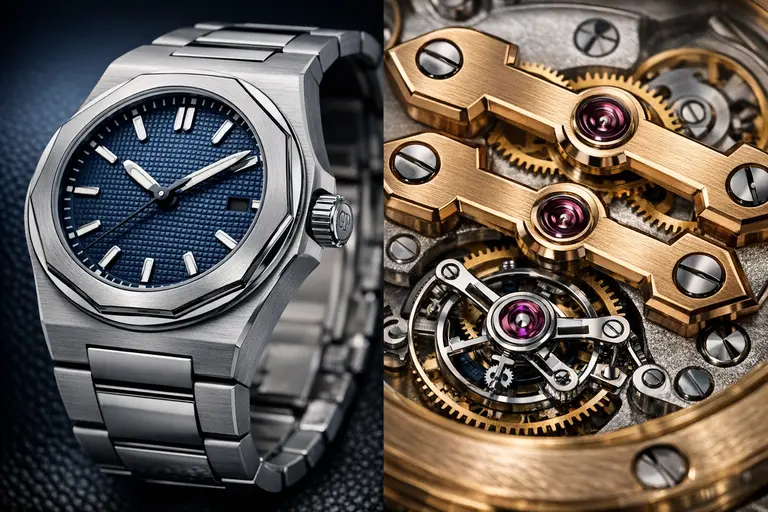
The Laureato serves as the commercial cornerstone of the brand. As the collection celebrates its 50th anniversary era (originally launched in 1975), GP continues to release new references in materials such as Titanium and Ceramic. These updates reinforce its modern, sporty-luxury aesthetic. Moreover, limited-edition releases throughout 2026 generate sustained collector interest without diluting the line’s exclusivity. You can compare this integrated-bracelet success to the Audemars Piguet 2026 Business Model.
The Bridges Collection: Historic Innovation
Meanwhile, the Three Gold Bridges collection anchors GP’s high-complication credentials. Historically, this design won a gold medal at the Paris Universal Exhibition in 1889. The open-worked architecture—where the movement’s bridges form a distinctive visual signature—represents one of the most recognizable constructions in fine watchmaking. In 2026, GP continues to evolve this collection using its groundbreaking Constant Escapement technology, which delivers unprecedented torque regulation to the balance wheel.
Marketing: The Aston Martin Partnership
Furthermore, independence does not mean obscurity. A key part of the Girard-Perregaux Business Model is its strategic partnership with Aston Martin Aramco Formula One Team. Through this alliance, GP creates highly sought-after, co-branded pieces.
Why does this work? It taps into the passion of motorsport fans, bringing a dynamic, high-tech audience to a 200-year-old brand. Specifically, using Formula 1 materials like green ceramic and tinted sapphire glass connects the watches to modern engineering. Read more about how brands use F1 in my IWC Schaffhausen analysis.
Distribution in the Girard-Perregaux Business Model
Over the past several years, GP has deliberately halved its retail network. Rather than maintaining a broad, diluted presence, the brand now focuses on deep partnerships with top-tier retailers. This selective retail strategy ensures that GP reaches consumers through partners who understand the brand’s storytelling.
In addition to wholesale partnerships, GP is expanding its Direct-to-Consumer (DTC) presence through mono-brand boutiques. These dedicated spaces allow GP to control the brand experience far more effectively. Additionally, GP integrates digital tools to enhance the client journey, similar to the strategies discussed in Creative Hospitality in Indian Jewelry Stores.
Market Outlook for the Girard-Perregaux Business Model
Despite industry headwinds throughout 2025—including softening demand in key Asian markets—GP has demonstrated notable resilience. The brand’s independence insulates it from the panic that forces larger groups to adjust pricing strategies reactively.
As a result, GP avoids the “mainstream trap” that can dilute a luxury brand’s prestige. By maintaining high-end exclusivity and resisting the temptation to chase volume, GP protects both its price positioning and its desirability among serious collectors. Finally, the Sowind Group’s governance ensures that management can focus on long-horizon thinking, investing patiently in research and collector relationships.
Conclusion: The Sweet Spot of Horology
In summary, the Girard-Perregaux Business Model is defined by a clear philosophy: Independence, Craftsmanship, and Exclusivity. By centering its strategy on in-house manufacture, two iconic collections, and a lean distribution network, GP occupies a uniquely credible position. Ultimately, for collectors ready to explore the heights of Swiss horology, GP continues to serve as both a destination and a gateway.
FAQ: Girard-Perregaux Business Model
Who owns Girard-Perregaux in 2026?
The Sowind Group owns Girard-Perregaux following a management buyout from the French luxury conglomerate Kering in 2022. This allows CEO Patrick Pruniaux full creative autonomy.
What makes Girard-Perregaux a “Manufacture” brand?
GP designs and produces its own mechanical movements entirely in-house at its workshops in La Chaux-de-Fonds, Switzerland. Therefore, they do not rely on third-party movement suppliers like ETA or Sellita.
What are GP’s most important collections?
GP’s two flagship collections are the Laureato (a luxury sports watch with an octagonal bezel) and the Bridges collection (anchored by the iconic Three Gold Bridges tourbillon).
Why did the Girard-Perregaux Business Model reduce retailers?
GP deliberately scaled back to focus on quality over quantity. By working exclusively with top-tier retailers, GP maintains tighter control over its pricing and brand image, avoiding the “discounting” trap.
What is GP’s Constant Escapement technology?
It is a patented innovation that delivers a constant force to the balance wheel regardless of how much energy is left in the mainspring. Consequently, it results in perfect timekeeping accuracy from the first hour to the last.