
Introduction to Customer Rights in Specialized Industries
The concept of customer rights in specialized industries is often misunderstood because it involves a delicate balance between personal preference and technical standards. In fields like gemology, horology, and high technology, many buyers expect the traditional rule that “the customer is always right” to apply in every situation. However, professional experts carry specialized training that establishes objective benchmarks for quality and safety. Consequently, both parties must communicate effectively to ensure that the buyer’s expectations align with scientific and engineering realities. Understanding these dynamics is essential for anyone navigating high-value markets in 2026.
Consequently, neither side holds all the answers in isolation. Instead, businesses and buyers reach the best outcomes when they communicate openly and rely on verified facts instead of subjective assumptions. This article explores the nuances of customer rights in specialized industries, identifying when expert standards must take precedence and how both sides can work together effectively within the Indian market. To understand how quality is maintained in these fields, you can read our guide on industry sheepdogs in tech and jewelry.
Jewelry Sales and Customer Rights in Specialized Industries
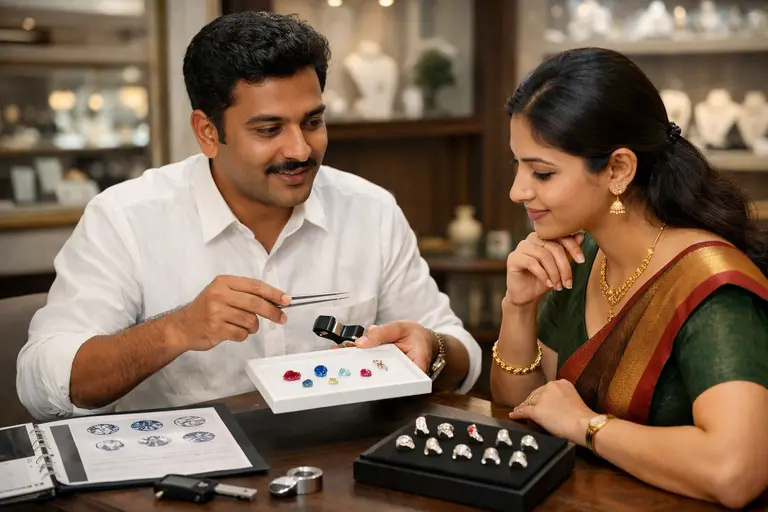
Buying high-end jewelry usually involves deep emotion, as people choose gemstones for beauty, sentiment, or cultural heritage. Customers are certainly the ultimate judges of design and fit. However, technical value follows internationally recognized gemological standards rather than personal taste. For example, many buyers cannot distinguish a natural gemstone from a lab-grown one without professional testing. Specifically, they often mistake natural inclusions for flaws, even though these microscopic markings often confirm a natural origin.
Independent laboratory reports, therefore, become non-negotiable for major purchases. In India, the BIS hallmarking system adds a further layer of protection. Buyers should always verify the Hallmark Unique Identification (HUID) of any piece through the official BIS CARE app. By relying on documented data, you ensure that your rights as a consumer are protected by science. For more details, see our guide on how to read a gemstone grading report.
Watch Buying: Customer Rights in Specialized Industries
Mechanical watches successfully blend complex engineering with centuries of tradition. Nevertheless, many modern buyers compare them solar-synced smartphone clocks. A smartphone syncs electronically with atomic time; in contrast, a mechanical watch runs on hundreds of finely tuned physical parts. Therefore, a small daily variation in timekeeping falls within normal mechanical specifications.
In this context, customers are fully right to flag cosmetic issues like scratches or poor finishing. However, they must accept the technical limitations of mechanical movements. To maintain trust, retailers must set expectations by explaining accuracy ranges before the sale is finalized. Furthermore, repair centers can reduce disputes by photographing every watch before starting a service. For a deeper look at Swiss standards, you can visit the Official COSC (Contrôle Officiel Suisse des Chronomètres) website.
Tech Support: Customer Rights in Specialized Industries
The technology sector creates a unique dynamic where users feel a problem directly, yet engineers must trace its microscopic cause. A frozen application or a fast-draining battery feels incredibly frustrating to a customer. While the user’s experience is valid, the actual cause could involve anything from a software bug to a hardware conflict.
Consequently, diagnosing the issue requires technical analysis rather than simple guesswork. In India, many innovative companies now utilize WhatsApp Business for real-time support. This platform allows users to send screen recordings, which helps technicians identify the issue faster. By providing trial versions and compatibility checks before a purchase, tech firms can reduce future frustration. This proactive approach is a hallmark of building India’s global brands in the tech space.
Travel Services: Customer Rights in Specialized Industries
In the hospitality industry, emotion strongly shapes how a guest judges a service. A poor experience can leave a lasting negative impression even when the staff follows every internal policy correctly. Guests are absolutely right to complain about unclean rooms or missing amenities. However, they may not see the operational reality behind a delay, such as housekeeping needing extra time between checkouts for deep cleaning.
Successful hotels, therefore, focus on “service recovery” rather than debating who is at fault. Honest and transparent communication rebuilds trust faster than any policy manual. In the travel sector, passengers rightly expect accurate pricing; however, airlines cannot control weather-related delays. Real-time updates through mobile apps help ease this frustration, even when an immediate fix is impossible. To see how these experiences are changing, you can read our guide on airports as travel destinations.
India and Customer Rights in Specialized Industries
This balanced approach fits the Indian market exceptionally well because Indian consumers value trust, transparency, and fair value. Jewelers who explain BIS hallmarking build much stronger buyer confidence than those who rely on verbal promises. The spirit of “Atithi Devo Bhava” still shapes hospitality expectations; consequently, hotels that respond with genuine empathy consistently outperform those that follow rigid, cold policies.
Ultimately, customer rights in specialized industries depend on a two-way street of information. When businesses educate their clients about technical standards, and when customers provide honest feedback on their experience, the entire industry improves. This collaborative model ensures that the consumer is respected and the professional’s expertise is valued.
FAQ About Customer Rights in Specialized Industries
Are customers always right regarding gemstone quality?
No. While a customer is always right about whether they like the “look” of a stone, the actual quality, origin, and treatment status are determined by laboratory science and certified gemologists.
Can I demand a refund for a watch that loses 5 seconds a day?
Generally, no. Most mechanical watches have an acceptable daily variation range. You should check the manufacturer’s manual to see if your watch is performing within its specified mechanical limits.
What is my primary right when buying jewelry in India?
Your primary right is to receive a BIS-hallmarked piece with a valid HUID number. This ensures the gold purity matches what the jeweler has claimed.
Why do tech companies ask for so much information during support?
They require specific data to narrow down complex causes. Without knowing your operating system or specific settings, an engineer cannot provide an accurate fix for your problem.
How should I handle a disagreement with a hotel?
You should speak with the manager immediately and stay focused on the specific outcome you want. Professional hotels prioritize your comfort and will usually offer a “service recovery” gesture to make up for the issue.
Disclaimer
This article serves general educational purposes only. Industry practices, regulations, and consumer protection laws vary significantly by region and can change over time. The author has no financial affiliation with the organizations mentioned. Always verify specific details with certified professionals or relevant government authorities before making significant financial or business decisions.