Introduction
The Chanel Watches 2026 Strategy proves that the brand is no longer simply a fashion house that happens to make timepieces. Impressively, Chanel has completed a deliberate transformation into a pure watchmaking player. Unlike other couture brands that license their name to third-party manufacturers, Chanel has built a genuine luxury manufacture with technical credibility.
The Chanel Watches 2026 Strategy is built on a vertically integrated supply chain and a bold ecosystem of strategic partnerships. As a Gemologist who tracks the business of luxury, I find their approach fascinating. They didn’t just buy a factory; they bought into the culture of Swiss watchmaking. In this article, I will break down exactly how Chanel is doing it—from their stake in Rolex’s partner factory to their investment in the avant-garde MB&F. Realistically, this explains why a ceramic J12 is now respected by serious collectors.
From Fashion House to Manufacture
For decades, Chanel occupied an unusual position in the watch world: too prestigious to be dismissed yet not quite taken seriously by purists. However, that tension is now firmly in the past. Throughout 2026, the brand will be restructuring its entire watch division around three interlocking pillars.
- Vertical Integration: Owning the means of production.
- Independent Ecosystem: Buying minority stakes in elite brands.
- Segmentation: Creating a clear ladder from “Icon” to “Art.”
Admittedly, this shift did not happen overnight. It required significant capital and a willingness to operate more like a Swiss manufacture than a Parisian couture house. Nevertheless, the results are visible across every aspect of the brand’s activity today.
Vertical Integration in the Chanel Watches 2026 Strategy
At the heart of the Chanel Watches 2026 Strategy is G&F Châtelain, its Swiss-based production facility. Remarkably, this operation handles the entire manufacturing chain in-house, from R&D to the production of high-tech ceramics. Consequently, owning this capability gives Chanel something most fashion brands lack: genuine control over materials science.
Equally important is Chanel’s 20% stake in Kenissi. In fact, this is the movement manufacturer co-founded by Tudor (Rolex). Consequently, this partnership guarantees a reliable supply of high-performance calibers, including the in-house 12.1 and 12.2 movements. As a result, Chanel is not dependent on the open market (like ETA or Sellita) for its engines. Therefore, a J12 has the same mechanical reliability as a Tudor Black Bay or a Breitling Superocean. Read more about movements in my Bangalore Watch Company guide.
Ecosystem of the Chanel Watches 2026 Strategy
Perhaps the most distinctive element of the strategy is its approach to partnerships. Rather than pursuing full acquisitions—which can kill the creativity of independent brands—Chanel has built a “Minority Stake Ecosystem.”
The Portfolio:
- Notably, F.P. Journe (20% Stake): The most revered living watchmaker.
- Romain Gauthier: A master of finishing.
- Bell & Ross: The aviation watch specialists.
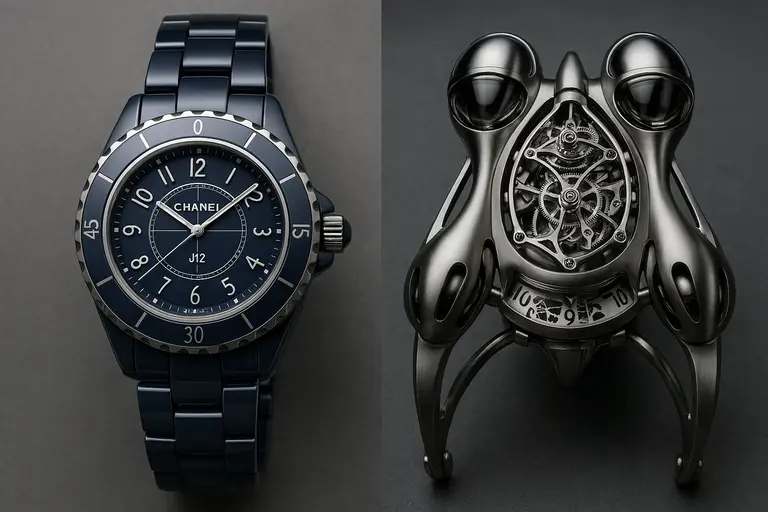
- MB&F (25% Stake): The “Kinetic Art” laboratory I reviewed in the MB&F Watch Brand.
Most recently, Chanel took a 30% stake in Kross Manufacture. Effectively, this model allows Chanel to secure specialized manufacturing capacity while preserving the independence that makes each partner valuable. In essence, Chanel acts as a “Patron of the Arts” rather than a corporate overlord.
Product Segmentation in the Chanel Watches 2026 Strategy
Strategically, Chanel’s product lineup is carefully structured to serve distinct audiences.
The J12 Collection
First, at the foundation sits the J12, the brand’s enduring flagship. For example, the recently launched J12 Bleu series represents a massive leap. Why? Technically, it features a proprietary blue ceramic that required five years of development. As an expert, I know that coloring ceramic without making it brittle is incredibly difficult. This signals Chanel’s commitment to material science. You can compare this to the ceramic innovation in the Hublot Business Model.
Haute Horlogerie
Next, moving up the range, we find pieces like the Monsieur de Chanel (with a jumping hour) and the J12 Caliber 3.1. Additionally, Chanel leverages its jewelry heritage. Fittingly, the “Lion” (Leo) collection features high-jewelry secret watches encrusted with diamonds. Symbolically, the Lion was Coco Chanel’s zodiac sign. Crucially, this connects the watch to the founder’s personal mythology, a powerful tool in luxury marketing. Read about gem setting in the Harry Winston Business Model.
Distribution: Scarcity as Strategy
Furthermore, Chanel watches reach customers through a deliberately narrow channel. They are sold exclusively through Chanel Boutiques and a tightly controlled network of authorized retailers. This selective distribution is a core pillar of the Chanel Watches 2026 Strategy.
Thus, by avoiding broad retail footprints, Chanel maintains the sense of scarcity. Crucially, this approach also gives the brand full control over pricing. Especially in an era where grey market discounting threatens many brands, Chanel’s discipline has helped it maintain stable secondary market values. Therefore, buying a Chanel watch is a safer financial bet than buying many other fashion watches.
Marketing the Chanel Watches 2026 Strategy
On the marketing front, Chanel continues to invest heavily. Simultaneously, the 2026 J12 “Water” campaign, featuring Gisele Bündchen, positions the watch simultaneously as a serious sports timepiece and an object of elegance.
Meanwhile, Arnaud Chastaingt, Director of the Chanel Watchmaking Studio, is pushing boundaries. Ingeniously, he is integrating couture details—like tweed-inspired straps and embroidered dials—into the watches. The result is a body of work that is unmistakably Chanel, yet undeniably serious as watchmaking.
Conclusion: The Quiet Giant
In summary, the Chanel Watches 2026 Strategy proves that a fashion house can become a horological powerhouse. Indeed, by respecting the Swiss tradition while injecting Parisian style, they have created a unique niche. Ultimately, Chanel is not trying to be Rolex. They are trying to be the best version of Chanel. Undeniably, in 2026, that is a very dangerous competitor for the rest of the industry.
FAQ: Chanel Watches 2026 Strategy
Is Chanel considered a serious watchmaker in 2026?
Yes. Through vertical integration at G&F Châtelain and its ownership of movement manufacturer Kenissi, Chanel has established genuine technical credibility well beyond its origins as a fashion house.
What is Kenissi and why does it matter?
Technically, Kenissi is a Swiss movement manufacturer co-founded by Chanel and Tudor (Rolex). This partnership guarantees a supply of industrial-grade, high-performance calibers (70-hour power reserve), giving Chanel independence from Swatch Group suppliers.
Why does Chanel invest in independent brands?
To protect the art. By taking minority stakes in brands like F.P. Journe and MB&F, Chanel ensures these geniuses have the capital to survive without interfering in their creative process. Also, it secures Chanel’s access to high-end know-how.
What makes the J12 Bleu special?
It features a proprietary Blue Ceramic. Admittedly, coloring ceramics is chemically complex. Consequently, Chanel developed a specific pigment that withstands the high firing temperature without burning off, creating a deep, permanent blue.
Where can I buy Chanel watches?
Exclusively at Chanel Boutiques and authorized partners. Strictly, they do not sell new watches on multi-brand e-commerce sites, ensuring price protection and brand exclusivity.