Introduction
In the universe of luxury, Cartier is not just a brand; it is an institution. Famously, King Edward VII of Great Britain called it “The Jeweler of Kings and the King of Jewelers.” However, behind the glamour of the “Red Box” lies a ruthless and brilliant machine. The Cartier Business Model exemplifies a “Classic Luxury” strategy that masterfully blends time-honored heritage with modern commercial power.
Owned by the prestigious Richemont Group (alongside Van Cleef & Arpels Business Model partner VCA), Cartier pursues an “Exclusively Inclusive” approach. This strategy resonates deeply in India, where the brand has a history dating back to the Maharajas. As a Gemologist, I admire Cartier for inventing the “Tutti Frutti” style—using Indian carved gems in Western settings. In this guide, we will explore their core pillars, operational strategies, and why the “Love Bracelet” is the greatest financial invention in jewelry history.
Core Pillars of the Cartier Business Model
At the heart of Cartier’s success lies a framework built on timeless value. First and foremost, the brand’s value proposition transcends mere adornment; it sells status.
The Product Mix
Approximately 75% of its annual revenue stems from High Jewelry and Fine Jewelry. However, the genius of the Cartier Business Model is the balance between “Assets” and “Accessories.”
- High Jewelry: Unique pieces worth millions, often featuring Kashmiri Saffron and Padparadscha level gems.
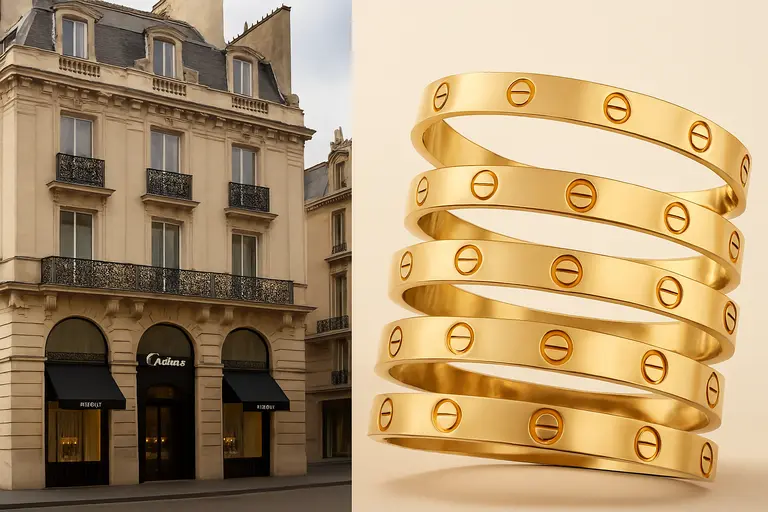
- Icons: The Love Bracelet and Juste un Clou. Crucially, these are mass-produced gold items that never go on sale. They provide a steady cash flow.
- Watches: Cartier is the #2 watchmaker in the world (after Rolex Business Model). The Tank and Santos are legends.
Consequently, this diversification ensures stability. Even if High Jewelry slows down, the Love Bracelets keep selling.
The Indian Connection to the Cartier Business Model
As an Indian expert, I must highlight the bond between Cartier and India. Historically, Cartier’s greatest commission came from India. Remarkably, in 1928, the Maharaja of Patiala commissioned a ceremonial necklace containing 2,930 diamonds (including the De Beers yellow diamond). This relationship changed Cartier’s design language.
Specifically, Jacques Cartier visited India and fell in love with our carved Rubies, Emeralds, and Sapphires. He took these Indian-cut stones (which Westerners thought were “flawed”) and set them in Platinum. The result? The “Tutti Frutti” style. Therefore, when you look at a Cartier piece today, you are often looking at a French interpretation of Indian art. Read more about royal collections in my Madurai Meenakshi Temple Jewels article.
Distribution Strategy of the Cartier Business Model
To safeguard its prestige, Cartier employs a meticulously controlled distribution strategy. Unlike mass-market brands, Cartier shuns discounts. Here, direct retail stands as the cornerstone, with over 200 luxurious boutiques worldwide. These immersive spaces allow customers to experience the brand’s heritage firsthand.
However, the real game-changer in 2026 is E-commerce. Cartier’s virtual boutiques now feature AR (Augmented Reality) try-on tools. For instance, a customer in Kerala can virtually “wear” a Panthère necklace before purchase. This digital pivot democratizes access without diluting the brand image. Compare this to the strategy of Ahmed Seddiqi & Sons in Dubai.
Operational Excellence of the Cartier Business Model
Furthermore, Cartier invests heavily in Savoir-Faire (Craftsmanship). Specifically, they maintain specialized workshops for High Jewelry. Moreover, as a founding member of the Responsible Jewellery Council (RJC), Cartier adheres to the Kimberley Process. This commitment to ethical sourcing appeals to the modern buyer who worries about “Blood Diamonds.”
In addition, Cartier excels in After-Sales Service. For example, restoring a vintage Tank watch or resizing a Trinity ring keeps the customer in the ecosystem for life. Thus, the Cartier Business Model relies on “Lifecycle Value,” not just a one-time sale. If you are interested in ethical sourcing, read my Future of Single Mine Origin Gold guide.
Target Audience of the Cartier Business Model
Who buys Cartier? Primarily, it serves High-Net-Worth Individuals (HNWIs) who buy for investment. Yet growth hinges on younger demographics: Millennials and Gen Z.
Why do they buy?
- First, Investment: A diamond-encrusted Love Bracelet often holds its value better than the stock market.
- Second, Status: Undeniably, it is instantly recognizable on Instagram. For example, global ambassadors like Deepika Padukone bridge the gap between Indian heritage and global fashion. Consequently, Cartier has successfully transitioned from being an “Old World” brand to a “Pop Culture” icon.
Conclusion: The Red Box Mystique
In summary, the Cartier Business Model thrives by harmonizing scarcity with accessibility. They sell a $50,000 watch and a $1,000 ring with the same level of prestige. Ultimately, Cartier proves that true luxury is not about price; it is about consistency. Whether in Paris or Mumbai, the Red Box means the same thing: You have arrived.
FAQ: Cartier Business Model
What percentage of Cartier’s revenue comes from jewelry?
Approximately 75% comes from jewelry (both High and Fine), making it the dominant stream. The remaining 25% comes largely from their highly successful watch division.
How does Cartier maintain exclusivity?
Through Price Control and Distribution. You will never find a new Cartier item on sale. Simultaneously, they also limit wholesale partners, preferring to sell through their own boutiques to control the experience.
What is the “Tutti Frutti” style?
It is a signature Cartier style inspired by India. Visually, the design features carved Rubies, Emeralds, and Sapphires set in Platinum to resemble leaves, fruits, and berries. Essentially, it represents a fusion of Mughal art and Art Deco.
Is Cartier jewelry a good investment?
Yes. Iconic collections like the Love, Juste un Clou, and Panthère have high resale value. In fact, vintage Cartier pieces often auction for multiples of their original price.
Who owns Cartier in 2026?
The Richemont Group. Currently, Cartier is the flagship brand of this Swiss luxury conglomerate, providing the bulk of the group’s profits.