Introduction
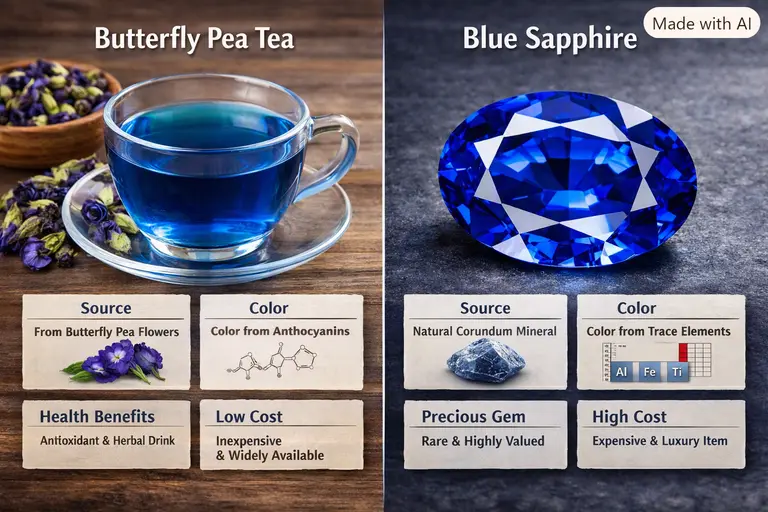
What connects blue tea with blue sapphire? Both show a striking blue, yet they come from different worlds. Blue tea acts as an herbal infusion that people brew from butterfly pea flowers, Clitoria ternatea. In contrast, blue sapphire represents a blue variety of corundum, the mineral that also forms ruby. However, similar colour does not mean similar chemistry, origin, or value. Therefore, this guide explains the difference in simple terms. By understanding what sets these two natural wonders apart, you will appreciate their unique properties and shop for your next piece with absolute confidence. Dive deeper into their differences with our guide on Gemology and Jewellery Education.
Why Blue Tea Looks Like Blue Sapphire
Butterfly pea flowers contain ternatins, which are anthocyanin pigments that give the infusion its vivid blue. Additionally, they react to acidity. So, lemon juice can shift the drink from blue to violet, purple, or reddish shades. Blue sapphire, by contrast, gets its colour from trace elements and crystal structure. It ranges from light blue to deep, velvety tones. Thus, calling a cup of tea “sapphire blue” serves as a poetic comparison, not a scientific one. Our guide to butterfly pea flower explains natural food colours in greater detail.
Popularity and Cultural Context
Is blue tea popular only in India?
No. In fact, Malaysian cooks use the flower to colour nasi kerabu, and Thai kitchens add it to drinks and desserts. Meanwhile, India maintains its own long relationship with the plant, which is known as aparajita. Gardens across Keralam commonly grow it as shankupushpam. Additionally, the United States permits butterfly pea flower extract as a colour additive for certain foods, though that permission does not cover every item. Overall, blue tea has Asian roots and global appeal.
The market for blue sapphire in India
Unlike the herbal drink, blue sapphire—or neelam—holds a significant position in Indian culture, particularly for its role in Jyotish traditions. Because demand remains high, buyers must distinguish between natural stones, treated varieties, and laboratory-grown options. While the visual appeal of a blue-hued drink is fleeting, the investment in a gemstone requires a permanent, verifiable identity.
Are There Imitations of Blue Tea and Blue Sapphire?
Yes, but each market needs a different approach. With blue tea, first read the ingredient list and check the seller’s reputation. For example, a genuine product names butterfly pea or Clitoria ternatea. Still, a vivid colour cannot prove purity, because blends can look equally bright. Similarly, the lemon test cannot prove it either, since other pigments change colour too.
Blue sapphire imitations, for instance, include glass and other blue gemstones. Synthetic sapphire is different, though. Laboratories grow it as real corundum; so, it shares the natural stone’s chemistry. Consequently, gemologists use microscopes and spectroscopy to separate natural, synthetic, and imitation stones. Our guide to natural and synthetic gemstones explains how these tests identify the truth behind the sparkle.
What Consumers Should Beware Of
When you buy blue tea, check the label and seller. In addition, the Food Safety and Standards Authority of India (FSSAI) regulates packaged foods. An ordinary herbal drink differs from a concentrated supplement, and health claims do not automatically prove medical benefit. Therefore, if you take medication or have a medical condition, ask a professional before you try concentrated products.
Likewise, when you buy blue sapphire, ask whether the stone is natural or laboratory-grown, and then ask about treatment. Indeed, heat treatment is an accepted trade practice, not automatically a flaw. In fact, many sapphires undergo heat or lattice diffusion treatment. Ask whether the seller discloses treatment and whether the price reflects it. For a valuable stone, an independent laboratory report helps. It can state whether the stone is natural, note detectable treatments, and offer an opinion on geographic origin.
How Experts Assess Quality
First, blue tea has no gemological grade. Instead, you judge it by ingredients, packaging, and labelling. Blue sapphire, on the other hand, follows a different path. Certainly, colour, clarity, cut, and carat weight shape its beauty and price. However, no universal grade exists, unlike the 4Cs for diamonds. In fact, the Gemological Institute of America (GIA) states that it does not grade sapphire or other coloured stones. Instead, its reports identify the stone and disclose detectable treatments. Thus, use the word “certificate” carefully.
Why Certification Means Different Things
Clearly, food and gemstones need different paperwork. For example, packaged tea needs documents covering food safety, ingredients, and legal compliance. In contrast, a valuable sapphire benefits from an independent report. Above all, do not confuse an approved ingredient with a pure or superior product. Likewise, do not treat a gem report as a guarantee of market value.
Frequently Asked Questions
Which gemstone has a colour similar to blue tea?
Blue sapphire offers the closest match because it can show vivid blue. However, tea colour shifts with concentration, pH, and brewing.
Does lemon prove that blue tea is genuine?
No, because lemon reveals pH sensitivity, but a colour change cannot confirm purity.
Is blue sapphire always natural?
No, because laboratories also grow sapphire, and sellers may offer imitations. Do not rely on appearance alone.
Does every blue sapphire need a laboratory report?
Not necessarily. However, a report matters most for high-value stones or when origin is important to the buyer.
Is blue sapphire graded like diamond?
No, because GIA does not grade coloured stones. Instead, its reports disclose detectable treatments.
Is blue tea actually tea?
In daily speech, yes. Botanically, butterfly pea comes from Clitoria ternatea, not Camellia sinensis, the plant behind conventional tea.
Disclaimer
This article offers general educational information only. Evaluate food products against applicable food-safety and labelling requirements. Ask qualified gemologists or independent laboratories to examine valuable gemstones. Because regulations and practices change, verify current information before any important purchase. The author has no financial affiliation with the labs, brands or organizations mentioned.