Introduction to our Actinolite Gemstone Guide
Welcome to our Actinolite Gemstone Guide, where we explore a striking green mineral that millions of people wear every day without even knowing it. Specifically, actinolite forms the structural backbone of nephrite jade, which remains one of the most historically significant gemstones in East Asian cultures. At the same time, some specific forms of this mineral belong to the regulated asbestos family, which makes it essential to understand both the beauty and the safety of the stone before you buy. Therefore, this guide breaks down everything in plain language to help you shop wisely and safely.
In this Actinolite Gemstone Guide, we break down every detail in plain language. Specifically, we explore what actinolite is, how to identify it, whether it is safe for your health, and how to shop for it wisely in 2026. Therefore, even first-time buyers can make confident decisions without needing specialist training. You should also read our guide on gemstone buying mistakes to understand how quality standards apply to all metamorphic minerals.
Origins in the Actinolite Gemstone Guide
Actinolite forms deep within the Earth’s crust when intense heat and pressure transform existing rocks through a process called metamorphism. Specifically, it develops in metamorphic environments such as greenschists and amphibolites. Furthermore, it frequently appears in magnesium-rich limestones. As a result, these specific environments provide the calcium, magnesium, and iron that actinolite needs to crystallize into its signature form.
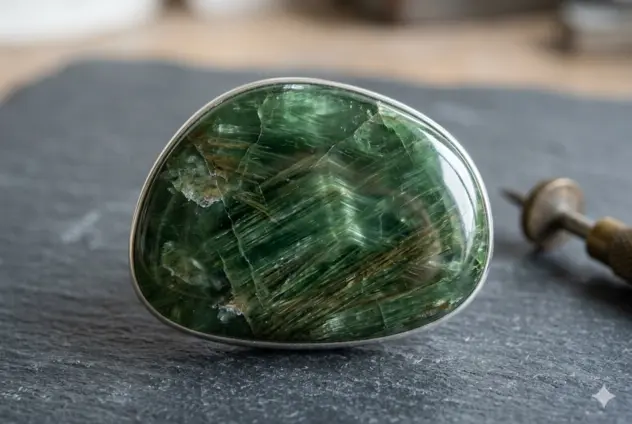
In terms of chemical composition, actinolite belongs to the amphibole group, which is a large family of silicate minerals. Moreover, it sits in a mineral series between magnesium-rich tremolite and iron-rich ferro-actinolite. Its color typically ranges from pale chartreuse to a very dark, forest green, depending on the iron content. More iron, therefore, results in a deeper and richer green hue. The name originates from the Greek words aktis (“ray”) and lithos (“stone”), referring to the radiating, needle-like crystals that the mineral often produces. To see more about the geological localities of these finds, you can visit Mindat.
Identification Tips for the Actinolite Gemstone
You do not need to be a professional scientist to recognize the basic features of this mineral. First, you should examine the color; it usually runs from light to dark green, though gray-green and nearly black shades occasionally appear. Second, you must check the hardness. This mineral scores about 5.5 to 6 on the Mohs hardness scale. This means a common steel knife can scratch it relatively easily.
Optical Data in this Actinolite Gemstone Guide
Additionally, actinolite possesses two directions of perfect cleavage. This causes the stone to split or chip along flat planes if you strike it with force. Furthermore, its refractive index ranges from approximately 1.60 to 1.68. Trained gemologists utilize these specific numbers to confirm an identification under proper laboratory instruments. For professional testing standards, you can refer to the Gemological Institute of America or Gemmological Institute of India.
Beyond these basic properties, the mineral appears in several distinct forms that are worth knowing:
- Nephrite Jade: A dense, interlocking mass of actinolite fibers that creates exceptional toughness.
- Actinolite-in-Quartz: Clear quartz with green needle inclusions, often sold as “Garden Quartz.”
- Cat’s-Eye Actinolite: A rare cabochon that shows a bright band of light across its surface.
- Byssolite: A form consisting of fine, hair-like fibrous crystals.
Safety Information in the Actinolite Gemstone Guide
This is the question that most buyers ask first, and the answer is a definitive yes—as long as the stone is polished and compact. Specifically, finished gemstones and carvings made from actinolite do not release harmful fibers during normal daily wear. Therefore, you can wear a nephrite pendant or carry an actinolite-in-quartz stone without any health concerns.
However, raw, fibrous actinolite is one of the six minerals that international regulatory agencies classify as regulated asbestos. When workers cut, grind, or break raw fibrous material without protection, they produce microscopic airborne particles. Long-term inhalation of these particles is linked to serious conditions like asbestosis. Consequently, the real risk exists only for lapidaries and miners who handle the raw material. If you are a buyer of finished jewelry, the polishing process seals the fibers safely. Therefore, you should always buy from reputable dealers who ensure their pieces are properly finished.
Purchasing Tips from our Actinolite Gemstone Guide
Because actinolite chips relatively easily due to its cleavage, jewelers rarely use it as a center stone in rings. Instead, it works best in pendants, earrings, and brooches that receive less daily physical impact. That said, several related options suit a wide range of budgets. For instance, nephrite jade objects remain widely available and affordable for most shoppers.
Similarly, actinolite-in-quartz cabochons offer a visually striking look at modest prices. These “needle quartz” pieces make an excellent entry point for new collectors. In contrast, rare transparent faceted actinolite commands higher prices among specialty collectors. One important caution: sellers sometimes label green actinolite loosely as “Jade.” This matters because true nephrite and jadeite carry different values. Therefore, you should always ask for written documentation for any higher-value purchase. You may also read our article on Understanding BIS Hallmark to see how certification protects jewelry buyers.
Caring for the Actinolite Gemstone
Caring for your actinolite jewelry is quite straightforward. First, you should clean it using warm soapy water and a very soft brush. Then, rinse the stone gently and dry it with a soft cotton cloth. In contrast, you must avoid ultrasonic cleaners and steam cleaners entirely. Sudden temperature or pressure changes can worsen internal fractures along those delicate cleavage planes. Additionally, you should store actinolite pieces separately from harder gems like diamonds or sapphires, which can scratch the surface over time.
FAQ: Actinolite Gemstone Guide
Is actinolite the same as jade?
No. Actinolite is a single mineral species, while nephrite jade is a tough rock composed primarily of interlocking actinolite-series fibers.
Is it safe to handle raw actinolite?
You should avoid handling raw fibrous actinolite without proper safety gear. Once the stone is polished into a gemstone or carving, it is perfectly safe for the wearer.
Where is actinolite found?
Major deposits exist in Canada, Taiwan, the United States, and Russia. Specifically, the finest gem-quality nephrite often comes from British Columbia or New Zealand.
How can I tell if my “Garden Quartz” is real?
Natural actinolite needles in quartz will appear irregular and have a distinct green color. Specifically, a professional can confirm the identity using a 10x jeweler’s loupe to look for natural growth patterns.
What is the best way to buy actinolite?
You should always purchase from established dealers who provide clear disclosures. Specifically, look for certificates that specify whether the stone is actinolite, nephrite, or inclusion quartz.
Disclaimer
This Actinolite Gemstone Guide provides general educational information only. It does not replace professional medical or legal advice. If you suspect asbestos exposure, please consult a qualified health professional. Always have your gems verified by an accredited laboratory. The author holds no financial affiliation with the mining regions mentioned.