Summary
Most people think pearls only come from oysters, but nature offers much more. Rare natural pearls form in conch, melo, abalone, clams, and scallops. Knowing about these pearls helps collectors, jewelers, and buyers recognize unique gems.
Pearls Beyond Oysters
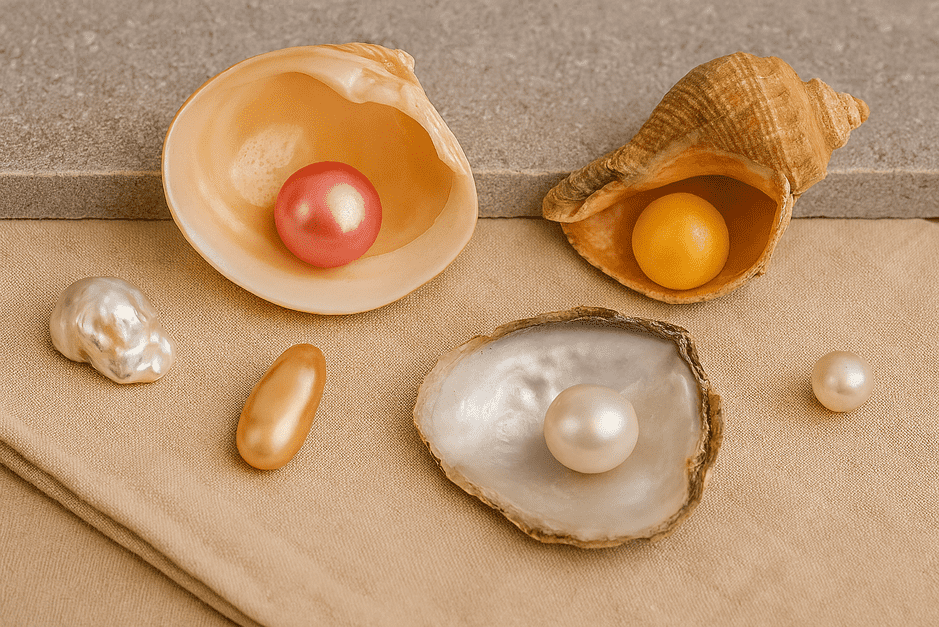
People often associate pearls only with oysters. However, rare natural pearls can form in several mollusks. Conch, melo, abalone, clam, and scallop pearls are non-nacreous and prized for their colors, textures, and rarity. For example, see our Natural vs Cultured Pearls guide.
Conch Pearls
- Produced by the Queen Conch in the Caribbean
- Non-nacreous with no mirror-like luster
- Famous for pink tones and flame-like patterns
- Rare and highly valuable in collections and jewelry
Additionally, you can read more about conch pearls on GIA for collector insights.
Melo Pearls
- Found in the Melo marine snail of Southeast Asia
- Colors range from orange to brown with a porcelain-like texture
- Large sizes increase demand at auctions
- Highly sought after by collectors
Moreover, Melo pearls provide detailed information on their origin and characteristics.
Abalone Pearls
- Produced by abalone in cold Pacific waters
- Iridescent with blue, green, and purple hues
- Each pearl has a unique play of color not found in oysters
- In addition, these pearls are often used in high-end jewelry.
Clam Pearls
- Form inside giant clams in the South Pacific
- Typically creamy or white in color
- Rare natural pearls often kept in private collections
- Similarly, clam pearls are treasured by collectors who value rarity.
Scallop Pearls
- Extremely rare, found in scallops from the Americas
- Can display deep purple shades
- Almost unknown outside gem circles
- Consequently, scallop pearls are among the rarest natural gems in the world.
Why Knowing This Matters
If you only consider oyster pearls, you miss the bigger picture. Collectors value rare pearls for their uniqueness, and jewelers prize their unusual colors and origins. Therefore, understanding pearls beyond oysters allows you to:
- Recognize natural versus cultured pearls (learn more in our Pearl Buying Guide for Malayalis)
- Make informed jewelry purchases
- Impress others with specialized gem knowledge
Next time you see a pink conch pearl or an orange melo pearl, you will immediately recognize its rarity and significance.
FAQ
Q1: Are conch and melo pearls real pearls?
Yes, they are natural non-nacreous pearls prized for their color and patterns.
Q2: Why are these pearls rare?
They form in specific mollusks under unique natural conditions, making them scarce.
Q3: Can these pearls be used in jewelry?
Absolutely. Jewelers value them for their unique colors, textures, and rarity.
Q4: How do they differ from oyster pearls?
They are non-nacreous, display different colors and textures, and are generally rarer than cultured oyster pearls.