Summary
Many home diamond tests—scratching glass, fogging, or checking sparkle—don’t prove authenticity. Learn why these methods fail and discover safe, reliable ways to test your diamond.
Introduction
Many people rely on old diamond tests that don’t work, like scratching glass, fogging the stone, or checking sparkle. These DIY methods are misleading and can even damage your gem. In this guide, you’ll learn why these tests fail and discover safe, professional ways to confirm if your stone is a real diamond.
You’ve probably heard someone say, “If it scratches glass, it’s a diamond.”
It’s one of the most repeated myths in the jewelry world. I’ve explained this countless times to buyers, sellers, and collectors. Let’s break down the most common “tests” and why they fail.
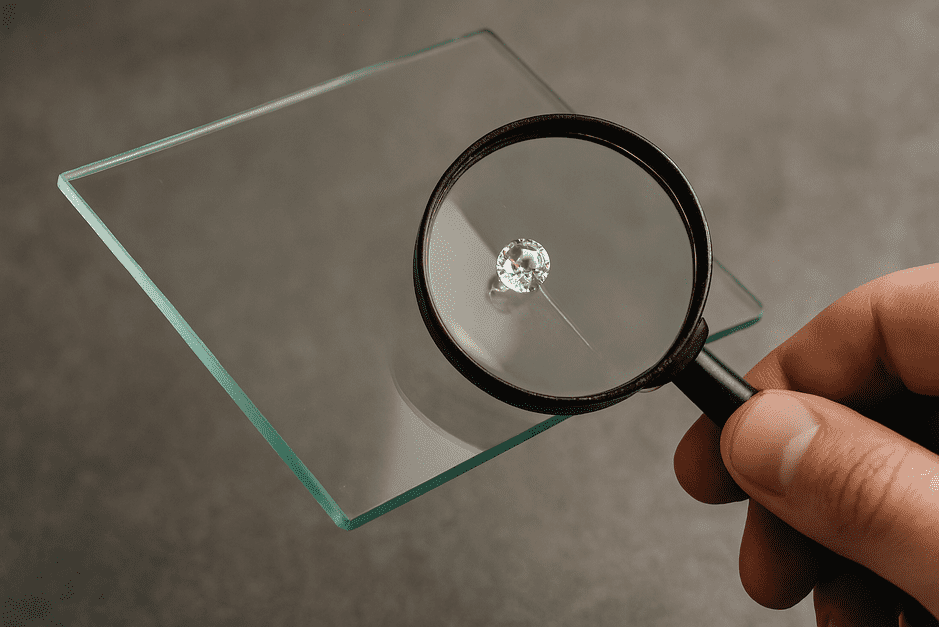
1. Scratching Glass
Diamonds are hard, but so are stones like quartz or moissanite.
Many gems can scratch glass. That doesn’t make them diamonds.
You risk damaging your stone if you try this.
Think about it—scratching a window with a key doesn’t turn your key into a diamond.
2. The Fog Test
Some say if you breathe on a diamond, it shouldn’t fog up.
In reality, almost any polished stone clears quickly.
Temperature and humidity also affect this test.
Gem labs rely on advanced tools, not breath, to verify authenticity.
3. The Lighter or Heat Test
Heating a stone with a lighter doesn’t prove it’s real.
Sudden heat can crack or fracture gems.
Lab-grown diamonds and natural diamonds react the same way.
Would you burn money to see if it’s real? Then don’t burn a diamond.
4. Sparkle or “Rainbow” Test
Sparkle alone can mislead.
Cubic zirconia and moissanite sparkle more than diamonds.
Lighting conditions change everything.
If you’ve seen a disco ball, you know sparkle isn’t proof.
5. Weight Check
Some try to guess authenticity by weight.
Cubic zirconia is heavier than diamond, but a few grams difference is hard to detect by hand.
Weight alone can’t confirm your stone.
The Better Way
If you want to know if your stone is a diamond:
- Use a professional diamond tester.
- Ask a certified gemologist.
- Request a lab report from GIA, IGI, or HRD.
These methods give answers you can trust.
For more insights, check out my guide on diamond certification and how to identify moissanite.
FAQ
Q1: Can a diamond scratch glass?
Yes, but so can other stones like quartz or moissanite. Scratching glass isn’t proof.
Q2: Does fogging test work?
No. Temperature and humidity affect fogging. Polished stones clear quickly.
Q3: How can I safely test a diamond?
Use a professional tester, certified gemologist, or lab report from GIA, IGI, or HRD.
Q4: Are home sparkle or weight tests reliable?
No. Sparkle and weight can mislead. Only lab-grade tests confirm authenticity.