
Introduction
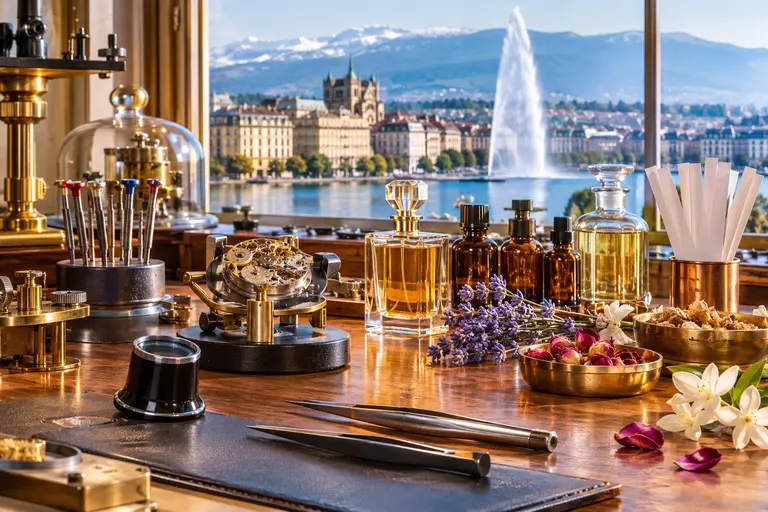
How did one small Swiss city earn global fame for both luxury watches and fine fragrances? The answer lies in craftsmanship, scientific innovation, and smart business choices. Although watchmaking began in the 16th century, the fragrance industry grew significantly in the 19th century through advances in organic chemistry. Nevertheless, both industries followed the same strategy: instead of chasing production volume, the Geneva luxury industry built specialised expertise, protected deep knowledge, and maintained strict quality standards. As a result, the city created a unique ecosystem where scientists, artisans, and entrepreneurs work together. Moreover, this story offers practical lessons for the 99%, including everyday shoppers, independent professionals, and small business owners. By understanding how these industries evolved, you learn how to value skill over mere branding. For more background, read our guide to buying your first mechanical watch.
How Geneva Became the Geneva Luxury Industry Home
Skilled Refugees and Geneva Luxury Industry Reforms
Geneva’s watchmaking story starts in the mid-16th century. During the Protestant Reformation, skilled artisans, including French Huguenots, fled persecution and settled in the city. Meanwhile, John Calvin’s reforms restricted the wearing of ornamental jewellery, and many historians link these rules to goldsmiths pivoting toward watchmaking. However, no single decree caused the shift, because Geneva introduced its restrictions gradually. Therefore, local goldsmiths combined their engraving and metalworking skills with the mechanical knowledge of the newcomers. In 1601, Geneva founded its Watchmakers’ Guild, which many sources identify as the first of its kind. Thus, the city rapidly improved its training and technical standards.
Specialisation, the Geneva Seal, and the Luxury Industry
Over time, Geneva watchmakers divided their work into specialised tasks. Some artisans built movements, while others crafted cases, springs, dials, and decorations. Furthermore, this internal teamwork improved precision and finishing across the industry. However, the city’s reputation also attracted imitators who borrowed the Geneva name. Consequently, authorities introduced the Poinçon de Genève, known as the Geneva Seal, on 6 November 1886. Today, Vacheron Constantin still submits its watches for the Seal. Patek Philippe, on the other hand, left the scheme in 2009 to apply its own proprietary quality criteria. Additionally, Geneva’s engineers, suppliers, and training schools strengthen the wider industry. Read our guide on Swiss watch brands for a breakdown of heritage makers, modern favorites, and what sets them apart.
How Geneva Became a Fragrance Capital
Organic Chemistry and the Geneva Luxury Industry
Geneva’s fragrance story followed a different path. In the 19th century, Switzerland built a strong tradition in organic chemistry. Traditionally, perfumers extracted scents from flowers, plants, and woods. However, chemists later created synthetic aromatic compounds that copied natural smells or invented entirely new ones. As a result, perfumers gained consistent ingredients and a wider creative palette, although natural materials still matter greatly. Moreover, the Rhône River supplied the necessary cooling water for production, and hydroelectric power supported factories. Likewise, the city’s closeness to France connected local chemists with the organic chemical industry around Lyon and with perfumers from Paris and Grasse.
Givaudan, Firmenich, and the Geneva Luxury Industry
Two companies shaped Geneva’s fragrance reputation. Brothers Léon and Xavier Givaudan founded Givaudan in Zurich in 1895, moving to Vernier, near Geneva, in 1898. Meanwhile, chemist Philippe Chuit and businessman Martin Naef started Firmenich in Geneva in 1895. In 2023, Firmenich merged with DSM to form dsm-firmenich. According to the Swiss government’s About Switzerland publication, companies in the Geneva region hold roughly 30% of the global flavours and fragrances market. In addition, around 400 chemical companies operate in the region, and the sector employs about 10,000 specialists. Hence, ordinary shoppers meet Geneva’s science in soaps, detergents, drinks, and packaged foods. Explore the guide on how perfume is made to learn how raw botanicals and aromatic oils are blended into finished fragrances.
What Gives the Geneva Luxury Industry Its Edge
Quality Over Quantity in the Geneva Luxury Industry
Swiss watchmakers cannot match mass producers in China or Japan on sheer volume. Instead, they focus on complex engineering, hand finishing, serviceability, and heritage. Similarly, fragrance companies compete through research, proprietary ingredients, and long-term customer relationships. Nevertheless, a high price does not guarantee better performance, so shoppers should still check materials, workmanship, and reliability before they invest.
Intellectual Property and Talent in the Luxury Industry
Intellectual property gives Geneva another major advantage. Fragrance companies patent some innovations and keep others as trade secrets. Likewise, watchmakers protect their designs, technologies, and know-how. Furthermore, Geneva’s concentration of chemists, perfumers, engineers, and watchmakers encourages collaboration and fresh ideas.
Standards, Trust, and Heritage in the Geneva Luxury Industry
Two designations deserve a clear distinction. First, “Swiss Made” is a legal label; since 2017, at least 60% of a watch’s manufacturing costs must arise in Switzerland. The Geneva Seal, on the other hand, is a voluntary certification for mechanical watches that makers assemble, adjust, and case in the Canton of Geneva. Therefore, the two labels are not interchangeable. Although both build consumer confidence, neither guarantees the best financial value.
Luxury Industry Lessons for Everyday Consumers
Geneva offers practical lessons for the 99%. First, shoppers should look beyond famous logos. When buying a watch, check the movement, accuracy, and serviceability. Likewise, when choosing a fragrance, consider its composition, concentration, and longevity instead of trusting advertising alone. Second, small businesses should avoid competing only on price. For example, an independent jeweller can stand out through gemstone education and transparent pricing. Similarly, a local perfumer can build a loyal following through original blends. Third, creators should protect their original designs and formulas. Finally, businesses must adapt when technology shifts. History shows that companies that innovate, like the Swiss watchmakers who embraced the Swatch in 1983, survive and thrive. Explore our guide to gemstone buying for beginners to learn how to evaluate cut, clarity, and authenticity before you shop.
Frequently Asked Questions
Why is Geneva famous for both watches and fragrances?
Geneva built two specialised industries at different times. Skilled artisans created its watchmaking tradition in the 16th century, while organic chemistry powered its fragrance industry in the 19th century.
Does Geneva produce the most watches and perfumes?
No. Geneva succeeds through expertise, research, craftsmanship, and high-value products rather than sheer production volume.
Can another city replace Geneva?
Glashütte, Tokyo, Grasse, and Holzminden have strong capabilities. Nevertheless, matching Geneva’s combined heritage, talent, and reputation remains difficult.
Can small businesses apply Geneva’s model?
Absolutely. Independent jewellers, perfumers, and food producers can stand out through knowledge, transparency, and craftsmanship.
Disclaimer
This article offers general educational information. Historical interpretations and industry statistics vary between sources and can change over time. Swiss Made and the Geneva Seal are separate designations with specific legal and technical requirements. Always assess product quality and value individually rather than judging by origin alone. The author has no financial affiliation with the brands or organizations mentioned.