Introduction
Imagine a river that looks like a giant, flowing gemstone. In Colombia, Caño Cristales creates this stunning illusion, and travellers often call it the “River of Five Colours.” Meanwhile, precious opals flash similar reds, greens, and blues in jewellery shops around the world. However, these two wonders create their colours in completely different ways. Therefore, this article explains both phenomena, so you can understand the science of colour better and purchase gemstones with greater confidence. Moreover, you will learn simple lessons that help you enjoy nature and fine jewellery even more. Whether you admire natural landscapes or faceted gems, you need to understand the source of their beauty to appreciate them fully. Before you explore these optical marvels, read our guide to colourful gemstones to get the necessary background.
Caño Cristales: A Natural Wonder Like Gemstones
How Caño Cristales Plants Create Colourful Wonders
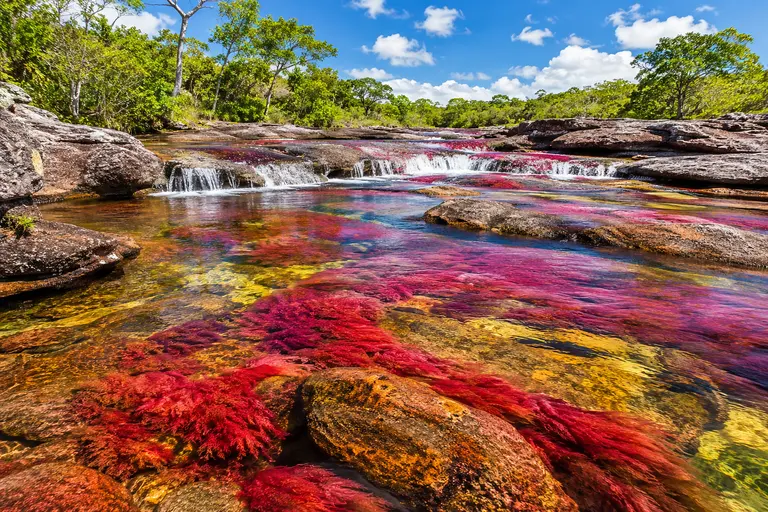
A small aquatic plant called Rhyncholacis clavigera paints the riverbed. Botanists formerly called it Macarenia clavigera, and many people still use that older name. The plant belongs to the Podostemaceae family, and it grows only in a few rivers in Colombia’s La Macarena region. It clings tightly to submerged rocks where the water flows fast. As it grows, its leaves shift from green to yellowish and finally to shades of deep red. Moreover, yellow sand, algae, and dark rocks add extra colours to the scene. Colombia’s national parks authority shares official information about the area on its National Natural Parks website.
Why Caño Cristales Changes Colour Like a Gemstone
Water levels and sunlight control the show. For most of the year, the plants look green, grey, or brown. However, when the rains ease and the water level falls, more sunlight reaches the plants, and brilliant red and pink shades appear. In contrast, when the water runs high and fast, sunlight reaches the plants less easily, so the colours stay muted. Similarly, when the water falls too low, the plants lose moisture and can suffer permanent damage. Importantly, the river water itself stays clear because it carries very few nutrients and particles. Consequently, the river gets its colour from living plants, not from dyes or coloured minerals. Therefore, visitors should follow local rules that protect this fragile ecosystem.
Precious Opals and Other Colourful Wonders
How Precious Opals Display Colourful Wonders
Precious opals flash red, orange, yellow, green, blue, and violet as you move the stone. Gemologists call this effect “play-of-colour.” Inside the gem, tiny silica spheres stack in an orderly, grid-like pattern. When white light enters, it bends between the spheres and splits into spectral colours through diffraction and interference. Specifically, the size of the spheres decides the colour. Smaller spheres produce blue and violet, while larger spheres produce orange and red. However, common opal lacks this orderly pattern, so it shows no play-of-colour. Furthermore, the Gemological Institute of America (GIA) offers a clear beginner’s guide to understanding how these stones work.
Water Content and Opal Care
Opal is hydrated silica, meaning it contains internal water. Nevertheless, this internal moisture does not create the play-of-colour; the internal sphere pattern does. Still, moisture levels affect stability. For example, hydrophane opals absorb water, and this can temporarily change their appearance and weight. Additionally, heat and sudden temperature shifts can cause “crazing,” which creates a network of fine, damaging cracks. Therefore, keep your opal jewellery away from strong heat and prolonged sunlight. Also, ask a specialist before you soak any stone, because improper soaking can harm some varieties. Read our jewellery care tips for maintenance advice.
Three Opals That Echo Colourful Caño Cristales
Black Opal as a Colourful Wonder
Black opal, famous from Lightning Ridge in Australia, sets vivid flashes against a dark body. Similarly, Caño Cristales shows bright plants against dark rocks. As a result, black opal makes a dramatic match for the river’s darker scenes. Moreover, its strong contrast makes the colours look even brighter.
Fire Opal as a Colourful Wonder
Fire opal glows with a yellow, orange, or red body colour. Some stones also show play-of-colour, but many do not. Likewise, the river’s sunlit sand and red plants create warm, golden scenes. However, remember that body colour and play-of-colour are different traits. Therefore, always ask a seller which of the two a stone actually shows.
White and Crystal Opal as Colourful Wonders
White opal has a light body, while crystal opal looks transparent to semitransparent. Both can show soft flashes of colour. Consequently, they remind many people of the river’s clear, gentle pools. Although they look gentler than black opal, they prove that the same optical effect can create very different moods.
Lessons from These Colourful Wonders for Buyers
First, separate body colour from play-of-colour. Body colour is the stone’s background shade, while play-of-colour is the shifting flash. Similarly, the river’s water holds no coloured minerals. Second, check an opal from several angles and under different lights, because its colours change with the view. Third, protect your opal from heat, just as the river’s plants need balanced conditions. Finally, ask the seller to state clearly whether the opal is natural, laboratory-grown, or imitation. Laboratory-grown opals show genuine play-of-colour, yet nobody mines them. Imitations may use glass or plastic. Therefore, never judge origin by appearance alone. Moreover, request a written identification for any expensive purchase, and consider a report from a recognised laboratory. See our how to buy gemstones safely guide.
What Nature Teaches Us
Overall, these two wonders show that similar colours can have very different causes. In the river, living plants and changing water create the display. In the opal, tiny spheres and light create it. Consequently, when you see a colourful stone or landscape, you should ask what really causes the colour. Furthermore, this habit helps you choose gemstones wisely and respect fragile natural places.
Frequently Asked Questions
Why do people call Caño Cristales the River of Five Colours?
The riverbed shows red, yellow, green, blue, and black, with red standing out most. Aquatic plants, clear water, and sunlight work together to create this.
Do opals and Caño Cristales make colour the same way?
No. The river gets its colour from living plants. In contrast, precious opals make colour when light bends through a microscopic silica structure.
Does water create the colours in opal?
No. Opal contains water, but the arrangement of tiny silica spheres creates the play-of-colour.
Which opal looks most like Caño Cristales?
No single opal matches the river exactly. However, black opal offers dramatic flashes, while fire opal offers warm tones.
Can an opal lose its play-of-colour?
Damage such as crazing can dull an opal’s beauty. Therefore, store and wear your stone with great care.
Are laboratory-grown opals real gemstones?
They are real materials made in a laboratory, but they are not natural stones. They differ from imitations, which use glass or plastic.
Disclaimer
This article offers educational information. Visual checks cannot confirm identity or origin. Consult a qualified gemologist for valuable purchases. The author has no financial affiliation with the brands or organizations mentioned.