Disclosure: This post contains Blue Nile diamond colour tools and affiliate links for our jewellery retail guide. If you make a purchase through these links, I may earn a small commission at no extra cost to you
Introduction
Shopping for a diamond online feels exciting, but navigating the diamond colour scale often confuses first-time buyers. Fortunately, Blue Nile offers a helpful guide to understand diamond colour for beginners. However, a single letter on a grading report tells only part of the story. Professional laboratories grade stones under controlled conditions, while you will view your stone face-up in a real-world setting. Therefore, this article explains how diamond colour impacts your ring’s look and value. In addition, it shows you how to compare different stones effectively so you can choose a diamond that appears beautiful while staying well within your budget. By understanding these subtle nuances, you avoid overpaying for features that the eye cannot see. If you want a deeper dive into the technical details, read our guide to understanding the 4Cs of diamonds.
How the Diamond Colour Scale Works
The Gemological Institute of America (GIA) introduced the D-to-Z colour scale in the early 1950s. The scale measures how colourless a diamond appears. It starts at D and moves toward Z as yellow or brown tints grow stronger. GIA places D, E, and F in the “Colorless” group, while G, H, I, and J fall into the “Near-Colorless” range. Blue Nile also lists K, which belongs to the “Faint” group. Because most shoppers browse the D through J range, this article focuses on those primary grades.
Colorless Diamonds and Diamond Colour Grades
Do You Need to Pay a Premium for Diamond Colour?
D represents the top grade; under standard laboratory conditions, a D-colour diamond shows no visible body colour. E and F also earn the “Colorless” label, although trained graders can spot tiny differences between them. These stones carry a significant price premium because they are inherently rare. However, many people struggle to tell D, E, and F apart without a strict side-by-side comparison. Accordingly, ask yourself whether the extra cost truly improves the ring you actually plan to wear daily. Still, if you love owning one of the rarest available grades, a Colorless stone remains a perfectly logical choice.
Near-Colorless Diamond Colour Grades from G to J
Why Near-Colorless Diamond Colour Grades Appeal to Buyers
Near-Colorless diamonds balance high quality and cost-effectiveness. Although they may hold a faint yellow or brown tint, many still look bright and white when set in a ring. G and H grades offer an appearance close to “Colorless” without the full price premium. Meanwhile, I and J cost less still, but their warmth can show more in larger stones and certain shapes. Consequently, you should inspect the actual diamond instead of trusting the letter on the report alone. For most shoppers, this group deserves serious attention, because it often delivers a strong balance of beauty and price.
Why Diamond Colour Lab Reports and Real Life Differ
How Laboratories Grade Diamond Colour
GIA graders place a loose diamond table-down and compare it with master stones under highly controlled light. Other respected laboratories, such as the International Gemological Institute (IGI), also grade colour under similar conditions. These steps reduce the masking effect of sparkle, so laboratories can assign consistent grades. However, a finished ring does not reproduce those laboratory conditions.
What You See Regarding Diamond Colour in Jewellery
You normally view a diamond from above, where the facets bounce light around. As a result, brilliance and scintillation shape the overall look. A well-cut stone can make slight body colour less obvious, but it cannot erase that colour entirely. Moreover, the size, shape, setting style, lighting, and your own eyes all play a role. Thus, judge the diamond face-up as well as on paper. In addition, view it in several lighting conditions, because a store spotlight and natural daylight produce very different results.
How Shape and Setting Change Visible Diamond Colour
How Diamond Shape Affects Diamond Colour
Different shapes handle light differently. Round brilliants use many facets that often hide slight warmth. By contrast, emerald and Asscher cuts use broad, open step facets, so they tend to reveal colour more easily. Oval, pear, cushion, princess, and radiant cuts vary from stone to stone. Nevertheless, no shape guarantees a specific result, so compare real stones in your preferred shape. Consequently, consider a slightly higher colour grade for a step-cut stone and a lower one for a round brilliant.
How Metal Choice Affects Diamond Colour
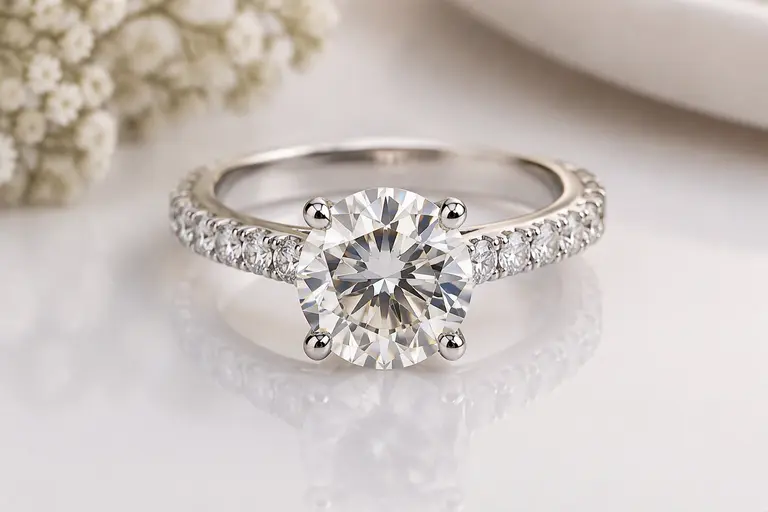
Blue Nile notes that platinum and white gold make a near-colorless diamond look icier. For this reason, many buyers choose higher grades for white-metal settings, and some retailers suggest H or I as a practical minimum. Even so, a carefully chosen I-colour stone can still look lovely in those settings. Yellow and rose gold add warmth, so G through J diamonds often blend in well. Still, metal does not remove body colour; therefore, prong design and stone position matter. Alternatively, try a white-metal setting around the centre stone with a yellow-gold band for a modern look.
How to Compare Diamond Colour on Blue Nile
First, compare stones with similar carat weight, shape, and cut so you can see how colour affects price. Next, study the photos and videos, because they help you compare stones even though screens cannot show exact colour. Then, check the grading report for the laboratory, colour, clarity, and dimensions. Furthermore, judge the face-up appearance instead of focusing only on the colour letter. Finally, add up the full ring price, including the setting and any extra costs. A Near-Colorless stone often frees up budget for a better design or a larger diamond. For setting ideas, browse the engagement ring buying guide.
Natural or Laboratory-Grown Diamonds
You also need to choose between natural and laboratory-grown diamonds. Both can receive grades on the D-to-Z scale, but their prices differ. Laboratory-grown stones often let buyers afford larger sizes and higher colour grades. Meanwhile, natural-diamond shoppers may choose an H or I stone and spend more on carat weight or design. Neither option wins every time; instead, weigh the origin, paperwork, price, and personal meaning. Read our natural versus lab-grown diamond comparison for more help.
What Matters Most for Everyday Buyers
Most people want beautiful jewellery without wasting money. Grading reports provide essential facts, yet they cannot replace seeing the finished diamond in person. Likewise, the highest grade does not guarantee the best purchase. Ultimately, you wear the diamond. So, choose one that looks lovely to you, comes with reliable documentation, and suits your household budget.
Frequently Asked Questions
Is a D-colour diamond visibly better than an H-colour diamond?
D earns a higher laboratory grade. Yet many people struggle to tell a well-chosen H stone from a D stone in a ring. Compare actual diamonds before you pay extra.
Do Near-Colorless diamonds suit engagement rings?
Yes, G, H, I, and J diamonds all make lovely engagement rings. Nevertheless, proportions, shape, size, and setting affect the final look.
Which colour grade offers the best value?
Many shoppers consider G and H first. Still, I and J can offer strong value when the individual stone and setting work well together.
Does diamond shape affect colour?
Yes. Step cuts such as emerald and Asscher show colour more easily. Meanwhile, round brilliants often hide slight warmth.
Should I choose a natural or laboratory-grown diamond?
Your budget, preferences, and views on origin should guide you. Both types can receive recognised colour grades.
Disclaimer
This article offers general consumer guidance. Diamond appearance and prices vary by stone, origin, and market conditions. Inspect the diamond before you buy.