Disclosure: This post contains Blue Nile Pearls and affiliate links for our jewellery retail guide. If you make a purchase through these links, I may earn a small commission at no extra cost to you.
Introduction
Pearls have remained popular in American jewellery for generations. They suit office wear, weddings, and everyday outfits perfectly. However, buying pearls online confuses many first-time shoppers, especially when one retailer sells several varieties at very different prices. Blue Nile, a well-known American online jeweller, sells four cultured pearl types: freshwater, Akoya, Tahitian, and South Sea. So, which type offers the best value for your budget? This guide explains the differences in plain language and provides essential tips for every buyer. Moreover, it highlights what ordinary consumers should check before spending their hard-earned money. By understanding the basics, you can shop with clarity and confidence. Before you browse, remember that these treasures require consistent care; our jewellery care guide explains how to protect them.
Understanding Blue Nile Pearls: Freshwater and Saltwater
Why Blue Nile Freshwater Pearls Offer Accessible Luxury
Freshwater pearls grow inside mussels in lakes, rivers, and ponds, and China produces the majority of the global supply. Because one mussel can yield many pearls at once, farmers supply more of them at accessible prices. As a result, shoppers find them in white, cream, pink, peach, and lavender, in shapes ranging from round to organic baroque. Many freshwater pearls consist almost entirely of nacre, although bead-nucleated versions also exist. Therefore, never assume every freshwater pearl has the same internal structure. These gems work well for office days and family celebrations, offering an elegant aesthetic for a budget-friendly price.
Saltwater Blue Nile Pearls and Their Characteristics
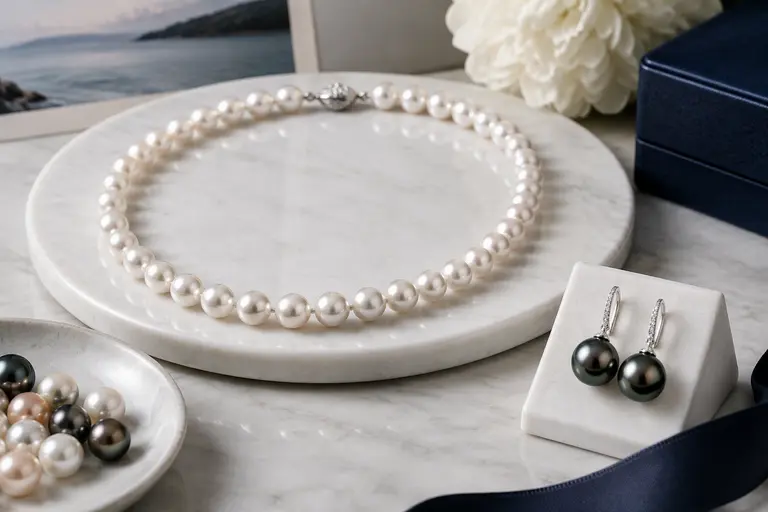
Saltwater pearls grow in marine oysters, and three main types dominate the market. Akoya pearls define the classic white necklace, and their bright, mirror-like lustre makes them popular for weddings. Tahitian pearls come mainly from French Polynesia, offering grey and charcoal tones, often with striking green or aubergine overtones. Consequently, they attract shoppers who want something distinctive. South Sea pearls grow mainly in Australia, Indonesia, and the Philippines, reaching the largest sizes. However, large size and limited supply raise their prices significantly. Therefore, compare each pearl variety on its own merits instead of assuming a higher price always means better quality.
How to Evaluate Blue Nile Pearls
Blue Nile lets you browse all four types on its official pearl jewellery collection page. However, a photograph cannot show everything, because lighting and screen calibration change how colour and lustre appear. Therefore, read the full product description before you order. Check the pearl diameter, body colour, shape, and metal purity. Likewise, judge how well the pearls match in strands and bracelets. The Gemological Institute of America (GIA) names seven quality factors: size, shape, colour, lustre, surface quality, nacre quality, and matching. Among these, lustre deserves special attention because sharp reflections lift a pearl’s beauty. Moreover, a larger pearl does not automatically beat a smaller one, because a clean surface can outshine extra size.
Questions to Ask Before Buying Blue Nile Pearls
Questions About Blue Nile Pearl Quality
First, ask Blue Nile whether the photographs show the actual pearls you will receive or just a representative sample. Then, request extra photos or videos if they are available. Next, confirm the exact diameter, colour, and shape of the items. Furthermore, ask whether the pearls have colour treatments and whether the retailer discloses them clearly. Similarly, ask how the retailer defines pearl quality, since grading terms differ significantly between sellers. For costly purchases, ask about independent documentation. A GIA pearl report describes identity and quality, but finished jewellery does not automatically include one. Meanwhile, our gemstone certificate guide explains how lab reports generally work.
Questions About Metals and Pearl Documentation
The pearl forms only part of the purchase. Therefore, confirm whether the piece uses sterling silver, 14-karat gold, 18-karat gold, or platinum. Likewise, understand the difference between a product description, an appraisal, and a laboratory report. Each serves a different purpose, so never mistake a retailer’s description for an independent scientific assessment.
Returns and Warranty for Blue Nile Pearls
The 30-Day Return Policy for Blue Nile Pearls
Blue Nile offers a 30-day return window on eligible purchases, and it counts from the shipment date, not the delivery date. Items must stay unworn and in original condition. The retailer provides prepaid, insured return shipping on eligible US orders, but it limits free returns to two per customer each year. In addition, personalised, custom, engraved, resized, clearance, and final-sale items fall outside the policy. Consequently, read the current Blue Nile return policy before ordering, and inspect your jewellery as soon as it arrives. Contact customer service promptly if you find damage.
Lifetime Warranty Limits on Blue Nile Pearls
Blue Nile’s Limited Lifetime Warranty covers eligible gold and platinum jewellery priced at $1,000 or more against manufacturing defects. However, it explicitly excludes pearl jewellery, silver jewellery, and normal wear. Therefore, do not assume an expensive pearl necklace carries lifetime protection. Instead, ask Blue Nile about any additional protection options. Compare their coverage, exclusions, and costs, because defects, accidental damage, theft, and loss carry different risks.
Which Blue Nile Pearls Offer the Best Value?
Freshwater pearls give practical shoppers attractive jewellery at accessible prices. Meanwhile, Akoya pearls suit lovers of classic white strands, Tahitian pearls offer distinctive colours, and South Sea pearls deliver larger size and a softer glow. Still, the priciest option rarely makes the best purchase. A well-chosen freshwater pearl with excellent lustre can satisfy you more than a weaker premium saltwater pearl. Above all, set a realistic budget and choose jewellery that suits the wearer’s lifestyle. Finally, keep every document after delivery so you can act quickly if a problem appears. For more ideas, see the pearl styling tips.
Frequently Asked Questions
Are Blue Nile freshwater pearls genuine?
Yes. They are genuine cultured pearls, which form inside living molluscs through human-assisted cultivation.
Are saltwater pearls always better than freshwater pearls?
No. Lustre, surface quality, nacre, shape, and matching determine most of a pearl’s appeal, regardless of the water type.
Can I return Blue Nile pearl jewellery?
Generally, yes. Eligible purchases qualify for the 30-day policy, although the policy excludes customised, engraved, and final-sale items.
Does Blue Nile’s lifetime warranty cover pearl jewellery?
No. The published warranty specifically excludes pearl jewellery.
Should I obtain an independent pearl assessment?
For expensive purchases, yes. However, arrange it promptly so you stay within the return period.
Disclaimer
This article offers general consumer education about cultured pearls and online buying. Prices, return conditions, and warranty terms can change. Confirm details with Blue Nile.