Introduction
A zipper looks simple, yet it solves a complex engineering problem. It joins two sides, holds them together securely, and lets them separate repeatedly. Most people recognize YKK as the world’s largest zipper maker. In fiscal 2024, the company passed 10 billion units in annual sales for the third time, and it operates in more than 70 countries. Similarly, the world of luxury goods depends on small parts that join, hold, and release. Therefore, studying zippers, clasps, and gemstone settings offers useful lessons about precision and reliability. By understanding these components, you learn why quality fastening is the hallmark of a well-made object.
Why YKK Leads the Fastener Industry
YKK’s success goes far beyond brand recognition. For instance, the company develops both its zipper materials and its zipper-making machines in-house. As a result, YKK keeps its manufacturing consistent across its global operations. Consequently, the company controls quality closely at every stage. Overall, the lesson is simple: a small component often decides how well a much larger product functions. Whether it is a jacket or a piece of high-end jewellery, the integrity of the fastener dictates the product’s longevity.
The Clasp: A Partner to Secure Gemstone Settings
The closest match to a zipper in watches and jewellery is the clasp. For example, a watch strap may use a pin buckle, while a metal bracelet may use a folding deployant clasp. Likewise, necklaces often feature lobster clasps, spring-ring closures, or box clasps. In each case, the mechanism connects two parts securely while allowing the wearer to open them when needed.
However, the industry has no single clasp maker comparable to YKK’s scale. Instead, watch brands, jewellery manufacturers, and specialist suppliers share the production volume. Therefore, treat any claim of a “world’s largest clasp manufacturer” with caution unless reliable, verified global data supports it.
Why Reliable Gemstone Settings and Clasps Matter
A clasp works hard. It opens, closes, rubs against skin, and takes physical knocks. Consequently, a failed clasp can result in the loss of an entire watch or expensive necklace. For that reason, you should check the closure as carefully as you check the gemstone or dial. Moreover, dust and skin oils can clog small moving parts, so clean valuable pieces regularly and ask a professional jeweller to inspect them. Furthermore, read our guide to caring for your jewellery for simple, daily maintenance routines.
Gemstone Cutting vs. Traditional Gemstone Settings
The comparison changes when we move to gemstone cutting. Here, lapidary work does not need two flexible parts that interlock repeatedly. Instead, cutters need reliable ways to hold and position a stone. A dop system offers one example. First, the cutter attaches the gemstone to a dop stick with wax or adhesive. Then, the cutter rotates the stone precisely during the cutting and polishing stages. Still, these tools hold and position rather than fasten. Thus, the dop system makes a useful comparison for holding, but not an exact one for fastening.
Invisible Gemstone Settings and Precision Engineering
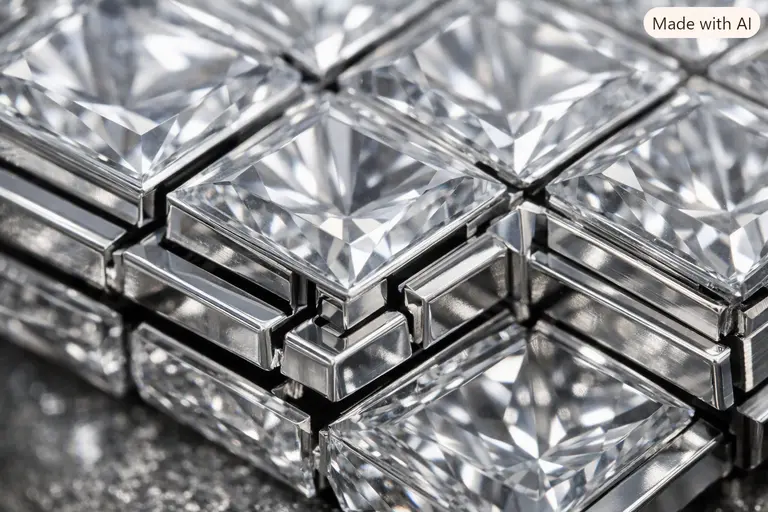
For jewellery design, the invisible setting offers a closer conceptual comparison. Van Cleef & Arpels patented its famous Mystery Set™ in 1933. In this technique, craftspeople cut each gemstone specially and insert it into delicate gold rails, so the stones cover the metal and form an almost continuous surface.
Like a zipper, this method relies on the precise interaction between parts. However, the mechanisms differ significantly. A zipper opens and closes repeatedly, whereas a Mystery Set holds stones in place while permanently hiding the metal infrastructure. Therefore, a good analogy explains a shared principle of precision without claiming the two technologies are identical.
Tension Gemstone Settings and Modern Engineering
Tension jewellery teaches a different lesson about structural integrity. Niessing introduced its Spannring in the late 1970s, and Walter Wittek created the original design. As a result, the ring grips a brilliant-cut diamond so firmly that the stone appears to float without visible prongs. In addition, specialized settings like these can complicate future servicing, so always consult a qualified jeweller before attempting any repair. Meanwhile, explore an overview of popular gemstone settings to compare different styles.
Practical Lessons for Buying Gemstone Settings
When you buy a watch, test the clasp and its locking system thoroughly. Likewise, when you buy jewellery, match the closure type to the weight and style of the piece. Furthermore, collectors should prioritize originality; an original clasp or buckle supports a vintage piece’s market authenticity. Consequently, replacing an original part with a modern substitute can reduce collector interest and total value. Finally, our watch buying guide shares more tips for finding quality components.
The Engineering Takeaway for Gemstone Settings
Good fastening mechanisms combine strength, repeatability, and easy operation. Therefore, the real link between these objects is not a shared mechanism, but a shared objective. Each one solves a small but critical problem, ensuring that the wearer feels secure.
Frequently Asked Questions
Who is the world’s largest zipper manufacturer?
Most people consider YKK the largest. Moreover, the company passed 10 billion zippers in annual sales in fiscal 2024, and it operates in more than 70 countries.
Is there a YKK equivalent for jewellery clasps?
No single company holds that position. Instead, jewellery makers, watch brands, and specialist suppliers share the global market.
What comes closest to a zipper in gemstone jewellery?
Invisible settings come closest in concept, because precisely cut stones engage gold rails. Van Cleef & Arpels patented its Mystery Set™ in 1933.
Is a dop stick a gemstone fastener?
No. Instead, a dop system temporarily holds a gemstone so the cutter can position it during the cutting and polishing process.
Why do small fastening mechanisms matter?
They form critical points of reliability. A failed zipper, watch clasp, or jewellery closure can compromise the safety of the entire product.
Disclaimer
This article uses zippers, clasps, and gemstone settings as a conceptual comparison. These mechanisms perform different technical functions, so readers should not treat them as identical.

Disclosure: This post contains Amazon affiliate links. If you make a purchase through them, I may earn a small commission at no extra cost to you.