Introduction
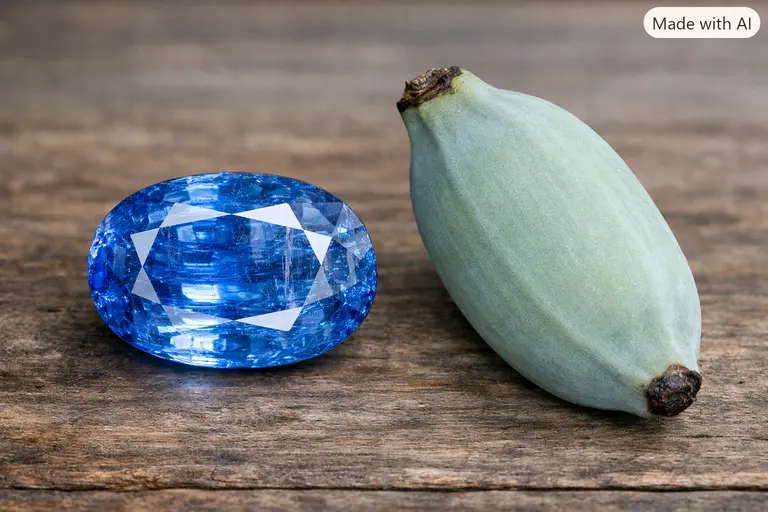
Which gemstone matches the look of a Blue Java banana? Blue kyanite offers the closest match. Its blue tone echoes the silvery-blue to blue-green skin of an unripe Blue Java banana. Furthermore, its rough crystals often grow in long, bladed shapes that mirror the fruit’s elongated form. Still, kyanite never curves like a banana, so the likeness stays visual rather than literal. This article explores why blue kyanite earns this comparison, which other stones come close, and what buyers should know before they shop for either the fruit or the gem. Discovering these natural connections gives you a whole new appreciation for the vibrant, diverse colors found in nature. Check out our Indian gemstone education guide to learn more!
Why Blue Kyanite Gemstones Resemble Blue Java Bananas
Growers classify the Blue Java banana within the ABB cultivar group, and its unripe peel often carries a striking silvery-blue or blue-green hue. A thick natural wax coating produces this effect, since it changes how light bounces off the green peel underneath. Once the fruit ripens, the peel shifts toward yellow and loses the blue cast entirely.
Blue kyanite, meanwhile, commonly forms in shades that range from pale to deep blue. Its elongated, bladed crystal habit adds a second point of comparison. However, kyanite also grows in green, grey, and colourless forms. Consequently, buyers should not expect every specimen to carry that banana-blue tone. Gemologists describe blue kyanite as a visual look-alike rather than a literal copy of the fruit’s mineral makeup.
Other Gemstones Similar to Blue Kyanite and Blue Java BananasBanana
Amazonite as a Blue Kyanite and Banana Visual Comparison
Amazonite, a blue-green variety of microcline feldspar, offers a second comparison. Its soft green, blue, and turquoise tones can recall the pastel look of an unripe Blue Java peel. However, amazonite typically forms blocky crystals rather than elongated blades. Therefore, its resemblance rests mainly on colour rather than shape.
Comparing Blue Kyanite to Larimar and Chrysocolla
Larimar and chrysocolla add loose comparisons too, since both often display pale blue or blue-green patterns. Even so, neither stone combines the specific blue colour and bladed crystal habit that make certain blue kyanite specimens especially striking.
Science Behind the Blue Java Banana and Blue Kyanite Colour
Unlike a gemstone, the Blue Java banana does not owe its colour to a mineral pigment. Instead, a heavy wax layer on the unripe peel alters how light interacts with the green skin beneath it. This optical effect produces the silvery-blue appearance. As the banana ripens, that effect fades and the peel turns yellow. Growers also call this variety the “Ice Cream banana,” a nickname that points to its creamy texture and vanilla-like flavour, though the name describes taste rather than a scientific fact about the fruit.
Can You Grow Blue Java Bananas and Find Blue Kyanite in India?
Yes, gardeners across India can grow Blue Java banana, though it remains far less common than major commercial varieties. It thrives in warm, humid conditions. Specialist nurseries increasingly supply planting material to home growers. Even so, buyers should confirm the cultivar first. Local sellers occasionally apply the name loosely to fruit that is not genuinely Blue Java.
Do Blue Kyanite Gemstones Occur in India?
India holds genuine blue kyanite deposits. According to the Indian Bureau of Mines, kyanite occurrences appear across several states. Current production records show output from Jharkhand, Karnataka, and Maharashtra. Karnataka stands out in particular, since mineral records document kyanite occurrences in districts such as Chikkamagaluru, Chitradurga, and Mysuru. Therefore, India offers real geological sources of kyanite, although not every specimen suits jewellery. Amazonite requires more caution, since claims about specific Indian localities need reliable records behind them.
Treatments for Blue Kyanite Gemstones
Dealers generally sell natural blue kyanite without treatment, though individual pieces can undergo enhancement. Its main gemological concern involves directional hardness. Kyanite measures roughly 4.5 to 5 along its softer direction and 6.5 to 7 across that direction. As a result, kyanite jewellery can scratch or chip easily, especially in rings that face daily impact. Buyers should also treat treatment claims carefully. Sellers cannot honestly claim routine stabilization without evidence for that specific piece. Furthermore, shoppers should not assume every inexpensive blue-green stone is synthetic, because glass and dyed materials often imitate these colours.
Identification and Wearability of Blue Kyanite
Because kyanite’s directional hardness makes it vulnerable to damage, buyers should never scratch-test jewellery or valuable specimens. Instead, they should examine crystal habit, colour, lustre, and transparency. Send valuable pieces to a professional lab for reliable identification. Amazonite often shows distinctive colour zoning, yet visual inspection alone cannot confirm its identity. A loupe helps spot clues, but it should never replace professional testing.
What Blue Kyanite Consumers Should Watch For
Blue Java bananas and blue gemstones teach a similar lesson, since unusual colours often invite exaggerated marketing. Online photos frequently make Blue Java bananas look bright electric blue, while the real unripe colour stays softer and more silvery blue green. Because Blue Java is a triploid hybrid, growers normally propagate it vegetatively rather than from viable seed. Consequently, buyers should stay wary of listings that offer ordinary Blue Java banana seeds. Gemstone buyers should apply the same caution. Always ask whether a stone is natural, treated, or imitation, since an independent gemological report offers far stronger proof than any photograph.
Frequently Asked Questions
Which gemstone looks most like a Blue Java banana?
Blue kyanite offers the closest gemstone comparison. Its colour echoes the silvery-blue tone of an unripe Blue Java banana, and its elongated, bladed crystals add a second visual link.
Does kyanite actually take the shape of a banana?
No. Kyanite typically forms elongated or bladed crystals, but it never curves like a banana. The comparison rests mainly on colour and crystal form.
Is the Blue Java banana really blue?
Yes. A heavy natural wax coating gives the unripe peel a silvery-blue or blue-green look, and the colour fades to yellow as the fruit ripens.
Can the Blue Java banana grow in India?
Yes. Gardeners can grow it in warm, humid regions of India, though it remains far less common than major commercial banana varieties.
Does kyanite suit everyday rings?
Blue kyanite works well in jewellery, but its directional hardness calls for care. Protected settings, such as pendants and earrings, hold up better than rings exposed to frequent impact.
Disclaimer
This article serves general botanical and gemological education. Gemstone identification, treatment detection, and valuation require examination by a qualified gemologist or an accredited gemological laboratory. Plant names and availability vary by region, so buyers should confirm the cultivar and planting material before purchase. The author has no financial affiliation with the labs, brands or organizations mentioned.