Introduction to Blue Garlic and Chinese Turquoise
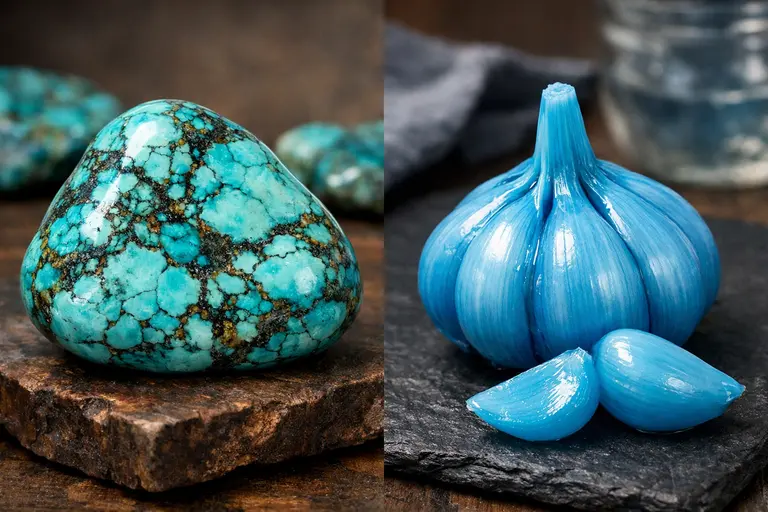
Blue-green garlic and Chinese turquoise share a striking visual resemblance that often confuses the casual observer. Both can display vivid shades of aquamarine, jade green, and blue-green that stop people in their tracks. However, the similarity ends at the surface level. One is a gemstone that forms deep inside the earth over millions of years; in contrast, the other is a common kitchen ingredient that changes color through a simple, albeit startling, chemical reaction.
Indeed, both subjects spark genuine curiosity among consumers. For instance, many gemstone shoppers ask whether Chinese turquoise is natural or treated. Meanwhile, home cooks across India and around the world often panic when their garlic suddenly turns blue or green during pickling. Therefore, understanding the science behind blue garlic and Chinese turquoise helps everyday consumers make smarter decisions. This article covers the origins of Chinese turquoise, its various treatments, common imitations, and the fascinating sulfur chemistry that creates blue garlic.
Origins of Blue Garlic and Chinese Turquoise
Turquoise is a hydrous phosphate of copper and aluminum. Although turquoise forms in several countries, China currently ranks among the world’s most important commercial sources. Most Chinese turquoise comes from the Hubei Province, where miners have extracted the stone for centuries. Specifically, the region produces a wide range of colors, including sky blue, blue-green, and deep forest green.
Many Chinese stones also display beautiful black or brown “spiderweb” matrix patterns that collectors find highly attractive. By comparison, Iranian turquoise from the historic Nishapur mines is famous for a consistent, robin ’s-egg blue. Meanwhile, American turquoise shows remarkable diversity, with colors ranging from pale blue to deep green. Understanding these regional differences is vital for collectors, much like how the Jean-Baptiste Tavernier gem trade relied on knowing specific geographic origins. For a deeper understanding of turquoise geology, the Gemological Institute of America (GIA) offers comprehensive educational resources.
Enhancements for Blue Garlic and Chinese Turquoise
If you are buying turquoise today, you must assume the stone has received treatment. In fact, approximately 98% of all turquoise on the market has undergone some form of enhancement. Gemological professionals—not just marketers—back this significant figure. The most common treatment is stabilization. During this process, manufacturers inject porous turquoise with a clear plastic resin or polymer.
As a result, the stone becomes harder, more durable, and far easier to polish for jewelry. Without stabilization, many turquoise specimens would remain too soft for everyday wear. In addition, some manufacturers apply dyes to boost color saturation. Pale stones often receive blue or green dye to improve their visual appeal. Furthermore, some turquoise undergoes the proprietary Zachery treatment. This electrochemical process improves the stone’s ability to take a polish and decreases its porosity. Therefore, buyers should always ask sellers directly whether a stone is natural or stabilized. This level of transparency is exactly what we advocate for in building India’s global brands.
Lab-Grown Gems vs Blue Garlic and Chinese Turquoise
Beyond treated stones, the market also contains synthetic turquoise and various imitations. First, synthetic turquoise shares a similar chemical composition with natural turquoise; however, technicians produce it in laboratories. This is a common practice in modern industry, similar to how synthetic gems in fiber optics drive the telecommunications sector.
Meanwhile, many products sold as turquoise are actually “simulants.” Dyed howlite and dyed magnesite remain the most common examples because both minerals absorb dye easily and mimic the matrix of turquoise. Manufacturers also produce “reconstituted” turquoise by combining crushed turquoise fragments with resin. Although this material contains real turquoise particles, it differs significantly from a solid natural stone. Fortunately, natural turquoise usually displays subtle color variations that imitations lack. For guidance on identification, visit the American Gem Trade Association.
Chemistry of Blue Garlic and Chinese Turquoise
When we pivot to the kitchen, blue garlic and Chinese turquoise meet through a visual overlap. Blue garlic has nothing to do with copper; instead, it results from ordinary sulfur chemistry. When you cut or crush garlic, an enzyme called alliinase reacts with a compound called alliin. This reaction produces allicin, which gives garlic its pungent smell.
Under acidic conditions—such as vinegar pickling—allicin breaks down further into sulfur-containing pigment compounds. These molecules produce blue and yellow colors. The combination of these two pigments ultimately results in the emerald green color most commonly seen in “Laba garlic.” This tradition is most prevalent in northern China, where families prepare Laba garlic on the eighth day of the twelfth lunar month. However, home cooks in Keralam and beyond encounter the same color change regularly. This biochemical reaction is as precise as the mechanical movements discussed in our article on watchmaking trade skills.
Safety of Blue Garlic and Chinese Turquoise
Yes, absolutely. Scientists have studied this phenomenon for decades and confirmed that the pigments are completely harmless. Blue or blue-green garlic does not indicate bacterial contamination or spoilage. Instead, it is a sign of healthy, active enzymes reacting to the acid in your vinegar.
In terms of flavor, blue garlic does not differ significantly from regular garlic. Pickled blue garlic typically develops a milder, less pungent taste with a pleasant tartness. Consequently, many people enjoy its crisp texture as an accompaniment to dumplings. Just as industry sheepdogs maintain order in tech, these chemical pathways ensure the safety and tradition of fermented foods. Therefore, if your garlic turns blue, do not discard it; it is simply a natural manifestation of organic chemistry.
FAQ About Blue Garlic and Chinese Turquoise
Is Chinese turquoise lower quality than Persian turquoise?
Not necessarily. While Persian turquoise is historically famous, high-grade Hubei turquoise is highly sought after by collectors for its unique matrix and vivid colors.
Does the blue color in garlic mean it is old?
Not always. In fact, younger, “fresher” garlic often has more active enzymes, which can actually lead to a more intense blue or green color when pickled.
How can I tell if my turquoise is dyed?
If you rub a cotton swab dipped in acetone on an inconspicuous part of the stone and color comes off, the stone is dyed. However, stabilization with resin does not react this way.
Why is my garlic green instead of blue?
Green is simply a mixture of blue and yellow pigments. Over time, the blue molecules in the garlic break down, leaving only the yellow, which makes the clove look green.
Can I prevent my garlic from turning blue?
Yes. If you blanch the garlic in boiling water for a few seconds before pickling, you will deactivate the enzymes and keep the cloves white.
Disclaimer
This article is for educational purposes only. It does not replace professional gemological analysis or food safety advice. The author has no financial affiliation with the companies mentioned. Readers should consult with experts before making gemstone purchases or consuming home-fermented foods.