Introduction to Kerala Food Pairings
Kerala Food Pairings represent far more than just a daily meal; they carry the collective memory, tropical climate, and ancestral wisdom of generations. Specifically, every combination on a Malayali plate tells a vibrant story about identity and regional history. While most of these culinary rules remain unwritten, millions of families in Kerala follow them daily. Whether you are enjoying a casual breakfast or a structured wedding feast, these pairings work because they masterfully balance texture, spice, and sweetness. Consequently, this guide explores the most important traditions of the region. You should also read our guide on gemstone buying mistakes to understand how the same attention to detail and quality standards apply to every high-value acquisition in your life.
Iconic Kerala Food Pairings for Breakfast
Most Keralites begin their day with specific combinations that they have known since early childhood. These Kerala Food Pairings are never accidental. In fact, each specific match solves a practical problem on the breakfast plate.
Puttu and Kadala: Essential Malayali Pairings
Puttu and kadala curry remain arguably the most iconic breakfast pairing in the state. This traditional meal consists of dry, steamed cylinders of rice flour and coconut. To provide essential moisture, the texture requires the spicy richness of kadala curry—a black chickpea gravy. Because the texture is naturally dry and crumbly, it requires the spicy richness of kadala curry—a black chickpea gravy—to provide essential moisture. Furthermore, many families place small ripe bananas, known as cherupazham, on the side. The natural sugar in the banana softens the chili heat and adds a pleasant creamy contrast. While some modern households skip the fruit, it remains a deeply familiar part of the traditional experience.
Appam and Stew in Kerala Cuisine
Appam and stew follow a similar logical framework. This fermented rice pancake features crispy, lacy edges and a soft, porous center. Because the middle section acts like a sponge, it absorbs liquid gravies beautifully. In central Kerala, Christian households traditionally serve appam with meat stew or egg roast on Sunday mornings. Similarly, Hindu and Muslim families often enjoy it with vegetable kurma or coconut-milk-based gravies. This pairing showcases how Kerala Food Pairings utilize fermentation to enhance both flavor and digestion. For more authentic recipes, you can visit Archana’s Kitchen Kerala Recipes.
Balanced Kerala Food Pairings for Lunch
The deep red matta rice of the region forms the heart of most midday meals. However, the rice itself does not create the full experience. Instead, the specific side dishes determine how balanced and satisfying the plate feels to the diner.
When a cooling moru (buttermilk) curry or pulissery takes the lead, families almost always pair it with a spicy fish curry or a dry beef roast. The reason for this is straightforward: the yogurt-based curry requires a bold, fiery contrast to prevent the meal from feeling flat. Consequently, a robust beef ularthiyathu alongside a mild curry creates the perfect equilibrium. In contrast, a varutharacha (roasted coconut) sambar already carries intense richness. Therefore, it pairs better with lighter sides like thoran (dry vegetable stir-fry). Adding another heavy coconut curry would simply overload the palate. To see how these standards define regional identity, visit the Kerala Tourism Cuisine Guide.
The Sadya Feast: Ultimate Kerala Food Pairings
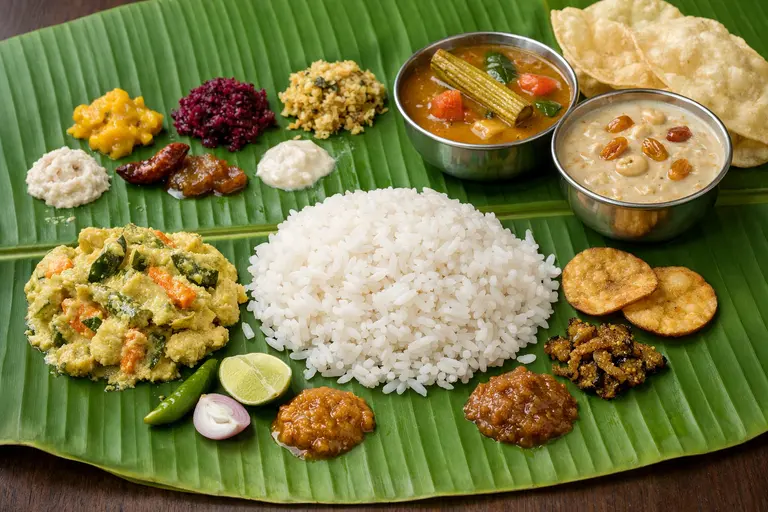
The Sadya feast is one of the most organized and scientific meals in the world. Served on a fresh banana leaf during Onam or Vishu, every dish occupies a specific mathematical position. The sequence of service supports flavor progression and efficient digestion.
Contrast in Traditional Kerala Meals
The meal typically begins with sweet banana chips and sarkara upperi (jaggery-coated ginger) placed at the lower left corner. These act as palate cleansers throughout the feast. Next, the host pours parippu (lentils) and ghee over the rice to open the meal gently. Avial and olan are two dishes that perfectly demonstrate the philosophy of Kerala Food Pairings. Avial is thick, vegetable-rich, and complex. In contrast, olan is one of the mildest dishes on the leaf, consisting of ash gourd and coconut milk. Together, they prove that extreme contrast creates harmony. Finally, diners often crush crispy pappadam into their sweet payasam to create a satisfying salty-sweet finish. You may also read our article Understanding BIS Hallmark to see how certification ensures the purity of the silver and gold vessels used during such elite celebrations.
Evening Malayali Food Combinations and Tea Culture
As the afternoon humidity fades, the roadside chaya peedikas (tea shops) fill with people. The food served here follows its own unique set of pairing rules. Pazham pori (banana fritters) and kattan chaya (black tea) are perhaps the most celebrated combination—the strong, slightly bitter black tea cuts through the sweetness and oil of the golden fritter. Neither item overwhelms the other; therefore, the pairing remains a timeless favorite.
In recent years, pazham pori with spicy beef fry has emerged as a popular modern pairing in northern Kerala. While this combination is relatively new compared to ancient traditions, it has firmly earned its place in everyday culture. These modern Kerala Food Pairings demonstrate how a cuisine can evolve while still respecting its roots of balance and contrast.
FAQ: Common Questions on Kerala Food Pairings
Why do we eat Puttu with Kadala?
Puttu is dry and needs a liquid, protein-rich gravy like Kadala (chickpea) to create a balanced texture and a complete nutritional profile.
What is the role of Matta rice in these pairings?
Matta rice is an ancient, nutrient-dense grain with an earthy flavor. It requires bold, spiced curries to match its substantial texture.
Why is Sadya served on a banana leaf?
The leaf is eco-friendly, hygienic, and adds a subtle aroma to the hot food. Furthermore, the large surface area allows for the structured layout of many different dishes.
Are these pairings scientifically healthy?
Yes. Traditional Kerala Food Pairings often combine fermented grains with proteins and probiotics (like yogurt) to aid digestion and nutrient absorption.
Can I substitute Basmati rice for traditional Kerala meals?
While possible, Basmati does not possess the same earthy weight as Matta rice or the masala-absorbing qualities of Kaima rice. Therefore, the traditional flavor profile may change significantly.
Disclaimer
Kerala food traditions vary significantly across regional, religious, and household lines. This article reflects widely recognized cultural patterns rather than rigid universal laws. Always verify dietary choices with your specific health requirements. The author holds no financial affiliation with the food brands mentioned.