Introduction to the Singapore Dubai India Jewelry Shift
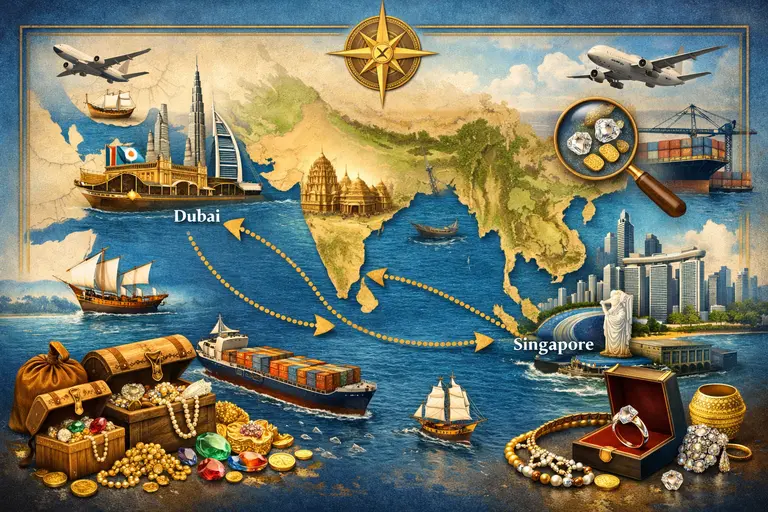
Understanding the Singapore Dubai India Jewelry Shift is essential for investors, as global wealth patterns and manufacturing hubs undergo rapid changes in 2026. Specifically, geopolitical tensions across parts of the Middle East are currently pushing many investors to spread their assets across multiple trusted financial hubs. As a result, we are witnessing a significant Singapore Dubai Jewelry Shift. Singapore is gaining serious traction as a primary center for wealth preservation, bullion storage, and high-value gemstone investment. Meanwhile, Dubai remains a powerhouse in the global gold and diamond trade, even as it adapts to new competition. India, conversely, continues to serve as the world’s manufacturing engine for diamonds and finished jewelry. Consequently, understanding these changes helps you make smarter buying decisions. You should also read our guide on gemstone buying mistakes to see how these global shifts affect the quality and pricing of stones in local markets.
Singapore’s Rise in the Global Jewelry Market Shift
Singapore draws high-net-worth investors because it offers unparalleled political stability and a transparent legal framework. Furthermore, the city-state provides world-class secure vaulting services that few other locations can match. In January 2026, the Monetary Authority of Singapore and the Singapore Bullion Market Association (SBMA) officially launched a working group to strengthen the region’s role as a trusted gold trading center.
Moreover, Singapore sits at the very heart of Asia. This strategic position places it close to the fastest-growing luxury markets on Earth, including China and India. Its strong legal protections make it especially attractive for storing investment-grade diamonds and rare colored gemstones. Nevertheless, the rise of Singapore does not necessarily replace Dubai. Instead, it expands the luxury ecosystem of Asia by adding another secure layer for asset protection. Consequently, the Singapore Dubai Jewelry Shift represents a broader diversification of the market. Wealthy collectors now frequently divide their portfolios between these hubs to minimize risk.
Dubai’s Position in the Singapore Dubai India Jewelry Shift
Dubai has spent several decades building one of the most powerful jewelry trade ecosystems in existence. Its legendary gold souks, tax-free environment, and sophisticated diamond transit networks give it advantages that no other city can easily replicate. Specifically, the Dubai Multi Commodities Centre (DMCC) continues to facilitate massive volumes of rough and polished diamond trade despite the ongoing Singapore Dubai Jewelry Shift.
However, regional instability can occasionally disrupt logistics and raise insurance costs. Therefore, some traders now choose to divide their inventory between Dubai and Singapore rather than depending on a single gateway. Even so, Dubai’s infrastructure and geographic position between Africa and India keep it highly competitive. As a result, Dubai will almost certainly continue its role as a leading re-export hub, even as its absolute dominance in wealth storage softens slightly in 2026.
India’s Manufacturing during the Jewelry Trade Transition
India plays a completely different but equally vital role in the Singapore Dubai Jewelry Shift. Rather than focusing primarily on wealth storage or trade transit, India remains the world’s indispensable manufacturing engine. The city of Surat currently cuts and polishes roughly 90% of the world’s rough diamonds.
Consequently, India serves both a massive global export market and a growing domestic consumer base. While Singapore stores wealth and Dubai moves goods, India creates the finished products on an industrial scale. Furthermore, India’s large domestic market provides a unique resilience. Even if international trade routes shift, domestic demand from Indian households continues to support industry growth. Therefore, India acts as the bridge that connects the trading hubs of the Singapore Dubai Jewelry Shift to the end consumer. For more on the manufacturing side, you can visit the Gem & Jewellery Export Promotion Council (GJEPC).
Challenges for India in the Jewelry Hub Shift
The Surat Diamond Bourse (SDB) represents India’s bold ambition to move beyond simple manufacturing and into direct global trading. However, the current picture remains mixed as the Singapore Dubai Jewelry Shift unfolds. Since its opening, only a fraction of its 4,700 offices are fully operational. Natural diamond traders have shown limited enthusiasm for relocating from established hubs in Mumbai.
Additionally, the broader diamond industry faces pressure from the rapid rise of lab-grown diamonds (LGDs). These stones now feature in nearly half of all engagement rings sold in Western markets, squeezing the traditional market that Surat built its reputation on. Nevertheless, the SDB is showing real signs of life. In its first full operational year, the bourse handled import-export parcels worth approximately USD 4.8 billion. Therefore, the SDB is not failing; it is simply evolving more slowly than its founders originally planned. Building global trust will take time, but the foundation is now firmly in place.
Market Impacts of the Singapore Dubai India Jewelry Shift
This shift creates specific impacts across different asset classes. For gold buyers, safe-haven demand tends to rise during uncertainty, which can increase price volatility. However, India’s import duties and festive demand still remain the biggest local pricing factors.
For diamonds, Singapore may attract more investment-grade certified stones, while India remains dominant in commercial and bridal jewelry. You must note that lab-grown diamonds are now a serious market reality that affects pricing across all categories. For colored stones, rubies and sapphires are seeing growing investor interest globally in 2026. This is driven by economic uncertainty and the demand for tangible assets. To understand the standards of these stones, refer to the Gemological Institute of America.
Advice for Buyers during the Jewelry Market Transition
For ordinary buyers, the most important issue remains trust and certification. Global trade shifts do not change the fundamental rules of smart jewelry buying. Therefore, you should focus on four core principles regardless of the Singapore Dubai Jewelry Shift.
First, always purchase BIS hallmarked gold when shopping in India. Second, you must insist on GIA, IGI, or HRD certificates for any diamond purchase. To learn more about these standards, visit the Gemological Institute of America. Third, always ask about the jeweler’s resale and buyback policies before you commit your funds. Fourth, enquire about the origin of your stone. Ethical sourcing is becoming a major market differentiator in 2026, not just a marketing slogan. Moreover, as trade diversifies, you may gain better access to a wider variety of designs and more competitive international pricing.
FAQ: Singapore Dubai India Jewelry Shift
Is Singapore replacing Dubai as the world’s gold hub?
No. Singapore is growing specifically as a secure wealth storage and bullion center. Dubai remains the primary gateway for physical trade and re-export logistics within the Singapore Dubai Jewelry Shift.
Why does India dominate diamond cutting?
India possesses a highly skilled workforce and specialized infrastructure in Surat. This allows the country to process rough diamonds more efficiently and cost-effectively than any other nation.
Will the Singapore Dubai India Jewelry Shift lower gold prices?
Not necessarily. Global gold prices depend on central bank policies and currency rates. However, more trade hubs can lead to better liquidity and more competitive local premiums.
What is the Surat Diamond Bourse?
It is the world’s largest office building, designed to centralize India’s diamond trade. While occupancy is currently low, it handles billions of dollars in customs activity annually.
Is it safe to buy jewelry in Singapore?
Yes. Singapore has some of the strictest consumer protection laws in the world, making it an excellent place for high-value gemstone and bullion purchases.
Disclaimer
This article is for educational and informational purposes only. It does not constitute financial or investment advice. Global trade routes and market data can change rapidly. Always verify jewelry purchases through proper BIS hallmarking and recognized gemstone certifications. The author has no financial affiliation with the institutions mentioned.