Introduction to Mona Lisa Turquoise
Most people think of Arizona and Nevada when they hear the word turquoise. However, a little-known mine tucked in the Ouachita Mountains of western Arkansas produces some of the most interesting specimens in the country. Mona Lisa Turquoise originates from Polk County and offers buyers a genuine American gem with a fascinating history. As a result, more collectors and jewelry lovers are now looking beyond the Southwest to discover this colorful stone from the “Natural State.” Furthermore, recent studies from leading mineralogists confirm that this material is real turquoise rather than a simple look-alike. If you want authentic American gemstones at a more approachable price, this stone is absolutely worth your attention. You should also read our guide on gemstone buying mistakes to understand how to evaluate quality regardless of the mine’s location.
The History of Mona Lisa Turquoise
The Mona Lisa Mine sits on Little Porter Mountain in Polk County, Arkansas. Initially, workers opened the site in 1958 to mine phosphate for agricultural fertilizers. However, phosphate demand eventually dropped, and the mine closed before 1963. In 1974, property owner Jack McBride discovered that the site actually contained turquoise. This finding changed the trajectory of the mountain forever. The mine reopened in 1978 and produced an estimated 30,000 pounds of turquoise before closing again in 1986.
Record-Breaking Mona Lisa Turquoise Nuggets
During that productive period, miners pulled out an enormous turquoise boulder in 1982. This nugget originally weighed approximately 380 pounds before processing. After stabilization and polishing—a process completed in 2018—the main specimen now weighs about 245 pounds. Most experts currently consider it the largest known American turquoise nugget ever discovered. Today, Avant Mining owns the property and displays this giant polished piece at its Fisher Mountain Rock Shop in Mount Ida. For more background on the mine’s history, you can explore the Encyclopedia of Arkansas for detailed records.
Scientific Analysis of Mona Lisa Turquoise
For several years, some skeptical collectors questioned whether Mona Lisa Turquoise was a copper-poor mineral cousin called planerite. Because Arkansas lacks the massive copper deposits found in Arizona, skeptics doubted the chemistry of the find. As a result, sellers often labeled the material cautiously, which slowed its acceptance in the high-end market.
However, modern science has officially settled the debate. GIA researchers published a comprehensive study in the Winter 2025 issue of Gems & Gemology, testing the material using X-ray diffraction and mass spectrometry. Specifically, they found copper as a major ingredient in every sample, with copper oxide levels running up to 6.18 percent by weight. Consequently, the GIA team concluded that the material clearly qualifies as turquoise in a gemological sense. Therefore, buyers can now feel completely confident that these stones are the real thing. For the full technical breakdown, you can visit the Gemological Institute of America.
Visual Characteristics of Mona Lisa Turquoise
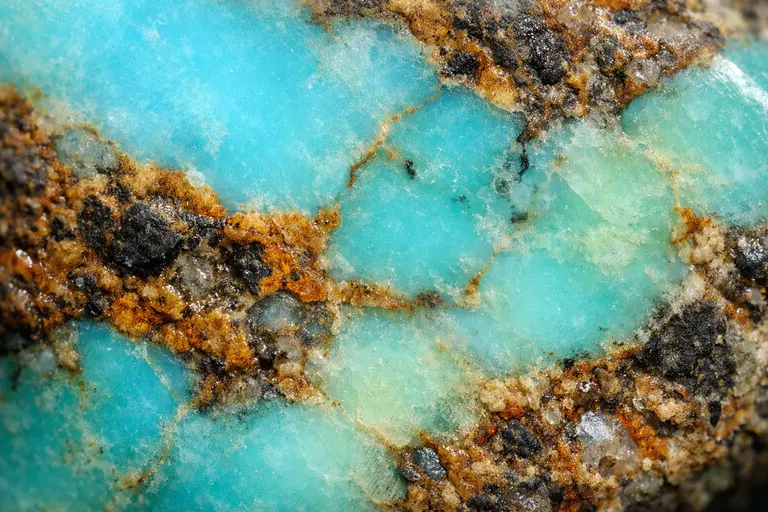
Visually, Mona Lisa Turquoise stands apart from typical Southwestern stones. The color usually ranges across vibrant blue-green tones, including teal, sky blue, and spring green. Frequently, these shades blend together in a single cabochon. In many stones, patches of beige or pale green matrix add an earthy character that collectors find highly appealing.
In contrast, the dense black “spiderweb” patterns famous in Nevada turquoise rarely appear in Arkansas material. Instead, these stones tend to have a softer, more organic aesthetic. In its raw state, the material often appears chalky on the surface. However, once cutters slice it open and stabilize it, the true blue-green color comes alive dramatically. If you want to understand how these colors compare to other varieties, check our article on Understanding BIS Hallmark to see how certification protects your investment in both metals and stones.
Geological Formation of Mona Lisa Turquoise
Geologically, this deposit is quite unusual. The Ouachita Mountains sit far from the desert Southwest, yet turquoise still formed here millions of years ago. The stone occurs inside and around Arkansas Novaculite—a type of hard, fine-grained rock—as well as in nearby shale. Specifically, phosphate-rich fluids filled ancient fractures in the rock and reacted with aluminum-bearing minerals and copper to create the gem.
In addition, researchers found other phosphate minerals alongside the turquoise, including crandallite. Because of this complex chemistry, the Mona Lisa Mine has become an important case study for geologists. They study how turquoise can form outside traditional copper mining districts. While scientists note that the exact copper source requires further research, the beauty of the result is undeniable. For historical mineral data, you can cross-reference findings at Mindat.
Caring for Mona Lisa Turquoise Jewelry
Avant Mining currently operates the property and promotes it as a source of rare American turquoise. Because the stone forms in a humid climate, much of the raw material comes out of the ground soft and porous. Consequently, cutters routinely stabilize the stones by pressing clear resin into the pores under a vacuum. This treatment makes the stones harder and more durable for daily wear.
Reputable sellers should always disclose stabilization. Fortunately, this is a normal and widely accepted practice throughout the global turquoise trade. Furthermore, a smaller amount of dense, natural material exists that needs no treatment at all. Once polished, these cabochons pair beautifully with silver or white gold settings. To ensure your jewelry lasts, you should avoid harsh chemicals and ultrasonic cleaners, as these can damage the resin bond.
FAQ: Mona Lisa Turquoise Common Questions
Is Mona Lisa Turquoise as valuable as Arizona turquoise?
Generally, top-grade untreated Southwestern stones command higher prices. However, Mona Lisa pieces are more affordable and carry a unique Arkansas origin story that many collectors value.
Does this turquoise change color over time?
Like most turquoise, it can be sensitive to skin oils and perfumes. However, because most Mona Lisa Turquoise is stabilized with resin, it is much more resistant to color changes than natural, untreated stones.
Where can I see the world’s largest turquoise nugget?
You can visit the Fisher Mountain Rock Shop in Mount Ida, Arkansas. The 245-pound nugget is on public display there, and admission is free for all visitors.
How do I identify a fake?
You should look for a certificate of authenticity or buy from reputable dealers like Avant Mining. Natural stones will show slight variations in the matrix, while fakes often look too uniform.
Can I wear this gemstone every day?
Yes, especially if the stone is stabilized. It works perfectly in pendants, earrings, and rings, provided you use a protective setting like a bezel.
Disclaimer
This article provides general educational information about Mona Lisa Turquoise. It does not replace professional gemological testing or independent appraisal. Market prices and mining activity fluctuate over time. Always ask for full treatment disclosure from a qualified jeweler before purchasing. The author has no financial affiliation with Avant Mining.